Beach Vacation Safety: What Conditions Must Parents Check First?
Table of Contents
Evaluating beach safety conditions transforms a potentially hazardous coastal environment into a highly manageable, predictable experience, directly mitigating the unique kinetic risks beaches pose to children before you even arrive.
A pre-trip evaluation of beach conditions is a non-negotiable step for ensuring a family’s well-being. This proactive assessment prevents accidents related to water hazards, weather, and environmental factors specific to coastal areas. For a broader perspective on family travel, consider researching the different types of family vacations available.
To explore the overall appeal and logistics of selecting a destination, learn what makes family beach vacations ideal and how to select the perfect coastline.
2. Why is evaluating beach safety conditions crucial for family vacations?
Executing proactive condition checks is mathematically the most effective method for reducing preventable child injuries during coastal trips, shifting parental focus from anxious reaction to confident supervision.
What unique risks do beach environments pose to children?
Beach environments pose unique risks to children through unpredictable ocean forces like rip currents and shorebreak, combined with intense sun exposure and the potential for rapid dehydration, differentiating them from controlled swimming areas. Unlike controlled swimming environments, beaches expose children to dynamic water forces that can overpower them quickly. Additionally, the reflective nature of sand and water intensifies UV radiation, increasing the risk of severe sunburn and heat-related illness.
According to a report from the American Academy of Pediatrics, teenage boys are 10 times more likely to drown than teenage girls, often due to over-confidence in their swimming ability and more risk-taking.
A key risk for toddlers is the shorebreak, where waves break directly on the sand. Even in ankle-deep water, the force can knock a small child over and pull them into the surf zone before a parent can react.
How do pre-trip condition checks benefit parental peace of mind?
Pre-trip condition checks benefit parental peace of mind by replacing anxiety and uncertainty with a concrete, actionable safety plan, allowing parents to be present and enjoy the vacation. Knowing the expected tide times, surf conditions, and weather forecast allows parents to structure their beach day around the safest and most pleasant times. This preparation shifts the mental load from constant worry to confident supervision.
For children, the generally recommended water temperature for comfortable and safe recreational swimming is between 82°F and 86°F (28°C–30°C).
The benefit is neurological; by making decisions in a calm, pre-trip environment, parents conserve cognitive resources for active supervision on the beach. This prevents “decision fatigue” in a high-stakes environment, leading to better-quality attention on their children.
Author’s Experience
“As a certified first aid instructor and parent, I’ve seen firsthand how a little planning drastically reduces beach day stress. Knowing what to expect allows me to truly enjoy watching my kids play, instead of constantly worrying about unseen dangers.”

Demonstrating how verifying the presence of official lifeguard infrastructure immediately neutralizes severe aquatic risks during a family vacation.
© WovenVoyages.com
3. How do parents assess ocean and water conditions for beach safety?
Parents assess ocean and water conditions for beach safety by first observing the beach flag warning system, then visually scanning the surf zone for signs of rip currents, and finally, noting the presence of any hazardous marine life. The assessment is a three-step process: check the official posted warnings (flags), look for specific water patterns like rip currents, and be aware of local marine life risks like jellyfish. This systematic approach provides a comprehensive view of water safety before anyone enters the ocean.
What do beach flag warning systems communicate about water hazards?
Beach flag warning systems communicate the current level and type of water hazards to the public using a simple, universally recognized color code. These flags provide an immediate, at-a-glance summary of the professional lifeguard assessment of surf and current conditions. A green flag indicates low hazard, while a red flag indicates high hazard and strong currents, advising the public to stay out of the water.
The purple flag is flown to warn of hazardous marine life, such as an abundance of jellyfish or stingrays, and can be used in combination with other colored flags.
The purple flag is often misunderstood. It does not signify “sharks.” It specifically warns of dangerous marine pests, most commonly jellyfish, stingrays, or sea lice, and can be flown in combination with other flags (e.g., yellow and purple).
| Flag Color | Meaning | Action for Parents |
|---|---|---|
| Green Flag | Low hazard. Calm conditions. | Always remain vigilant. |
| Yellow Flag | Medium hazard. Moderate surf and/or currents. | Use caution. |
| Single Red Flag | High hazard. High surf and/or strong currents. | Non-swimmers and children should remain on shore. |
| Double Red Flag | Water closed to the public. Extremely dangerous. | Stay out of the water entirely. |
| Purple Flag | Hazardous marine life (e.g., jellyfish, stingrays, sea lice). | Exercise caution, watch for marine life, can be combined with other flags. |
How to identify hazardous rip currents and strong undertows?
To identify hazardous rip currents, parents must look for a channel of water that appears different from the surrounding area, often characterized by choppy, churning water, a line of foam moving out to sea, or a break in the incoming wave pattern. Scan the surf zone for anomalies. A rip current will look like a river flowing out to sea, disrupting the pattern of waves rolling toward the shore. An undertow is different; it’s the backwash of a wave on a steeply sloped beach and is felt as a pull on the legs, not a channel moving offshore.
Rip currents are the leading surf hazard for all beachgoers and are powerful, narrow channels of fast-moving water that can move a person far from shore very quickly.
A common misconception is that rip currents pull you under the water; they do not. They are surface currents that pull you *away* from shore. The correct survival response is not to fight the current but to swim parallel to the shore until you are out of the channel, then swim back to land.

A critical visual breakdown of a rip current formation, allowing parents to rapidly assess surf zones before permitting children to enter the water.
© WovenVoyages.com
Which marine life encounters require caution for families?
Marine life encounters that require caution for families at the beach primarily involve jellyfish, stingrays, and crabs, as these are the most common sources of stings and pinches. Parents should be most cautious of jellyfish, which can be nearly invisible in the water and deliver painful stings, and stingrays, which often bury themselves in the sand in shallow water. Teaching children to shuffle their feet when entering the water is the most effective way to scare off stingrays and prevent stings.
A jellyfish sting leaves thousands of microscopic stingers, called nematocysts, in the skin which can continue to release venom into the body.
The “Stingray Shuffle” is a critical, experience-based safety technique. Instead of taking big steps, shuffling the feet through the sand creates vibrations that alert a buried stingray to your presence, causing it to swim away rather than defensively strike with its barb.
4. What beach environment characteristics affect family safety choices?
The beach environment characteristics that most affect family safety choices are the presence of lifeguards, the level of crowding, the physical hazards on the sand, and the availability of essential facilities like restrooms and first-aid stations. When choosing a beach, parents must evaluate more than the water. A safe family beach destination has clear sightlines, is free of debris like glass, offers quick access to emergency help, and provides amenities that support a full day with children.
How does beach overcrowding influence safety risks for children?
Beach overcrowding dramatically influences safety risks for children by reducing parental visibility for supervision and significantly increasing the chance of a child becoming separated and lost. In a crowded environment, a child can disappear from sight in seconds. This makes constant, close supervision difficult and elevates the risk of both water-related accidents and child separation.
Research from aquatic safety specialists shows that the most visible swimsuit colors for open water environments are bright, neon hues like orange, yellow, and green, which helps parents spot their child in a crowd.
Overcrowding creates “auditory masking,” where the ambient noise of the crowd makes it difficult for a parent to hear their child call for help. It also makes it harder for a lifeguard to spot a swimmer in distress, increasing response times.
Which natural and man-made hazards exist on the sand and shoreline?
The most common natural and man-made hazards that exist on the sand and shoreline include sharp shells and rocks, broken glass or litter, hot sand capable of causing burns, and unstable dunes. Parents must scan the sand for physical hazards before setting up their spot. Hot sand can burn a child’s feet, sharp debris can cause cuts that risk infection, and climbing on fragile dunes is both dangerous and environmentally destructive.
On hot days, the surface of beach sand can reach temperatures as high as 100° F (38° C), which is hot enough to cause burns to a child’s sensitive feet.
A less obvious hazard is improperly discarded charcoal from beach fires. Coals can remain dangerously hot for over 24 hours when buried in sand, creating a hidden risk of severe burns for a child digging in the sand the next day.
What essential facilities support a safe family beach visit?
The essential facilities that support a safe family beach visit are lifeguard towers, first-aid stations, public restrooms with changing tables, freshwater showers for rinsing, and accessible drinking water fountains. These facilities are not just conveniences; they are critical safety infrastructure. Lifeguards prevent drownings, showers help remove stinging marine organisms and prevent skin irritation, and accessible restrooms support proper hygiene and hydration throughout the day.
According to the U.S. Lifesaving Association, the chances of drowning at a beach protected by lifeguards are 1 in 18 million, highlighting their critical role in beach safety.
The presence of a dedicated first-aid station is a key indicator of a well-managed, safety-conscious beach. These stations are typically staffed by personnel with more advanced training than standard lifeguards and are equipped to handle common beach injuries, from severe cuts to heat exhaustion.
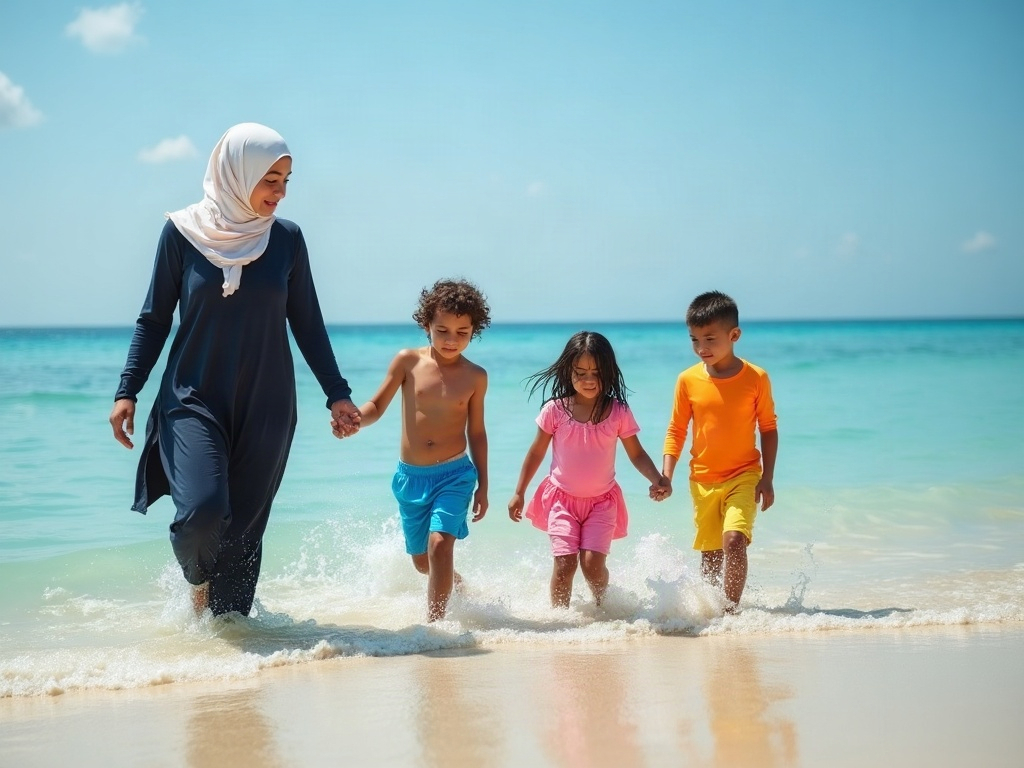
Showcasing a low-risk environment featuring gently sloping shorelines, clear sightlines, and immediate proximity to municipal safety facilities.
© WovenVoyages.com
5. How can parents monitor and adapt to changing beach weather conditions?
Parents can monitor and adapt to changing beach weather conditions by using a reliable weather app with real-time alerts, understanding the UV Index, and knowing the immediate actions to take for lightning or high surf advisories. Monitoring beach weather is an active, ongoing process, not a one-time check. Parents must track weather radar for pop-up thunderstorms and heed all official warnings from lifeguards or local authorities without delay.
What are the critical weather alerts parents should track before and during a beach trip?
The critical weather alerts parents must track before and during a beach trip are High Surf Advisories, Rip Current Statements, Small Craft Advisories, and Severe Thunderstorm or Tornado Watches/Warnings. These alerts, typically issued by the National Weather Service (NWS), provide specific information about hazards. A High Surf Advisory means waves are dangerously large for swimming, while a Rip Current Statement indicates a high risk of life-threatening rip currents.
Experts advise that if you can hear thunder, you should leave the beach immediately, as lightning can strike from a storm up to 20 miles away.
A Small Craft Advisory, while intended for boaters, is an excellent indicator of unsafe conditions for family beach activities. The choppy, windy conditions that are dangerous for small boats also create hazardous surf and currents for swimmers.
How to ensure adequate sun and heat protection for children at the beach?
To ensure adequate sun and heat protection for children at the beach, parents must apply a broad-spectrum, water-resistant sunscreen with an SPF of 30 or higher, enforce the use of UPF-rated clothing and hats, and schedule regular breaks in the shade while ensuring constant hydration. Sun and heat protection is a multi-layered system: chemical protection (sunscreen), physical barriers (clothing, shade), and internal support (hydration). Relying on sunscreen alone is insufficient and a common cause of sunburn and heat-related illness in children.
Research indicates that between 55% and 72% of children get sunburned each year, and just one blistering burn in childhood more than doubles the chances of developing melanoma later in life.
The most effective sun protection strategy is avoidance during peak UV hours, typically between 10 a.m. and 4 p.m. Planning beach time for the early morning or late afternoon drastically reduces total UV exposure and the risk of heatstroke, making for a more pleasant and safer experience.
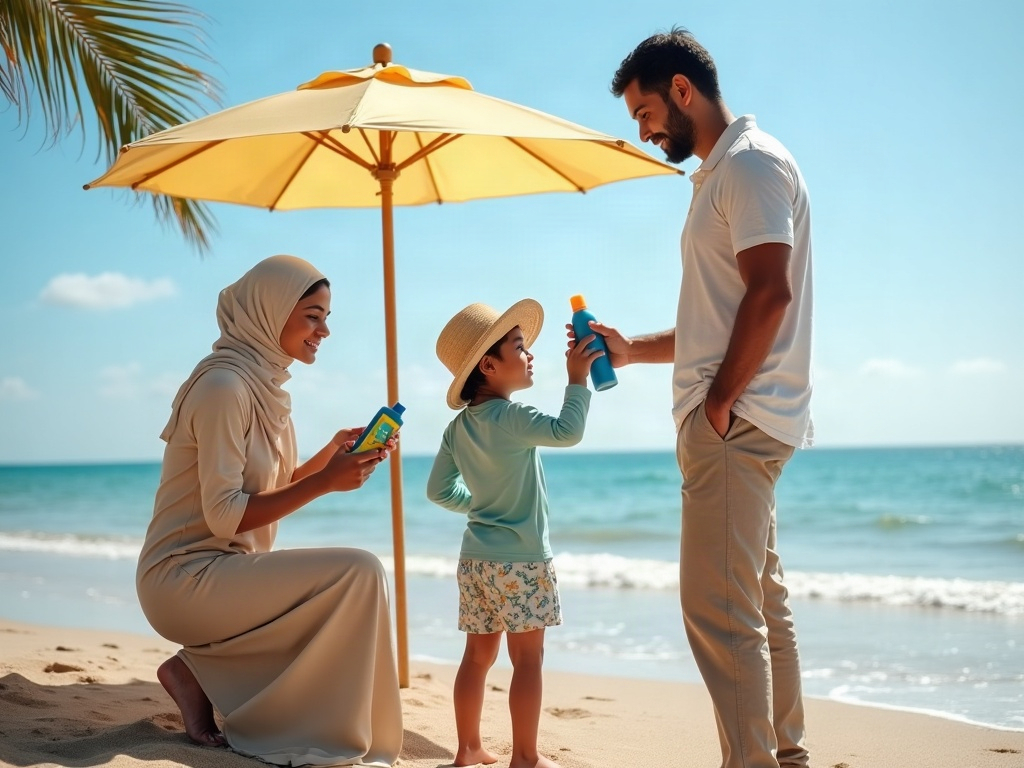
Illustrating the necessity of combining physical barriers (UPF clothing, structured shade) with chemical protection (SPF 50+) during peak solar intensity.
© WovenVoyages.com
6. What proactive steps can parents take to ensure beach safety for their children?
The most effective proactive steps parents can take to ensure beach safety for their children involve establishing clear family safety rules before the trip, packing essential safety equipment, and designating a responsible “Water Watcher” for active supervision. Proactive safety is a combination of education, equipment, and execution. Parents must teach their children the rules, bring the right gear like life jackets, and implement a supervision plan on-site.
How to establish and reinforce family water safety rules before a beach vacation?
To establish and reinforce family water safety rules before a beach vacation, parents must have a dedicated conversation with their children to clearly explain the rules, the reasons behind them, and the consequences for not following them. Hold a “family safety meeting” before you leave for your trip. Key rules to cover include: always swimming with a buddy, staying within sight of the designated adult, and never going in the water without permission. Repetition is key to reinforcement.
The American Academy of Pediatrics strongly supports formal swimming lessons for most children ages four and up as a foundational layer of protection for water activities.
Role-playing scenarios can be highly effective for reinforcement. Ask children, “What would you do if your ball went into deep water?” or “What do you do if you can’t see me?” This makes the abstract rules concrete and helps them internalize the correct response.
Which safety equipment should families bring for a secure beach day?
The essential safety equipment families should bring for a secure beach day includes a well-stocked first-aid kit, US Coast Guard-approved life jackets for non-swimmers, a fully charged cell phone, and high-SPF, broad-spectrum sunscreen. Consider all the beach vacation essentials to pack for a family trip. Your beach bag should contain more than towels and toys; it’s a mobile safety station. A first-aid kit for minor injuries and a reliable communication device for emergencies are non-negotiable items.
For children under 5, a U.S. Coast Guard-approved “Type II” life jacket is specifically recommended because it is designed with head support to help keep a child’s face out of the water.
While often seen as pool toys, a simple, loud whistle is a crucial piece of safety equipment. It can be used to get the attention of a child wandering too far, signal for help over the sound of the surf, and is more effective than a human voice over long distances.
Essential Safety Equipment Checklist
- Well-stocked first-aid kit.
- US Coast Guard-approved life jackets for all non-swimmers and weak swimmers.
- Fully charged cell phone in a waterproof case.
- High-SPF, broad-spectrum sunscreen.
- A loud whistle for signaling.
7. How can parents prevent common oversights in beach safety planning?
Parents can prevent common oversights in beach safety planning by researching local beach regulations, establishing a clear supervision plan before arriving, and understanding the dangers of underestimating the ocean’s power. The most common oversights stem from assumptions: assuming all beaches have the same rules, assuming a child is being watched when supervision is diffuse, and assuming calm-looking water is safe. Preventing these requires explicit planning and communication.
What are the consequences of neglecting local beach regulations?
The consequences of neglecting local beach regulations range from financial penalties, such as fines for possessing glass containers or alcohol, to severe safety risks incurred by swimming in prohibited areas or after lifeguard hours. Ignoring local regulations can lead to a ruined vacation via expensive tickets or even removal from the beach. More importantly, these rules are often in place for safety reasons, and violating them can put a family in direct, preventable danger.
A common beach regulation bans fires outside of designated pits to prevent injuries from buried coals, which can remain hot enough to cause severe burns for more than 24 hours.
Regulations about beach fires are a key example. Many destinations restrict them to designated pits or ban them entirely not just because of fire risk, but to prevent the hidden danger of buried hot coals that can severely burn beachgoers the following day. A fine is the lesser of the two consequences.
How to maintain constant supervision and prevent child separation at the beach?
To maintain constant supervision and prevent child separation at the beach, parents must implement the “Water Watcher” system for focused attention, establish a fixed family meeting point, and keep non-swimmers and toddlers within arm’s reach at all times. Constant supervision is active, not passive. It means assigning one adult to the sole task of watching the children in or near the water. For preventing separation, a memorable landmark (e.g., “the big blue umbrella at lifeguard tower 5”) is more effective than a mobile spot like “our towels.”
Taking a photo of your child each morning of vacation provides search personnel with an exact, current visual of their appearance and clothing, which is invaluable in case of separation.
Before the trip, take a photo of your child on your phone each morning. In the event of a separation, having a current photo showing exactly what they are wearing that day is invaluable for lifeguards and security personnel, saving critical search time.

Deploying the ‘Water Watcher’ protocol guarantees that at least one adult maintains unbroken visual contact with children entering the surf zone.
© WovenVoyages.com
8. What actions should parents take during a beach safety emergency?
The first actions a parent must take during a beach safety emergency are to alert a lifeguard if one is present, call 911 immediately if not, and provide basic first aid only to the level of their training while ensuring their own safety. In any beach emergency, the primary rule is to get professional help on the way as fast as possible. Signal for a lifeguard or call 911 before you do anything else. Do not attempt a water rescue yourself unless you are trained, as it often results in multiple victims.
How to provide immediate first aid for typical beach-related injuries?
To provide immediate first aid for typical beach-related injuries, parents should clean cuts from shells with antiseptic wipes, treat jellyfish stings by rinsing with saltwater and removing tentacles, and cool minor sunburns with a damp cloth. The goal of beach first aid is to clean the wound, alleviate initial pain, and prevent infection until more thorough care can be given. A well-stocked first-aid kit containing antiseptic wipes, bandages, pain relievers, and vinegar or saltwater for stings is essential.
For a jellyfish sting, it is best to rinse the area with vinegar, as rinsing with fresh water can cause the stingers to fire more venom; this should be followed by removing any remaining stingers with tweezers.
For jellyfish stings, the old advice to use urine is a myth and can actually make the sting worse by causing more stingers (nematocysts) to fire. The scientifically backed approach is to rinse with ocean water (not fresh water) or vinegar, then carefully remove any visible tentacles with tweezers.
Where can families locate emergency services and assistance on the beach?
Families can locate emergency services and assistance on the beach by first identifying the nearest lifeguard tower or beach patrol station, as these are the primary points of contact for any emergency. On a guarded beach, a lifeguard is your fastest route to help. If no lifeguard is present, look for posted signs at beach entrances or on bulletin boards that list the local emergency number (911 in the U.S.) and the beach’s specific address or access point number.
When calling 911 in an emergency, the most vital information is a precise location, which can be a lifeguard tower number, a beach access point number, or a cross street.
Many popular beach destinations now use location apps like “what3words” or have their own emergency location systems. Check the local park’s website beforehand to see if they use such a system, as providing a three-word address or a specific location code can pinpoint your location to within a few feet for responders.
9. Logistics: Beach Safety Quick Checklist
| Checklist Item / Tactic | Status |
|---|---|
| PRE-TRIP: Research local beach regulations and conditions. | ⬜ |
| PRE-TRIP: Pack essential safety equipment (first-aid kit, life jackets). | ⬜ |
| PRE-TRIP: Establish and discuss family water safety rules. | ⬜ |
| ON-SITE: Check beach flag warnings upon arrival. | ⬜ |
| ON-SITE: Designate a non-distracted “Water Watcher.” | ⬜ |
| ON-SITE: Monitor weather conditions and UV index regularly. | ⬜ |
| ON-SITE: Reapply sunscreen and ensure hydration. | ⬜ |
| EMERGENCY: Know how to contact emergency services and provide precise location. | ⬜ |
10. Frequently Asked Questions (People Also Ask)
Why is evaluating beach safety conditions crucial for family vacations?
How do parents assess ocean and water conditions for beach safety?
What proactive steps can parents take to ensure beach safety for their children?
Resolution
Ultimately, ensuring beach vacation safety is a function of diligent preparation, active supervision, and a deep respect for the power of the natural environment. By evaluating water and weather conditions, understanding environmental risks, and establishing clear family rules, parents can transform potential anxiety into confident control. This proactive approach is the key to a safe, memorable, and truly relaxing vacation. While beach trips offer unique benefits, families often explore various options for their perfect getaway, including considering how to choose the perfect ship and itinerary for family cruise vacations. The goal of this guide is not to create fear, but to build competence. A competent parent is not one who avoids the beach, but one who understands its risks and knows exactly how to manage them, unlocking a lifetime of safe coastal adventures for their family.