Family Beach Vacations: How Do You Choose the Perfect Coastline?
Table of Contents
Choosing the perfect coastline family vacation requires rigorously matching your family’s safety thresholds, activity preferences, and budget to verified beach environments rather than relying on idealized tourism photography.
A family beach vacation offers unparalleled opportunities for bonding, but its success hinges on treating it as a distinct vacation type requiring specific logistical strategies. While this guide focuses entirely on executing the ideal coastal stay, those evaluating other high-level options should review our comparison of family city break vacations.
Furthermore, for parents looking to entirely outsource daily logistics and planning burdens, examining how to choose the perfect ship and itinerary for family cruise vacations serves as an excellent alternative framework.
1. What makes a coastline perfect for family beach vacations?
A coastline becomes the ideal setting for a family beach vacation when its physical layout, intrinsic safety features, and logistical amenities directly support the developmental and physical needs of both children and parents.
The perfect family beach vacation balances non-negotiable safety elements—like calm waters and active lifeguards—with conveniences such as accessible restrooms and immediate food options. It must also offer age-appropriate engagement that caters to the entire family, from toddlers needing sensory play to teenagers demanding autonomy, ensuring a worry-free experience.
How do family needs shape the ideal beach environment?
Family needs for safety, routine, and low-stress logistics dictate the ideal environment by placing a premium on predictability and convenience. Toddler supervision demands calm, shallow waters and a clear line of sight, while the necessity for naps requires shade and quiet zones.
Panama City Beach offers families 27 miles of shoreline, with sections specifically known for calm waters ideal for swimming and paddle boarding, accommodating various family capability levels.
An “ideal” family beach environment is often a low-sensory-overload environment. For young children, a beach featuring loud music, intense crowds, and crashing waves acts as a stressor, whereas a quiet cove with gentle lapping water serves as an optimal learning lab.
Why prioritize safety and accessibility at family beaches?
Prioritizing safety and accessibility is crucial because it establishes a baseline of security that allows parents to actually relax. Features like on-duty lifeguards prevent tragic accidents, while wheelchair and stroller accessibility ensures no family member is excluded from the shoreline.
While the US boasts 95,000 miles of shoreline, not all beaches are suitable for family holidays due to critical factors like a lack of kid-friendly attractions, unsafe swimming zones, and inadequate restroom facilities.
The psychological benefit of visible safety and accessibility is equal to the physical benefit. A parent who is not constantly paralyzed by the fear of a dangerous undertow or how they will physically drag a stroller over dunes is a parent who can be present and create positive memories.
For an even deeper understanding of crucial safety factors, consider reviewing what conditions parents must check first for beach safety before your trip.

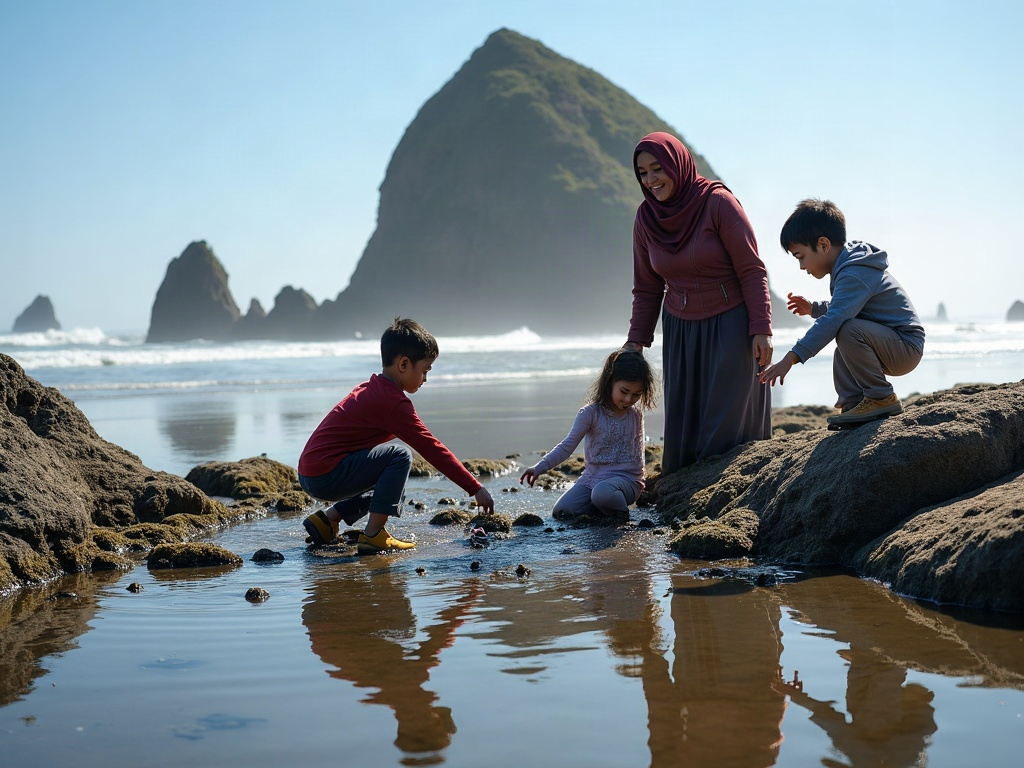
Demonstrating how a protected cove creates a low-sensory, high-safety ‘learning lab’ essential for toddlers encountering the ocean.
© WovenVoyages.com
2. How Do Different Types of Coastlines Offer Unique Family Experiences?
Different types of coastlines offer unique family experiences by providing distinct levels of kinetic water energy, specific natural topographies, and suitable activities that cater to vastly different risk tolerances.
Calm-water coastlines, such as those on gulfs or in protected bays, are ideal for families with young children seeking gentle water play. Conversely, active, wave-filled oceanfronts cater to families with older children and teenagers who demand surfing and a highly energetic atmosphere.
What experiences define a serene, calm-water coastline?
The experiences that define a serene, calm-water coastline are centered around safe wading, uninterrupted relaxation, and gentle discovery. Defining experiences include toddlers splashing safely without fear of surprise waves, allowing parents to read or relax on the sand.
A sea floor slope with a gradient of less than 5 percent is considered mathematically optimal for calm-water beaches, as it provides a significantly larger, safer shallow-water play area for children.
Calm-water coastlines serve as natural “learning labs.” The lack of intimidating waves allows children to rapidly gain water confidence, observe small marine life in clear shallows, and engage in imaginative play without the constant physical interruption of the surf.
When do active, wave-filled coastlines suit adventurous families?
Active, wave-filled coastlines suit adventurous families containing confident swimmers, typically those with older children or teenagers who seek the adrenaline of water sports like boogie boarding and surfing. They are the right choice for families who find static, calm beaches unengaging.
Manageable waves at Corolla and Carova Beach in the Outer Banks are excellent for new surfers, making them highly suitable for adventurous families introducing their children to the sport.
The “danger” of an active coastline is precisely its primary draw. The kinetic energy of the waves is not just a risk to be managed but the source of the adventure. The key is accurately matching the family’s swimming skill level with the specific beach’s daily conditions.
Author’s Experience
“As a parent who has navigated countless coastal trips, I’ve learned that a successful family outing hinges on meticulous pre-planning. Finding that sweet spot where everyone feels safe and entertained, from toddlers to teens, isn’t luck—it’s a well-researched strategy that acknowledges changing developmental needs.”

Showcasing how active, wave-filled coastlines successfully engage older children and teenagers who require high-kinetic output.
© WovenVoyages.com
3. Which Coastline Characteristics Matter Most for Family Safety and Comfort?
The coastline characteristics that matter most for family safety and comfort are predictable water conditions, the presence of official supervision, and the immediate availability of essential shore amenities.
For safety, the most critical characteristics include gentle water entry, low risk of rip currents, and the presence of on-duty lifeguards. For comfort, essential characteristics encompass soft sand, available shade, and clean, accessible restroom facilities.
How to evaluate water conditions for young children and non-swimmers?
To evaluate water conditions, you must assess water depth, wave action, and current indicators before entering. Look for a very gradual slope and minimal wave action. Always check for a posted beach flag warning system (green is safe, red is dangerous) and position your family near a lifeguard tower.
A longer swell period of 10 seconds or more indicates calmer, more organized waves, which is a significantly safer condition for family swimming than shorter, rapid-fire swell periods.
A key evaluation technique is to physically observe the water for 10-15 minutes before setting up camp. This allows you to spot dangerous patterns, like where waves are consistently breaking or if there are channels where water is flowing rapidly back to sea (a definitive sign of a rip current).
What shore amenities ensure a comfortable family beach day?
Shore amenities that ensure comfort solve the primary logistical challenges of a long day out: food, hygiene, and sun protection. The most crucial are clean public restrooms with changing tables, freshwater showers to rinse off sand, and easy access to food and drinks.
Around eight million visitors come to Ocean City, Maryland for the surf and sand each year, highlighting the absolute necessity for robust civic amenities to accommodate large crowds.
The “end-of-day” amenities are as critical as the “start-of-day” ones. A freshwater shower to rinse off sticky sand and salt before a hot car ride can prevent major pediatric meltdowns and is a high-value feature experienced families actively hunt for.
Once you’ve considered the amenities, the next step in planning a comfortable trip is reviewing what must you pack for a family beach vacation to ensure complete preparedness.

Visualizing the critical ‘end-of-day’ civic infrastructure—like freshwater showers—required to execute a stress-free family beach departure.
© WovenVoyages.com
4. How Do Family Activity Preferences Influence the Best Coastline Choice?
Family activity preferences directly influence coastline choice by determining whether the ideal destination should support high-energy water sports or provide a tranquil, static setting for relaxation.
If your family prefers active pursuits like kayaking or surfing, you need a coastline with clear water, appropriate waves, and rental facilities. If your family prefers to relax in the sand, a wide, flat beach with calm water perfectly aligns with their desired pace.
What types of beaches support water sports and exploration?
Beaches supporting water sports are defined by specific geological features: clear waters with reef systems for snorkeling, consistent wave breaks for surfing, or rocky intertidal zones for exploration.
The Haystack Rock at Cannon Beach, Oregon, created 17 million years ago, is a landmark specifically known for its dramatic tide pools and diverse marine life, ideal for scientific exploration.
These features are often mutually exclusive. A great surfing beach with constant wave action is typically a terrible choice for snorkeling due to churned-up sand reducing visibility. Families must either choose a primary activity or hunt for a destination with multiple, distinct micro-climates nearby.
Which coastlines offer tranquil settings for relaxation and play?
Tranquil coastlines are typically characterized by wide, sandy shores, protected waters (coves or bays), and a strict lack of commercial development, fostering a peaceful atmosphere away from jet skis.
Amelia Island, Florida, offers 13 miles of uncrowded beaches for a peaceful, off-the-beaten-path beach getaway, emphasizing its tranquil environment over high-thrill attractions.
The “tranquility” of a beach is almost always inversely proportional to its ease of access. The most serene spots require a short walk from the parking lot or are located away from the main tourist strip—a physical trade-off many families find worthwhile.
5. Which Infrastructure and Accessibility Features Are Crucial for Family Trips?
Crucial infrastructure features for family trips are those that ensure easy access from vehicle to sand, provide essential hygienic services, and guarantee safety in case of an emergency, actively supporting a smooth experience.
The most critical features are proximity to lodging and family-friendly dining, readily available medical facilities, and verified accessibility for strollers and wheelchairs.
How important is proximity to lodging, dining, and medical facilities?
Proximity to lodging and dining is critically important because it drastically reduces logistical stress and provides an essential safety net. Close lodging allows for easy mid-day naps and breaks from the sun, preventing overtired children from escalating into meltdowns.
Ocean City, Maryland, is just under 3 hours away from Washington DC and Baltimore, making it a highly accessible destination for families in those metropolitan areas.
For families with young kids, the “trip back” is a key consideration. A short 3-minute walk back to a condo for a forgotten item or a bathroom break is a minor inconvenience; a 20-minute hot car drive is a trip-ending disaster. Proximity dictates flexibility.
What accessibility factors should families consider for strollers or mobility needs?
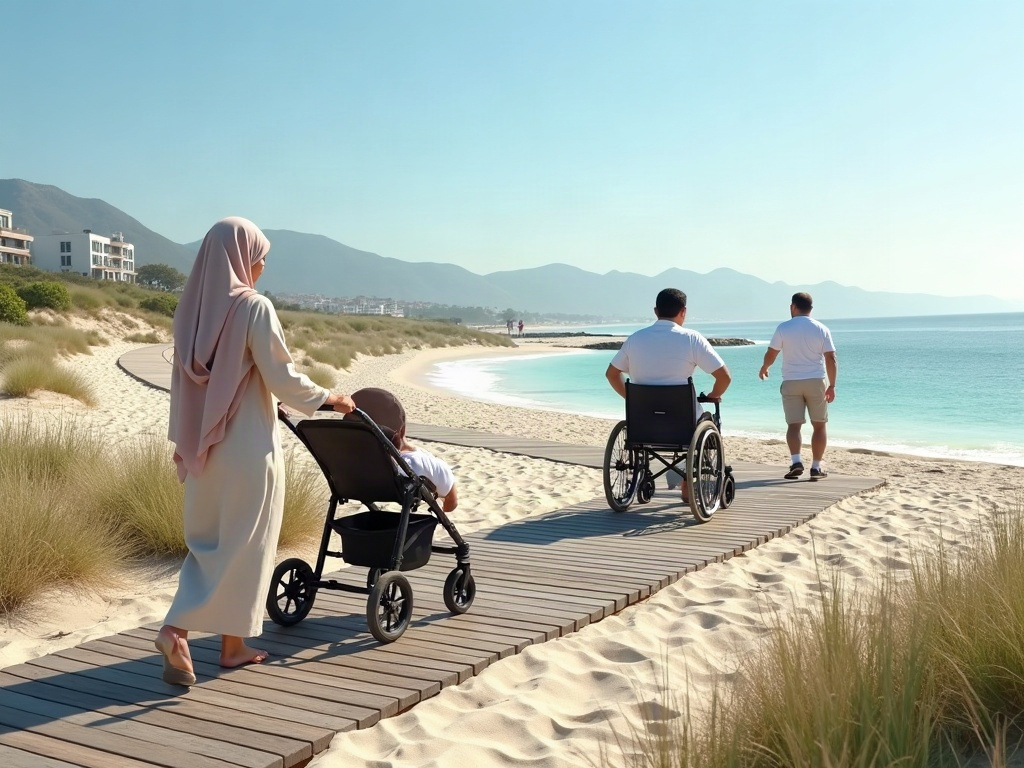
Families must evaluate the entire physical journey, from the parking lot to the water’s edge, for potential barriers. Key factors include designated accessible parking, paved boardwalk paths, and the presence of beach mats or ramps leading directly onto the sand.
Hilton Head’s wide, flat shoreline is famously ideal for bike rides and beach walks, giving families plenty of compact space to maneuver strollers and beach wheelchairs.
Many beaches advertised as “accessible” only provide access *to* the sand, not *on* it. True accessibility means a family can get their equipment or a person with mobility issues all the way to a comfortable spot near the water, requiring special rigid beach mats or the availability of balloon-tire beach wheelchairs.
Demonstrating true accessibility: rigid beach mats that allow strollers and wheelchairs to traverse soft sand without sinking, a critical feature for families.
© WovenVoyages.com
6. How Do Budget and Travel Time Impact Coastline Selection?
Budget and travel time are primary, immutable constraints that directly impact your family’s coastline selection by defining the geographic range and type of lodging that is mathematically feasible.
A smaller budget and shorter travel time naturally dictate closer, drive-to destinations that may offer fewer premium amenities but are highly accessible. Larger budgets and extended timeframes open up possibilities for remote, fly-to destinations or comprehensive all-inclusive resorts.
What are the cost implications of different beach destination types?
All-inclusive resorts bundle lodging, food, and activities, making budgeting simple but often representing the highest total upfront cost. Vacation rentals (condos/houses) can be significantly more economical for larger families who cook their own meals, but require careful tracking of granular expenses for groceries, parking, and activities.
Destinations like Myrtle Beach, the Outer Banks, and Gulf Shores consistently offer affordable lodging and free beach access, making them highly popular choices for budget-friendly family vacations.
The “cost per person” calculation changes violently with family size. For a family of three, an all-inclusive might be comparable to a rental. For a family of six, the ability to cook in a rented house almost always results in massive financial savings over any commercial dining option.
How does travel duration affect your choice of coastline accessibility?
For a weekend or 3-day trip, choosing a coastline within a 3-hour drive is essential to maximize actual vacation time and minimize travel fatigue. However, for a week-long vacation, investing a full day in aviation travel to reach a unique international coastline becomes a logical and worthwhile trade-off.
Ocean City, Maryland, is easily accessible, being just an hour from Philadelphia and two hours from New York City, making it ideal for short, drive-to regional getaways.
The “1:3 Rule” is a useful heuristic for family travel: for every one day of arduous travel (e.g., long flights, layovers), you must plan for at least three days of static relaxation at the destination to make it feel worthwhile and for the family’s biological rhythms to recover.
7. How to Research and Compare Potential Family Beach Destinations Effectively?
To research effectively, you must adopt a multi-source validation approach, cross-referencing polished official tourism information with unfiltered real-world reviews and satellite visual data.
Start with official city park websites for reliable data on amenities and safety, then validate this information with recent, detailed family travel blogs. Pay close attention to user photos that show current conditions, and always triangulate information to ensure accuracy.
What online resources and reviews should families consult?
Use local government and parks department websites for factual data on lifeguards, facilities, and accessibility. Consult family travel blogs that provide detailed trip reports with original, non-filtered photos to gain real-world perspective.
Elafonisi Beach, Greece, was named the best beach in the world for 2025 by Tripadvisor, indicating high aggregate user satisfaction and broad international appeal.
Pay special attention to the *date* of reviews and blog posts. Beach conditions, amenities, and even sand levels can change dramatically year to year due to hurricanes or municipal budget changes. Information more than two years old should be considered suspect and require fresh verification.
How can virtual tours and local insights inform your decision?
Virtual tours provide a realistic sense of a beach’s space and atmosphere that text alone cannot capture. Use Google Maps’ Street View feature to “walk” the boardwalk or access roads to check for physical accessibility barriers before booking.
Using Google Maps’ Street View feature allows you to visually inspect the terrain and pathways of a potential beach destination, such as the exact distance from parking to the sand.
Webcam streams are an underutilized, powerful intelligence tool. Many coastal towns have live webcams pointed at their beaches. Watching one for 10 minutes on a weekend afternoon gives you a real-time, unbiased view of crowd density, wave action, and the general demographic of beachgoers.
8. How to Personalize Your Coastline Choice Based on Your Family’s Unique Dynamics?
To personalize your coastline choice, you must perform a “needs audit” of your family’s unique dynamics, prioritizing the non-negotiable safety needs of the youngest member while finding ways to engage the oldest.
With both a toddler and a teenager, this often means choosing a destination with a “dual environment,” such as a calm bay for the little one and nearby access to surf lessons for the older one, ensuring wildly varied interests are met.
What role do children’s ages and interests play in final selection?
The ages of your children act as the most powerful filter for determining the suitability of a coastline. For infants, safety and logistics are everything. For teenagers, key drivers are autonomy and social opportunities, making beaches with waves and a lively atmosphere more appealing.
Teens often love active ocean beaches with moderate waves perfect for body surfing, making destinations like Southern California or the Outer Banks highly popular.
The “interest” component is as important as the “age.” A teenager obsessed with marine biology will have a fantastic time at a “boring” calm beach with rich tide pools, while a teen focused on socializing will prefer a bustling beach with a boardwalk. Plan for their passion, not just their age.
How to balance relaxation needs with active family pursuits?
To balance relaxation with active pursuits, strategically choose a destination that accommodates both styles simultaneously. Select a resort or beach area that has “zones,” such as a large beach with a designated quiet area and a separate area for water sports.
Many resorts in Turks and Caicos offer all-inclusive packages where everything from meals to kids’ activities is covered, providing options for both total relaxation and active engagement.
The “tag team” approach works best when the location is designed for it. A beach with a shaded cafe overlooking the main play area allows one parent to relax with a coffee while maintaining line-of-sight supervision over the active children.
9. What Common Mistakes Should Families Avoid When Choosing a Beach Destination?
The most common mistakes families make involve overlooking practical logistical details, aggressively underestimating costs, and making assumptions based on incomplete photographic information.
Top mistakes include picking a destination based on a single beautiful Instagram photo without researching rip current safety, failing to account for peak season parking traffic, and ignoring hidden costs like resort fees.
How to prevent overcrowding and disappointment during peak season?
To prevent overcrowding, you must either shift your timing or shift your location. Visit the beach early in the morning (before 10 AM) or late in the afternoon (after 4 PM). Alternatively, choose a less famous beach a few miles down the coast or travel during the “shoulder season.”
To avoid peak sun hours and associated crowds, take breaks in the shade between 10 AM and 4 PM, combining pediatric health advice with crowd management.
The “15-minute walk” rule is a powerful crowd-avoidance technique. On most popular beaches, 90% of the crowd clusters within a 5-minute walk of the main parking access point. By being willing to walk 15 minutes down the sand, you can often find ample space even on holidays.
Why overlooking hidden costs can spoil your family’s beach budget?
Overlooking hidden costs spoils the budget because seemingly minor expenses—like daily parking fees, mandated beach access tags, and expensive chair/umbrella rentals—accumulate rapidly, forcing cutbacks on planned dining or activities.
In Cape May, NJ, anyone over the age of 12 is required to wear a beach tag, representing a common, often overlooked, hidden cost for municipal beach access.
The biggest hidden cost is often “convenience.” Paying a premium for a soda on the beach, renting a chair because you didn’t want to carry one, or buying a forgotten toy at a boardwalk shop are all convenience taxes. Advanced packing neutralizes these costs.
How to avoid unsuitable beach conditions for specific family needs?
To avoid unsuitable conditions, you must rigorously match your family’s most specific needs—such as calm water for a toddler—with verified features of the destination. Never book a trip based on a vague marketing description like “family-friendly.”
San Diego has 70 miles of coastline, with a beach for every family type, from the gentle waves of La Jolla Shores (ideal for calm waters) to the white sands of Coronado Beach, underscoring the importance of specific matching.
The most common way this mistake is made is through “Transitive Trust”—trusting a friend’s recommendation without realizing their family’s needs are fundamentally different. A friend with teenage surfers who recommends an active beach is giving a great recommendation *for them*, but it is a disastrous choice for your family with a 2-year-old.
Illustrating the stress of ‘Transitive Trust’: arriving at a beautiful but highly energetic surf beach that is completely unsuitable for a young toddler’s safety.
© WovenVoyages.com
10. Logistics: Essential Beach Trip Planning Checklist
| Checklist Item / Tactic | Status |
|---|---|
| Determine Family Needs: Assess age-specific safety, comfort, and activity preferences for all family members. | ⬜ |
| Evaluate Coastline Type: Match your family’s preferences with calm, active, or dual-environment beach characteristics. | ⬜ |
| Verify Safety & Accessibility: Confirm presence of lifeguards, suitable water conditions, and stroller/wheelchair access. | ⬜ |
| Check Essential Amenities: Research availability of restrooms, showers, food access, and shade options. | ⬜ |
| Review Budget & Travel Time: Align destination options with financial constraints and available vacation days. | ⬜ |
| Conduct Thorough Research: Utilize official sites, blogs, and visual tools (webcams, Street View) to triangulate information. | ⬜ |
11. Frequently Asked Questions (People Also Ask)
What makes a coastline perfect for family beach vacations?
How do you evaluate water conditions for young children?
Why overlooking hidden costs can spoil your family’s beach budget?
Resolution
Choosing the perfect family beach coastline is an achievable goal when you transition from hoping for the best to following a structured process of evaluation and personalization. The perfect choice is found at the intersection of your family’s needs, your budget, and the verified characteristics of the destination. By prioritizing safety, understanding your family’s activity style, and conducting thorough research via multiple sources (including webcams and maps), you can engineer a successful and memorable vacation tailored specifically to your family. The “perfect” beach isn’t a static place, but a successful match. Use this guide not as a set of rules, but as a flexible framework to compare your top choices side-by-side and make your final decision with absolute confidence.
One Response