How to Choose the Right Accommodation Features for Families
Table of Contents
As you navigate the essential steps of selecting the perfect family lodging, remember that this is one crucial part of a larger journey to plan a family vacation step by step.
The key accommodation features families need for a comfortable trip directly address the core challenges of traveling with children: sleeping arrangements, meal preparation, safety, and entertainment. For a comfortable family trip, essential accommodation features include separate sleeping areas for better rest, kitchen facilities for meal flexibility, and verified safety measures. These core features form the foundation of a low-stress family vacation basecamp.
. What Key Accommodation Features Do Families Need for a Comfortable Trip?
The key accommodation features families need for a comfortable trip directly address the core challenges of traveling with children: sleeping arrangements, meal preparation, safety, and entertainment. For a comfortable family trip, essential accommodation features include separate sleeping areas for better rest, kitchen facilities for meal flexibility, and verified safety measures. These core features form the foundation of a low-stress family vacation basecamp.
Beyond a simple list, the value of these features lies in their ability to replicate a child’s home routine (sleep schedules, familiar foods), which is the single most effective factor in reducing travel-related stress for both parents and children.
**Family Suite**: An accommodation category that offers more space than a standard hotel room, typically featuring at least one separate sleeping area and often a small living space or kitchenette, distinct from simply having two double beds in one room.
Choose to prioritize these foundational features over novelty amenities if your primary goal is to minimize daily friction and maximize rest for the entire family.
These general needs become highly specific when considering the different ages and developmental stages of children.
Why Do Specific Accommodation Features Matter for a Stress-Free Family Vacation?
Specific accommodation features matter for a stress-free family vacation because they provide practical solutions to the logistical and emotional challenges unique to traveling with children. Features like blackout curtains or a full kitchen directly solve common family travel problems, such as differing sleep schedules and picky eating habits. Investing in these features mitigates daily stressors, leading to a more relaxing experience for everyone.
The impact is cumulative; a single feature like a separate sleeping area doesn’t just improve sleep, it prevents a chain reaction of overtired children, stressed parents, and a strained vacation atmosphere the following day. Eliminating unknown variables and ensuring the right features are in place neutralizes the 40% increase in poor choices that can result from mental depletion and decision fatigue during a trip.
Separate sleeping area → prevents → early morning wake-ups for parents.
Author’s Experience
“As a parent who’s navigated many family trips, I’ve learned that overlooking even small features can derail an entire day. Once, a missing travel cot meant my toddler slept in a dresser drawer. Never again! Thorough planning prevents such travel mishaps and ensures everyone, especially the parents, truly enjoys the vacation.”
. How Do Children’s Ages and Needs Influence Necessary Family Accommodation Features?
Children’s ages and developmental needs directly determine the priority of necessary family accommodation features, shifting the focus from basic safety for infants to engagement and privacy for teenagers. The age of your children is the primary determinant for choosing accommodation features. Infants require safety and convenience features like cribs and kitchenettes, while teenagers prioritize amenities like strong Wi-Fi and separate social spaces.
The transition from toddler to school-age marks a critical shift in feature priority: from *containment and safety* (childproofing, ground-floor rooms) to *structured entertainment and energy expenditure* (pools, kids’ clubs, playgrounds).
**Aparthotel (Apartment Hotel)**: A type of accommodation that combines the amenities of a hotel (like a front desk and housekeeping) with the space and facilities of a furnished apartment, such as a kitchen and separate living/sleeping areas.
If you are traveling with a multi-generational family or kids with a large age gap, prioritize features that serve the youngest child’s needs first, as their requirements are the least flexible.
We will now break down the specific needs for the two most distinct age brackets: infants/toddlers and school-aged children/teens.
For families traveling with specific accessibility needs, knowing how to book accessible hotels for a family vacation is a critical aspect of ensuring a comfortable and inclusive experience for everyone.
What Specific Features Do Infants and Toddlers Require in Family Accommodation?
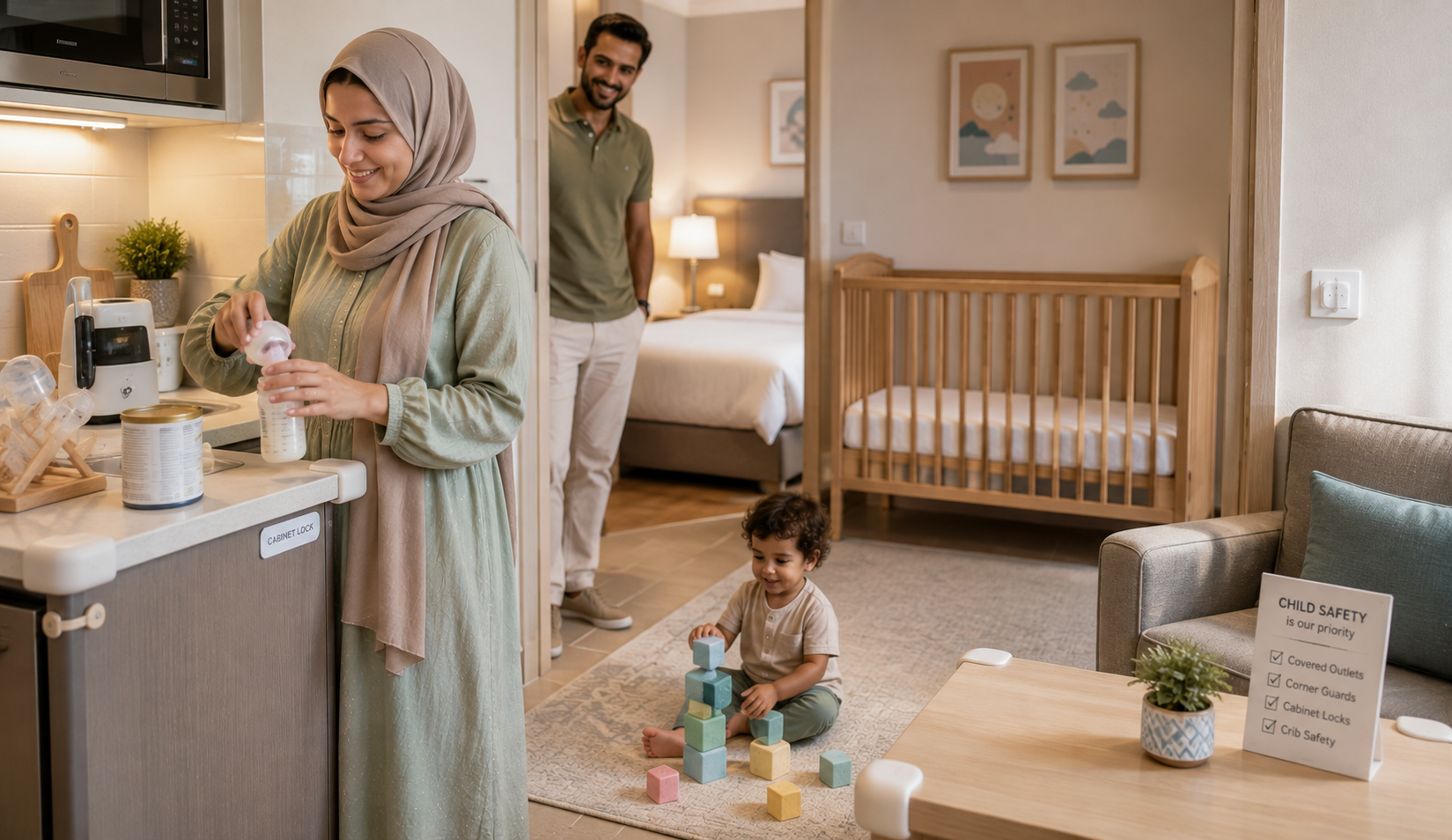
The specific features infants and toddlers require in family accommodation prioritize safety, sleep hygiene, and the ability to manage feeding schedules with ease. For infants and toddlers, prioritize accommodation with verified childproofing, available cribs or travel cots, and a kitchenette for preparing bottles or meals. These features are non-negotiable for a safe and functional family trip with very young children.
Infants and toddlers require family accommodation features focused on safety, sleep, and feeding. Non-negotiable items include verified childproofing, available cribs, and a kitchenette for meal preparation, ensuring a safe and functional trip for the youngest travelers. A ground-floor room is not just about convenience; it is a significant safety feature that eliminates the risk associated with balconies and windows in multi-story buildings for highly mobile toddlers. According to a survey by the American Hotel & Lodging Association, 60% of parents prioritize hotels with child-friendly amenities such as cribs and high chairs.
Kitchenette access → enables → sterilization of bottles and adherence to feeding schedules.
Which Accommodation Features Are Best Suited for School-Aged Children and Teenagers?
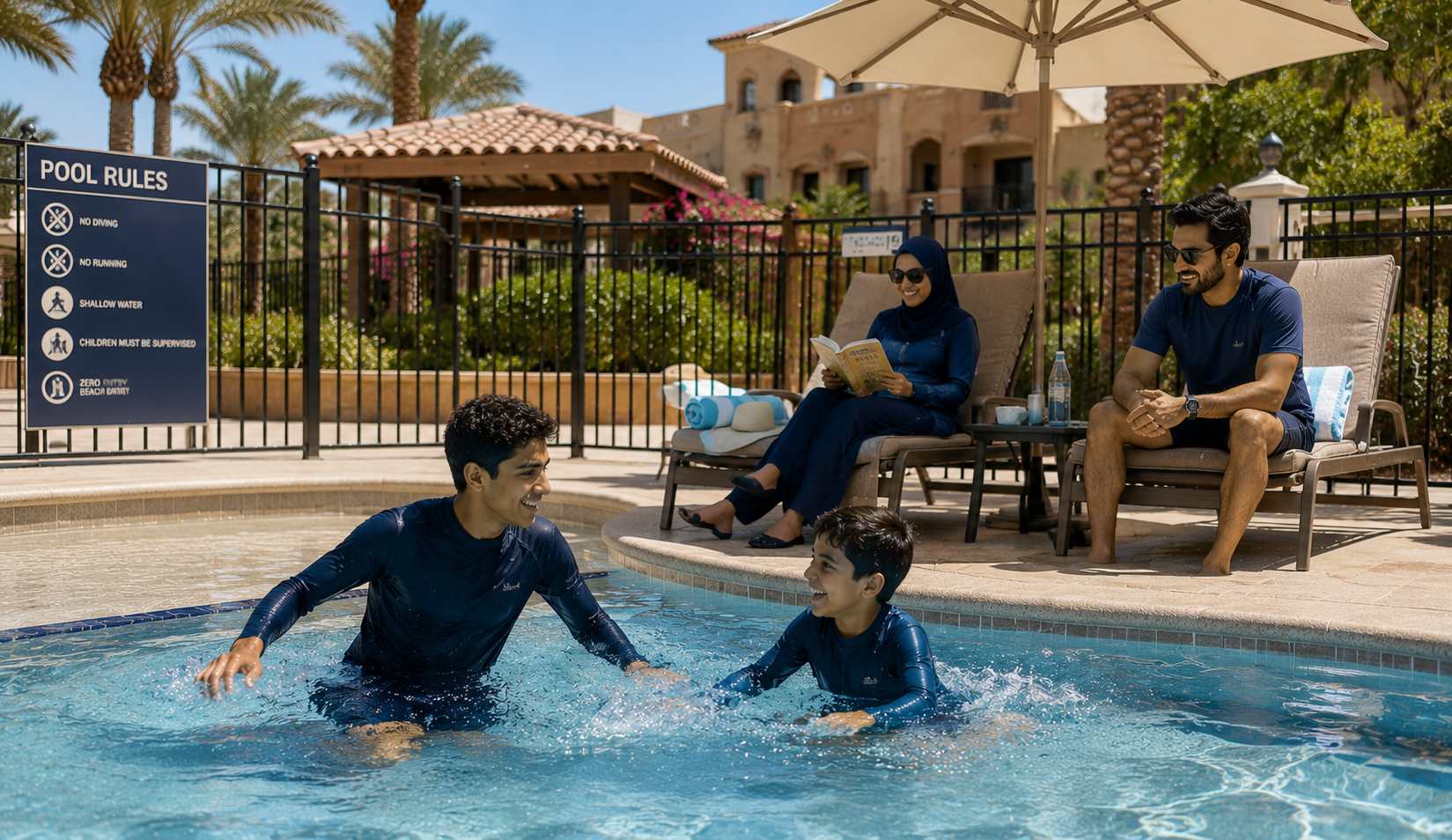
The accommodation features best suited for school-aged children and teenagers are those that provide a balance of entertainment, connectivity, and personal space. For school-aged kids and teens, focus on features like a reliable swimming pool, strong Wi-Fi, and separate sleeping or living areas. These amenities prevent boredom and provide the privacy and independence older children crave.
For school-aged children and teenagers, optimal family accommodation features include a reliable swimming pool for entertainment, strong Wi-Fi for connectivity, and separate sleeping/living areas for privacy. These elements combat boredom and foster the independence older children seek. The value of a “second space” (like a living room with a sofa bed or connecting rooms) is less about sleep and more about providing a psychological “escape” for teenagers, reducing family friction in shared quarters. For school-aged kids and teens, amenities matter, with 48% of families ranking kids’ amenities as a top priority when choosing a hotel, according to the 2025 Family Travel Association Survey.
Reliable Wi-Fi → provides → essential downtime and connection for teenagers.

. How Can Families Prioritize Essential Accommodation Features Based on Budget and Trip Type?
Families can prioritize essential accommodation features by using a decision matrix that weighs each feature’s importance against its impact on the total trip budget and its relevance to the vacation type. To prioritize features on a budget, first classify them as “must-have” (e.g., safety for a toddler) versus “nice-to-have” (e.g., a game room). Then, match your “must-have” list to the accommodation type that offers the best value, such as a vacation rental for kitchen and space.
The most common budgeting mistake is comparing nightly rates alone. A higher-priced vacation rental with a full kitchen can be significantly cheaper overall than a low-rate hotel room once the cost of dining out for every family meal is factored in.
**Shoulder Season**: The travel period between peak and off-peak seasons, which often presents a “sweet spot” of good weather, fewer crowds, and lower prices on accommodations with premium family features.
If your trip is a fast-paced city tour, prioritize a central location over in-room amenities. If it is a relaxing resort stay, prioritize on-site features like pools and kids’ clubs. Once a budget priority is set, the next step is to understand which *type* of accommodation delivers those features most effectively.
To make the best choices for your family, consider exploring What Types of Accommodation Work Best for Family Vacations, understanding the nuances of Choose Family Vacation Rentals vs. Hotels planning, and determining Which Family-Friendly Hotel Amenities Matter Most During Planning vacation to ensure your travel plans align perfectly with your family’s needs.
Which Accommodation Types Offer the Best Value for Different Family Feature Needs?
The accommodation types that offer the best value are directly linked to your family’s highest-priority features: vacation rentals for space and kitchens, all-inclusive resorts for activities and dining, and aparthotels for a hybrid solution. Vacation rentals offer the best value for families needing space and a kitchen. All-inclusive resorts provide the best value for families prioritizing structured activities, childcare, and predictable meal costs.
For family accommodation features, vacation rentals offer best value for space and kitchen needs, while all-inclusive resorts are ideal for structured activities and predictable costs. Aparthotels present a hybrid solution combining hotel services with apartment-like amenities. The “best value” of an all-inclusive resort for families is not just financial; it’s a “decision-fatigue-free” value, eliminating hundreds of small daily choices about where to eat and what to do, which is a significant mental relief for parents. While 80% of families plan to stay in a hotel, 45% are now looking to book vacation rentals, which often provide better value for families seeking more space and kitchen facilities.
Vacation rentals → provide the best value for → multi-bedroom and full-kitchen needs.
How to Balance Desired Accommodation Features with Your Family Travel Budget?
Balancing desired accommodation features with your family travel budget requires a strategy of prioritizing non-negotiable needs, considering alternative accommodation types, and booking during lower-cost periods. To balance features and budget, focus spending on your top one or two “must-have” features and be flexible on the rest. For instance, book a less central vacation rental to afford more space, or travel in the shoulder season to get a resort with a kids’ club for a lower price.
To balance desired family accommodation features with budget, prioritize “must-have” features and be flexible on “nice-to-haves.” Strategies include booking less central locations for space, or traveling during shoulder season for premium amenities at a lower cost, optimizing overall trip cost. The “cost” of a feature is not just its price tag. The “cost” of *not* having a needed feature (e.g., a kitchen for a child with allergies) can be immense in terms of stress, time spent searching for safe food, and medical risk. With family vacation dining costs surging by 28.2%, booking an accommodation with a kitchenette to prepare some meals is a key budget-balancing strategy.
Traveling off-peak → unlocks access to → premium family features at a lower cost.
For comprehensive insights on managing your travel finances, explore our guide on How to Budget Accommodation Costs for a Family Vacation to maximize your savings without compromising on comfort.
. Which Accommodation Features Best Enhance Safety and Convenience for Traveling Families?
The accommodation features that best enhance safety and convenience for traveling families are those that minimize physical risks and reduce logistical friction, such as secure access points and on-site laundry. To enhance safety, prioritize features like childproofed rooms and secure, limited-access entryways. For convenience, look for on-site amenities like laundry facilities and kitchenettes to simplify daily routines and reduce time spent on chores.
For traveling families, accommodation features enhancing safety include childproofed rooms and secure access points, minimizing physical risks. Convenience is boosted by on-site amenities like laundry and kitchenettes, reducing daily logistical friction and simplifying routines. Convenience and safety are often two sides of the same coin. A “convenient” on-site kitchenette is also a “safety” feature for a child with severe food allergies, as it guarantees control over ingredients.
**Secure Access**: Modern entry systems beyond a simple metal key, such as RFID key cards or keypad codes, which prevent easy duplication and often provide an auditable log of entry, enhancing security.
If you are debating between two otherwise equal properties, choose the one with demonstrably superior safety features (e.g., confirmed balcony locks, 24/7 front desk). We will now break down the specific features for safety and convenience individually to give each the focus it deserves.
Understanding the detailed aspects of accommodation safety is paramount, and it complements the broader topic of How Do You Plan for Family Vacation Safety to ensure a secure trip.
What Specific Safety Features Should Families Prioritize in Accommodation?
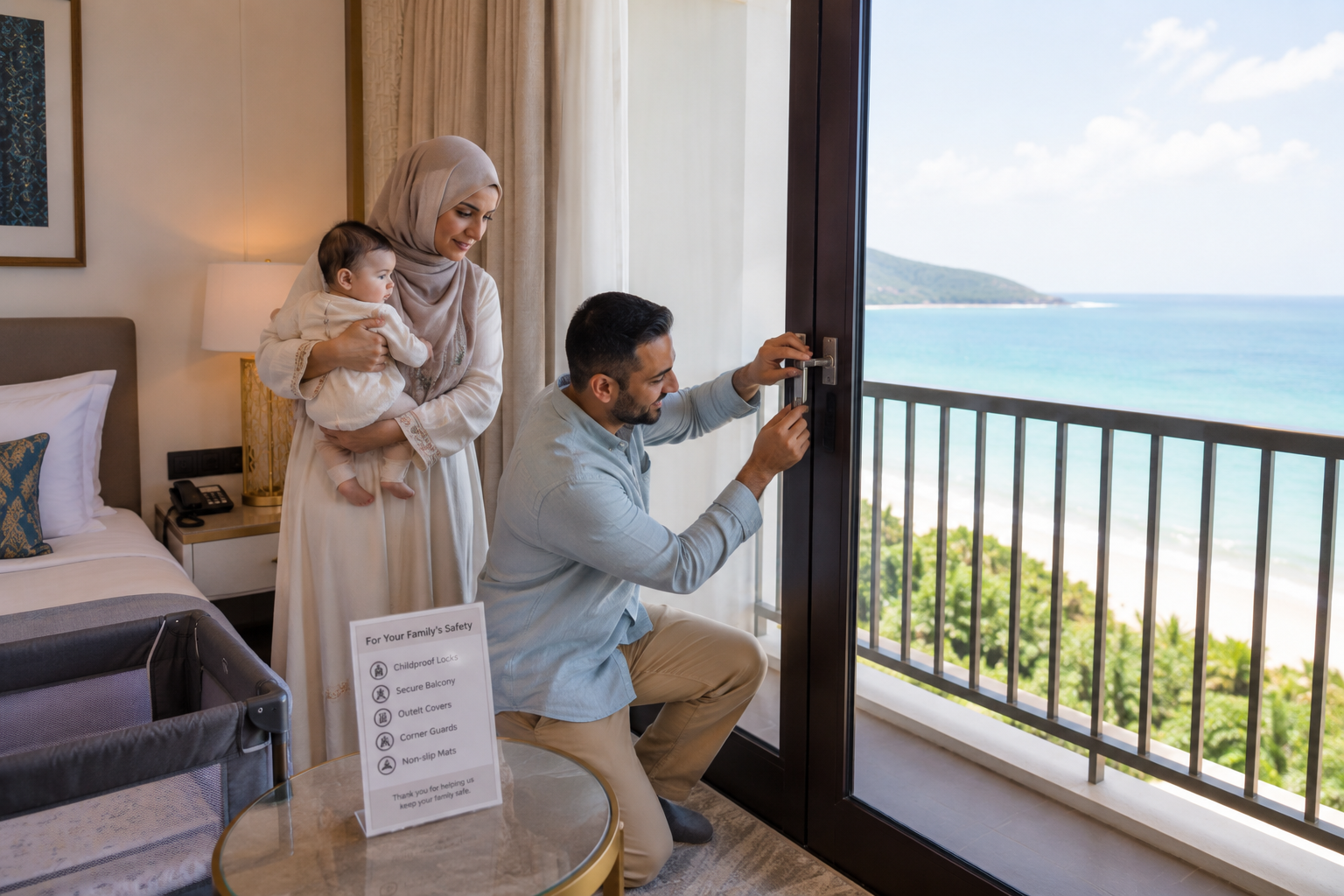
The specific safety features families must prioritize in accommodation include secure window and balcony locks, the absence of accessible toxic plants or chemicals, and functional smoke detectors. When choosing accommodation, prioritize verifying that all windows (especially on upper floors) and balcony doors have secure, child-resistant locks. This single check is one of the most critical for preventing falls and ensuring child safety.
Families must prioritize specific safety features in accommodation, including secure window and balcony locks, absence of toxic substances, and functional smoke detectors. Verifying child-resistant locks on all windows and balcony doors is critically important to prevent falls and ensure child safety. Beyond obvious locks, experienced family travelers check for furniture that can be easily tipped over (like unsecured dressers or TVs) and ensure it is either anchored or can be moved away from a toddler’s reach. Safety is a top priority for 54% of families when choosing accommodation, making features like secure locks and childproofed rooms essential considerations.
Childproof balcony locks → are a critical feature for → preventing falls in multi-story accommodations.
How Do On-Site Accommodation Amenities Simplify Family Travel and Enhance Convenience?
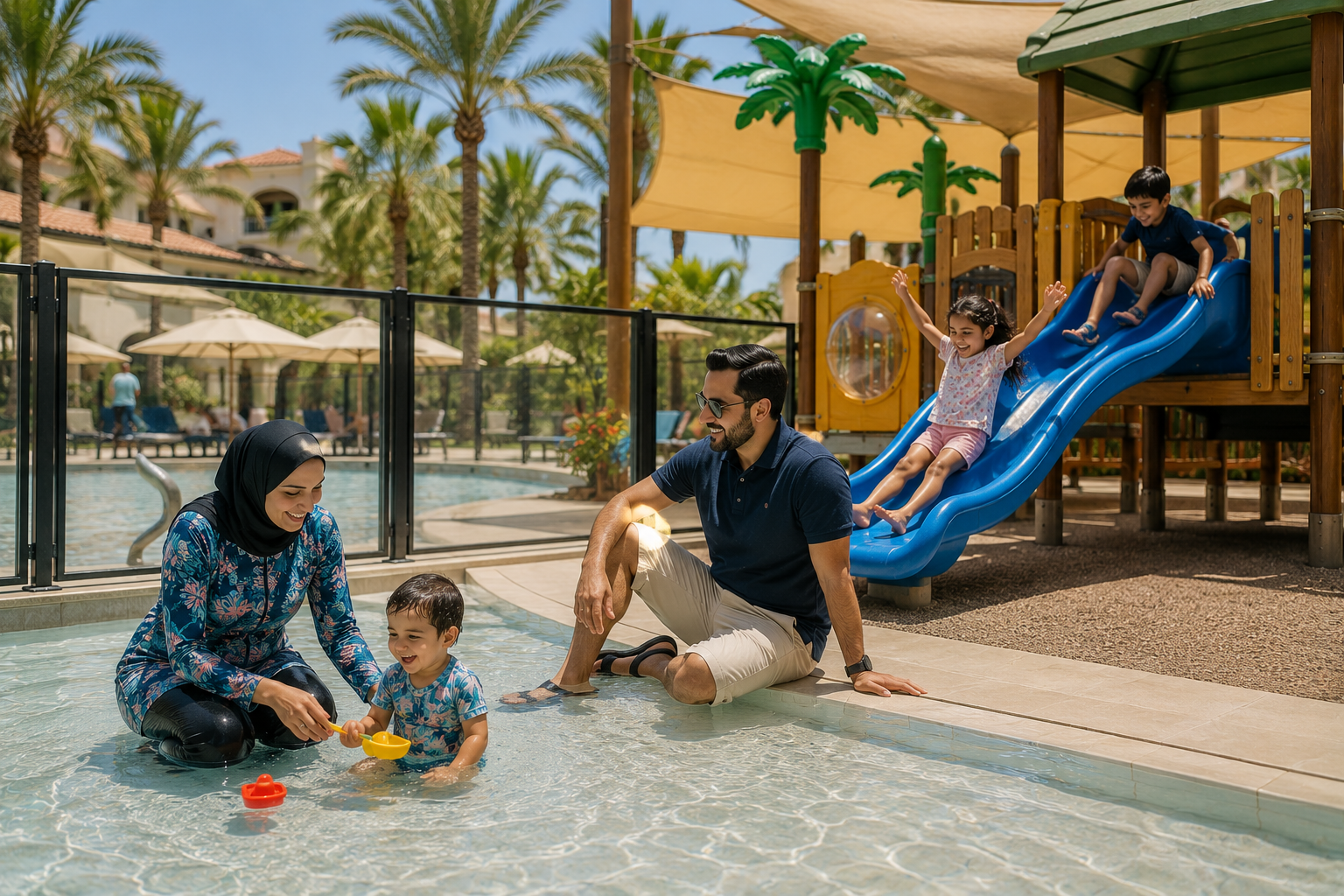
On-site accommodation amenities simplify family travel by consolidating necessary activities and services in one location, which drastically reduces travel time and logistical planning for parents. On-site amenities like a pool, restaurant, or laundry facility simplify family travel by saving significant time and effort. Having entertainment and necessities just steps from your room means less time in transit and more time relaxing.
On-site family accommodation amenities like pools, restaurants, or laundry significantly simplify travel by consolidating activities and services. This reduces transit time and logistical planning, offering parents more relaxation and convenience by keeping entertainment and necessities steps away. The convenience of an on-site amenity like a pool is not just about the activity itself, but about the *low activation energy* required. It’s an easy, low-planning way to fill a 60-minute gap in the day, which is invaluable on a family trip. On-site laundry provides a substantial financial return, as it allows families to pack lighter and avoid checked bag fees, from which airlines extract over $7 billion annually.
An on-site pool → provides → a low-effort entertainment option for children.
. How to Effectively Research and Verify Family Accommodation Features Before Booking?
To effectively research and verify family accommodation features, you must employ a multi-pronged approach that cross-references official property claims with recent user-generated content and direct communication. To verify features, first read recent reviews from other families on sites like TripAdvisor, specifically searching for mentions of the features you need. Then, call or email the accommodation directly to get written confirmation of critical items like crib availability and associated fees before you book.
Effectively research and verify family accommodation features by combining user reviews and direct communication. Start by filtering recent family reviews on platforms like TripAdvisor for desired features, then contact the accommodation directly for written confirmation of critical details like crib availability and fees before booking. Photos can be deceiving. Use Google Maps’ Street View to assess the property’s immediate surroundings—a “beachfront” hotel might have a busy four-lane highway between it and the sand, a critical detail for a family with young children.
**Family Travel Blog**: Niche travel blogs written by parents who provide first-hand, detailed reviews of accommodations and destinations, often including practical details and photos that are not found in official marketing materials.
Trust recent (last 6 months) family reviews over the hotel’s professional photos and marketing copy, as amenities can change and wear over time. This research process involves consulting specific sources and asking targeted questions.
Where Can Families Find Reliable Reviews About Accommodation Features for Their Trip?
Families can find the most reliable reviews about accommodation features on booking platforms with robust filtering options and in the detailed posts of specialized family travel blogs. For reliable reviews, use the “traveler type” filter on TripAdvisor or Booking.com to see only reviews from families. Supplement this with searches on reputable family travel blogs, which often provide more nuance and real-world photos.
To find reliable reviews about family accommodation features, utilize “traveler type” filters on platforms like TripAdvisor or Booking.com to view family-specific feedback. Additionally, consult reputable family travel blogs for nuanced perspectives and authentic photos, providing comprehensive insights. The most valuable reviews are not the 5-star or 1-star, but the 3- and 4-star reviews. These often contain the most balanced and specific feedback about what worked and what didn’t for a family (e.g., “The pool was great, but the kitchenette lacked a microwave, which was a hassle”). A 2021 survey found that 74% of U.S. travelers plan to stay in accommodations they previously enjoyed, highlighting the importance of positive experiences and reliable reviews in booking decisions.
Family-specific review filters → provide → highly relevant insights into feature performance.
What Questions Should You Ask Accommodation Providers to Confirm Specific Features?
The questions you should ask accommodation providers to confirm specific features must be direct, unambiguous, and focused on details that impact safety and convenience, such as item cleanliness and associated costs. When contacting an accommodation, ask specific, closed-ended questions. Instead of “Do you have cribs?”, ask “Can I reserve a full-size wooden crib for my dates, and is there a rental fee?”
When confirming family accommodation features, ask direct, closed-ended questions. Instead of general inquiries like “Do you have cribs?”, specify: “Can I reserve a full-size wooden crib for my dates, and is there a rental fee?” This ensures clear, unambiguous answers. Ask about the *location* of the room relative to noise sources. Request a room away from elevators, ice machines, and the hotel bar, as a “quiet room” is a critical but often overlooked feature for families with infants. With data showing that 63% of guests rely on photos as their main source of information when booking, it is critical to ask direct questions to confirm if pictured amenities are accurate and guaranteed.
Specific questions → elicit → non-ambiguous answers about feature availability.
. What Strategies Help Families Secure the Best Accommodation Features for Their Vacation?
The strategies that help families secure the best accommodation features for their vacation center on advance planning, clear communication, and leveraging loyalty. To secure the best features, book high-demand family rooms or vacation rentals at least 6-9 months in advance, especially for peak travel times. Additionally, always add your specific requests (e.g., “crib needed,” “quiet room requested”) in the booking notes and follow up with a direct call.
To secure the best family accommodation features, prioritize advance planning, clear communication, and leveraging loyalty programs. Book high-demand options 6-9 months early for peak seasons, and always detail specific requests in booking notes, following up with a direct call. Direct booking with a hotel, while not always the cheapest, can sometimes give you leverage. A direct customer is more valuable to the hotel than one from an OTA, and they may be more willing to accommodate specific room requests or offer complimentary upgrades to a family suite.
**Loyalty Program**: A rewards program offered by hotel chains (e.g., Marriott Bonvoy, Hilton Honors) that gives members benefits like points, potential room upgrades, and early check-in, which can be advantageous for securing better family accommodations.
If a specific feature like connecting rooms is a non-negotiable “must-have” for your trip’s success, prioritize booking early over waiting for a potential last-minute deal. A key element of this strategy is timing, which leads directly to the question of *when* to book.
When Is the Best Time to Book Family Accommodation to Ensure Desired Feature Availability?
The best time to book family accommodation to ensure desired feature availability is typically 6 to 12 months in advance, particularly for travel during peak seasons or school holidays. For peak travel times like summer or holidays, book family-sized accommodations 9-12 months out. For shoulder season travel, a 4-6 month lead time is generally sufficient to secure rooms with good features.
The best time to book family accommodation features for desired availability is 6-12 months in advance. Specifically, aim for 9-12 months for peak seasons (summer, holidays) and 4-6 months for shoulder seasons, ensuring access to high-demand options like family suites. The highest-demand features—multi-bedroom suites, connecting rooms, and well-located vacation rentals—are often the first to sell out, and they rarely become available in last-minute sales. The “wait for a deal” strategy is ineffective for these specific inventory types. Data from Statista (2022) shows that hotels with family suites experience a 25% higher booking rate from families, indicating these high-demand rooms should be booked far in advance.
Booking 9-12 months in advance → maximizes the probability of → securing connecting rooms during peak season.
To ensure you secure your preferred lodging and amenities, gaining a deeper understanding of When Should Families Book Accommodation for a Family Vacation is highly recommended.
How Can Families Effectively Request Specific Accommodation Features During the Booking Process?
Families can effectively request specific accommodation features by documenting their needs in multiple channels during and after the booking process and by tying the request to a need rather than a want. To effectively request features, first use the “special requests” or “comments” box during online booking. Then, follow up with a direct email to the hotel reservations desk a week before your arrival to politely reconfirm your needs.
To effectively request specific family accommodation features, document needs during online booking using the “special requests” box, then follow up with a direct email to the hotel’s reservations desk a week before arrival to politely reconfirm. Frame requests as needs, not wants. Frame your request around a non-negotiable need. Instead of “We’d like a quiet room,” write “We request a quiet room away from the elevator as we are traveling with an infant who is a very light sleeper.” This adds urgency and context that front desk staff are more likely to act on. Offering competitive rates for children can increase a property’s family bookings by up to 15%, which suggests that hotels are actively seeking family business and are more likely to accommodate specific requests.
Documenting requests in writing → creates → a verifiable record for the hotel staff.
. What Common Mistakes Do Families Make When Choosing Accommodation Features?
The most common mistakes families make when choosing accommodation features involve making unsafe assumptions, prioritizing price over function, and failing to verify marketing claims. The biggest mistake is assuming a “family-friendly” label guarantees safety features like childproofed rooms; you must always verify specifics. Another common error is booking a cheaper, smaller room that leads to poor sleep and more stress, negating the vacation’s purpose.
Common mistakes in choosing family accommodation features include assuming “family-friendly” implies childproofing, prioritizing low price over functionality, and failing to verify claims. These errors lead to unmet expectations, increased stress, and ultimately detract from the vacation’s purpose. A frequent mistake is focusing only on the room and ignoring the property’s “sound profile.” A trendy hotel with a popular rooftop bar might be “family-friendly” by day, but its noise levels can be a disaster for a family with an early bedtime.
**Resort Fee**: A mandatory daily charge added by some hotels, ostensibly to cover a bundle of amenities (like Wi-Fi, pool access, etc.). It is a common source of budget mistakes as it is often not included in the initial nightly rate displayed on booking sites.
To avoid these mistakes, create a non-negotiable checklist of your top 3 safety and comfort features and do not book any property that cannot confirm them. These general mistakes can be broken down into specific errors of overlooking crucial features and failing to verify.
How Can Families Avoid Overlooking Crucial Safety or Comfort Features?
Families can avoid overlooking crucial safety or comfort features by creating and using a standardized, age-specific checklist for every accommodation search. To avoid overlooking features, create a physical or digital checklist of your family’s top 5 non-negotiable needs before you even start looking at hotels. Refer back to this list before you click “book” to ensure emotion or a flashy price hasn’t made you forget a crucial item like a bathtub for a toddler.
Families can avoid overlooking crucial safety or comfort features by creating a standardized, age-specific checklist of non-negotiable needs. Refer to this list before booking to prevent emotional decisions or attractive pricing from overshadowing essential family accommodation requirements. Overlooking features often happens when planning is rushed. Institute a “24-hour rule”: put a promising accommodation on a courtesy hold or save it to your cart, then review it again the next day with your checklist to catch anything you missed in the initial excitement. According to one report, 88% of guests consider high-quality bedding and towels a crucial factor in their overall satisfaction, yet these are comfort details easily overlooked during the booking process.
An age-specific checklist → prevents → the overlooking of crucial safety features.
What Are the Risks of Not Thoroughly Verifying Accommodation Features Before Arrival?
The risks of not thoroughly verifying accommodation features before arrival range from significant inconvenience and added expense to acute stress and potential safety hazards. Not verifying features risks arriving to a room without a promised crib, forcing a stressful, late-night scramble to find a solution. It can also mean unexpected costs for amenities you thought were included, or worse, discovering a major safety issue like an unsecured balcony door.
Not thoroughly verifying family accommodation features before arrival risks significant inconvenience and added expense. Consequences include unexpected missing amenities (e.g., cribs), hidden costs, or even discovering major safety hazards like unsecured balcony doors upon check-in, leading to acute stress. The secondary risk is “vacation degradation.” The time and mental energy spent solving a predictable problem (like a missing high chair) is directly stolen from relaxation and family enjoyment time, diminishing the overall value of the trip. The risk of not verifying features is that you may be forced to rely on costly ancillary services, which can constitute up to 20% to 30% of total hotel income, leading to unexpected budget increases.
Failure to verify → creates a high risk of → arrival-day stress and logistical failure.
. Logistics: Execution Checklist: Verifying Family Accommodation Features
| Checklist Item / Tactic | Status |
|---|---|
| Step 1: Search recent family reviews on sites like TripAdvisor for desired features. | ⬜ |
| Step 2: Call or email the accommodation to get written confirmation of critical items. | ⬜ |
| Step 3: Confirm all associated fees, such as crib availability or resort fees, in writing. | ⬜ |
Frequently Asked Questions
What key features do families need for a comfortable trip?
For a comfortable family trip, essential accommodation features include separate sleeping areas for better rest, kitchen facilities for meal flexibility, and verified safety measures. These core features form the foundation of a low-stress family vacation basecamp.
How do children’s ages influence necessary family accommodation features?
The age of your children is the primary determinant for choosing accommodation features. Infants require safety and convenience features like cribs and kitchenettes, while teenagers prioritize amenities like strong Wi-Fi and separate social spaces.
How can families avoid overlooking crucial safety or comfort features?
To avoid overlooking features, create a physical or digital checklist of your family’s top 5 non-negotiable needs before you even start looking at hotels. Refer back to this list before you click “book” to ensure emotion or a flashy price hasn’t made you forget a crucial item like a bathtub for a toddler.
Resolution
Ultimately, choosing the right accommodation features for families is an act of strategic planning that directly shapes the success and enjoyment of your vacation. The key to a successful family vacation lies in making informed, deliberate choices about your accommodation. By prioritizing your family’s unique needs, conducting thorough research, and verifying features, you transform your accommodation from just a place to sleep into a valuable tool for a stress-free trip. The process of choosing the right features is an investment, where the currency is pre-trip planning time and the return is in-trip relaxation and positive memories. Informed feature decisions are paramount for a successful family vacation.