How to book accessible hotels for a family vacation?
Table of Contents
You book accessible hotels for a family vacation by carefully researching your options, calling the hotel directly to confirm your exact needs, and getting written proof of those features before you arrive.
This guide will walk you through the exact steps to find, verify, and secure the perfect barrier-free lodging for your family, which is an essential part of how to plan a special needs family vacation with confidence. An accessible hotel offers safe and comfortable spaces that cater to the specific mobility, sensory, or medical needs of all your family members.
. What defines an accessible hotel for a family vacation?
An accessible hotel for a family vacation is defined by its ability to give safe, comfortable spaces that meet the specific mobility, sensory, or medical needs of everyone in your family, not just the person with a disability.
This type of hotel provides specific physical features like roll-in showers and enough room space, alongside family-friendly amenities and trained staff. It ensures that your whole family can move around and enjoy the property without facing barriers.
True family accessibility means more than just one accessible bedroom. It looks at the need for connecting rooms for parents, space for medical equipment, and access to fun family areas like pools and playgrounds, which standard “accessible” listings often forget.
Path of Travel: This is a clear, open path from any point in a building to a public area. For families, this means making sure the path from your accessible room to the pool, restaurant, and parking lot is wide enough for a wheelchair, a stroller, and another person to walk together.
Once you understand the definition of an accessible hotel, your next step might be to consider how to find wheelchair-accessible destinations for a family vacation.
Understanding these definitions is the first step; now, it’s very important to see why careful planning around these features is an absolute must for a successful family vacation.
What essential accessibility features should families look for in hotels?
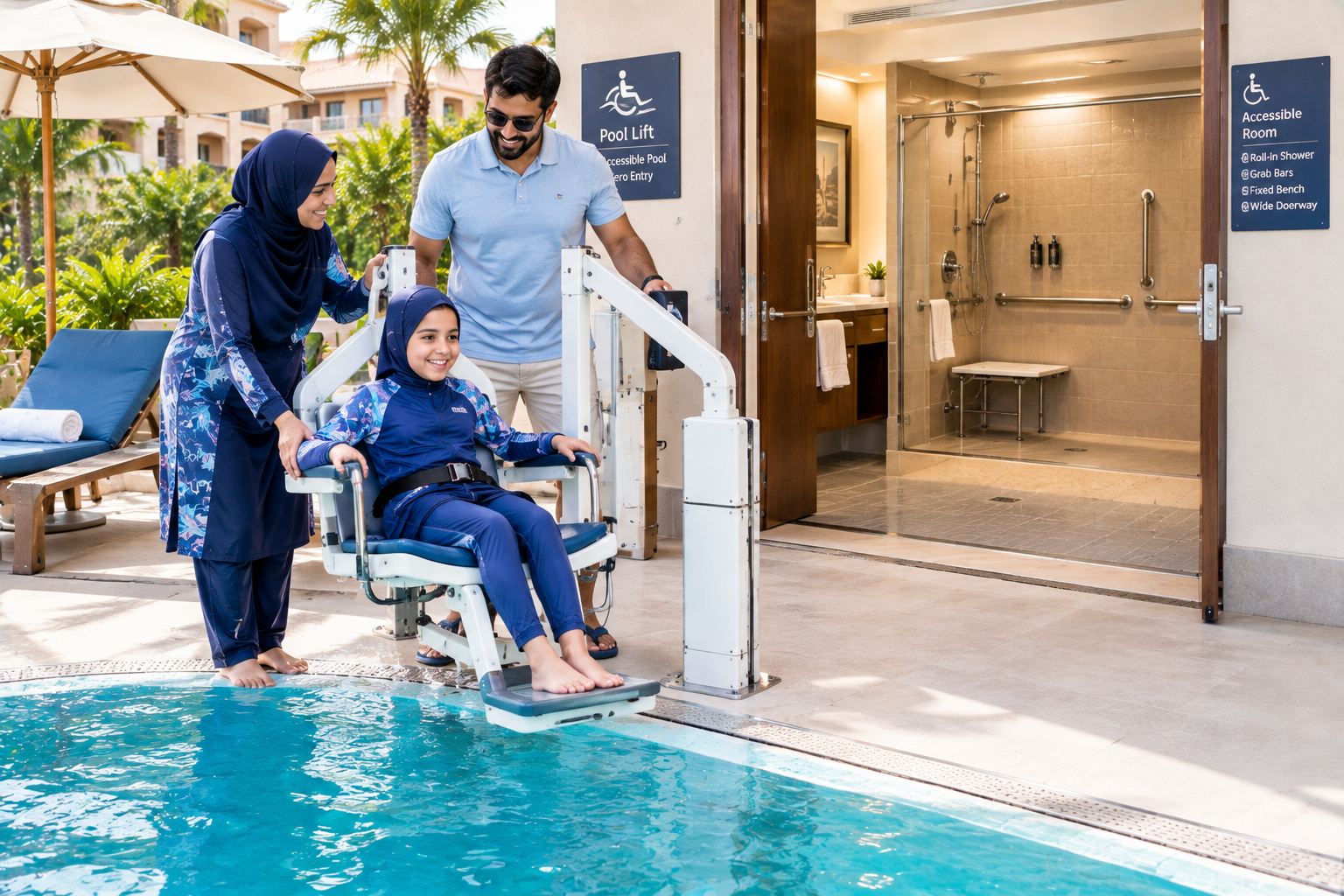
The essential accessibility features families should look for in hotels include roll-in showers with a fixed bench, enough space to turn a wheelchair around the beds, and guaranteed access to pools using a lift or ramp.
When booking accessible hotels for a family vacation, families must look for these features in three main areas: inside the room, inside the bathroom, and around the entire property. These details ensure safety and allow everyone to join in the family activities.
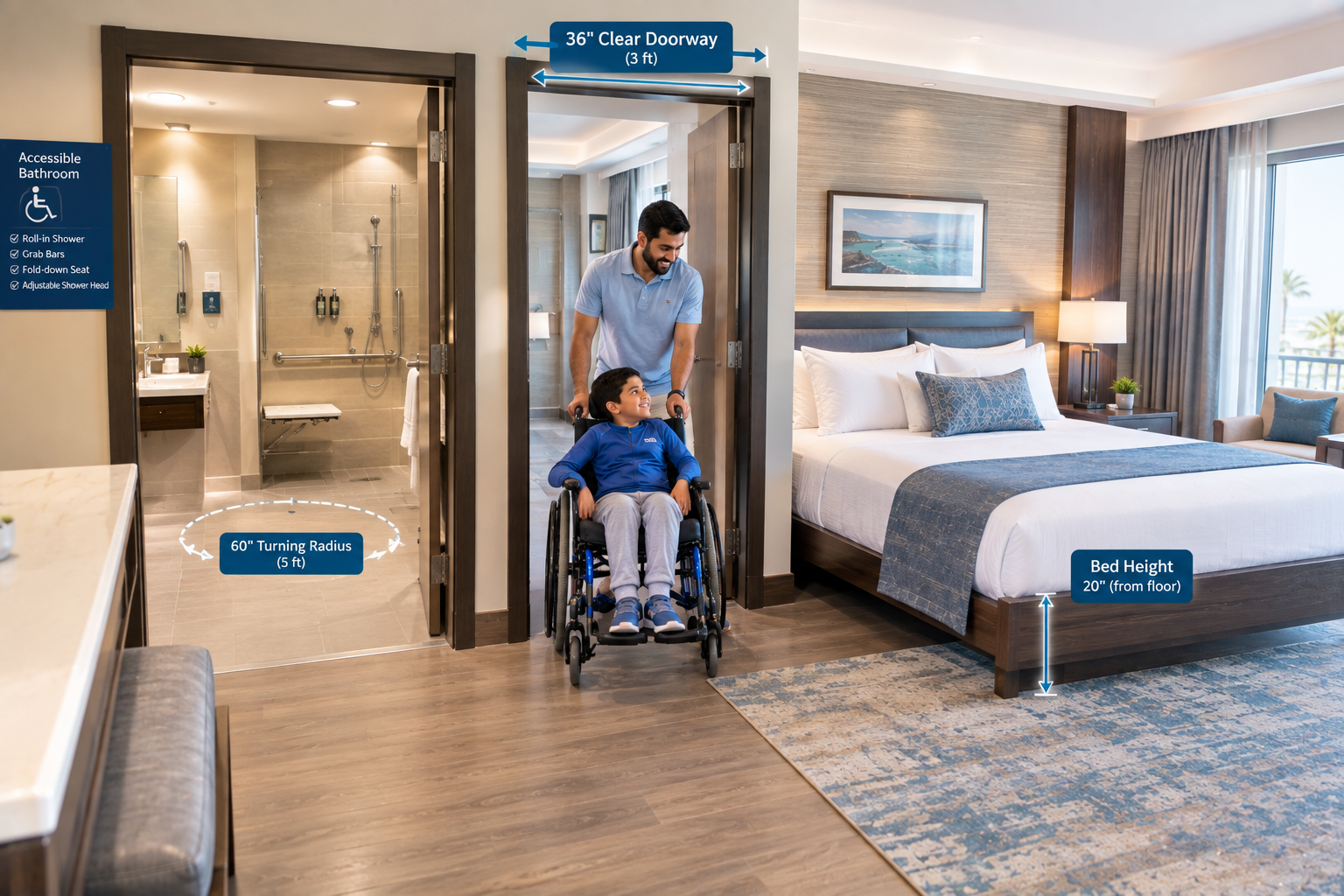
Beyond standard features, families should always ask about bed height. Many modern hotel beds are way too high for a person to safely transfer themselves from a wheelchair. This is a critical detail that is almost never listed on booking websites and can ruin a stay if you don’t check beforehand.
The ADA standards require hotels with more than 50 rooms to provide at least one room with a roll-in shower, a feature that is critical for wheelchair users.[1]
Author’s Experience
“As a parent, I’ve learned that a few extra inches of doorway width or a lower bed height can make all the difference for my child’s comfort and safety. It’s not just about following the rules; it’s about dignity and allowing everyone to have a truly joyful family vacation.”
How do family-specific needs impact hotel accessibility requirements?
Family-specific needs impact hotel accessibility requirements because families need more space, specific room setups, and ways to safely care for children with disabilities while traveling.
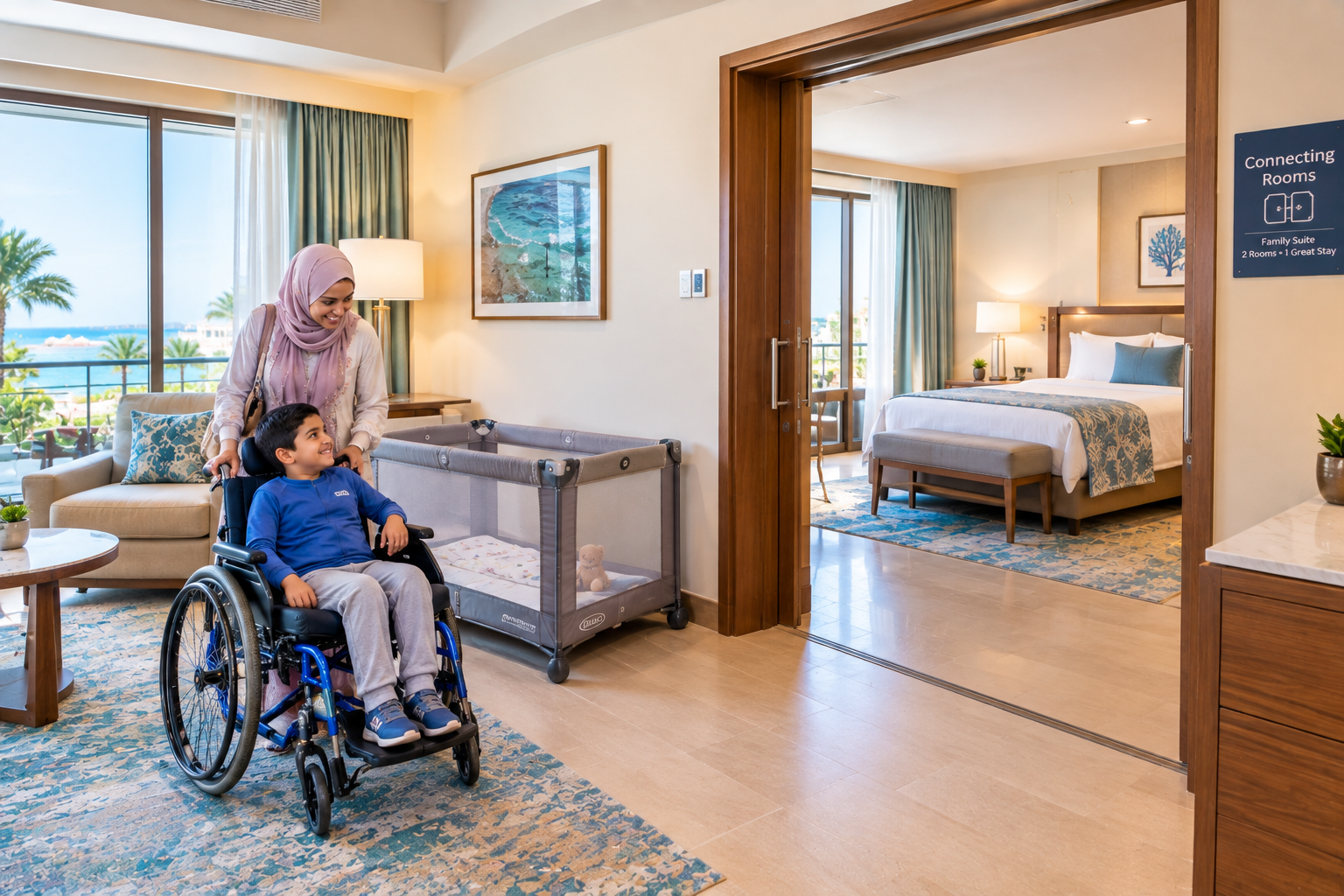
A standard accessible room meant for one person is often not enough for a whole family. Families usually need connecting rooms for caregivers, floor space for both a wheelchair and a baby’s travel crib, and to be close to amenities so they can manage their children’s schedules.
The need to keep medication cold in a refrigerator is a common family requirement. A standard tiny hotel mini-fridge might not be enough, and families often must request and confirm a medical-grade or larger refrigerator directly with the hotel staff.
When planning for specific needs like keeping medication cold, you might also find it helpful to learn more about how to travel with medical equipment on a family vacation.
About 8.8% of U.S. adults with disabilities use a motorized scooter or wheelchair, which are often larger and have specific charging needs that you must tell the hotel about.[2]
. Why is careful planning for accessible family hotel stays very important?
Careful planning for accessible family hotel stays is very important because it stops on-site failures that can put a child’s safety at risk, cost a lot of money, and ruin the whole vacation.
Good planning lowers the risk of arriving at a hotel that cannot actually meet your family’s needs, even if you received a confirmation email. It turns your booking from a risky gamble into a safe and predictable setup, giving you peace of mind.
The financial risk is more than just losing a hotel deposit. It includes the huge cost of booking a new room at the last minute, renting emergency equipment in a city you don’t know, or even having to end your vacation early.
Guaranteed vs. Requested Room: A “requested” accessible room on a booking website is not a promise. “Guaranteed” status is only given when you talk directly to the hotel and they send you written proof, which is a very important difference when planning.
The importance of planning is clear; the next step is to learn the best ways families can search for and check the right hotel options.
How does early booking benefit accessible family vacations?
Early booking benefits accessible family vacations by giving you a wider choice of suitable rooms, since the number of truly accessible family rooms is very small.
The benefits of booking early are clear, but for a deeper look into timing, consider reading when families should book accommodation for a family vacation.
Booking months in advance increases your chances of finding and locking in connecting rooms, ground-floor rooms, or specific suites that fit your entire family. It also gives you more time for the very important step of verifying details with the hotel staff.
Early booking gives families power. With more time, you can negotiate details, wait for a specific room type to become available, and have the freedom to walk away from a hotel that isn’t helpful—an option you don’t have when booking at the last minute.
Under the ADA guidelines, large hotels are often only required to make about 2% of their total rooms accessible, making them very hard to find and showing exactly why you need to book early.[4]
What risks can families avoid with thorough accessible hotel research?
With thorough accessible hotel research, families can avoid risks like physical danger from unsafe rooms, losing money on non-refundable bookings, and feeling left out of family activities.
Thorough research stops the nightmare of arriving to find a “roll-in shower” that is actually a bathtub, or a “pool” that has no way for a wheelchair to enter. It protects your money and, more importantly, keeps the family member with a disability safe and included.
A hidden risk is that hotels sometimes put accessible rooms in loud, bad locations (like right next to the ice machine or service elevator). Thorough research includes asking *where* the room is located in the building, a question that experienced travelers always ask.
In a survey, 80% of travelers with disabilities reported being given an “accessible” room that did not actually meet their specific needs, highlighting a major risk of poor research.[3]
. How do families effectively research accessible hotels for their vacation?
Families effectively research accessible hotels for their vacation by using a mix of hotel websites, booking sites, and first-hand reviews from disability forums.
The best way to research is to look at information from the hotel’s own website, check third-party booking sites that have accessibility filters, and read honest reviews from disabled travelers. No single website is enough to guarantee your booking is safe.
For a bigger picture on picking your stay, check out how to plan accommodation for a family vacation, which covers hotel types, when to book, and how to judge location and safety.
A smart trick is to use Google Images and search for “[Hotel Name] accessible room” or “[Hotel Name] roll-in shower.” This often shows real, unedited photos from past guests, which are much more trustworthy than the perfect photos posted by the hotel.
Online Travel Agency (OTA): Websites like Booking.com or Expedia. While they have filters for accessibility, these are known to be unreliable and should only be used to get ideas, not for making your final booking.
To help you decide which tool to use, let’s compare the strengths and weaknesses of the main research methods available to families.
| Method | Best For | Reliability | Key Weakness |
|---|---|---|---|
| Online Booking Sites (OTAs) | Initial discovery and broad search | Low (filters often unreliable) | Inaccurate accessibility information; lack of direct verification. |
| Hotel Websites | Accurate photos and floor plans | Medium (requires further verification) | Information can be generic; may lack specific accessible details. |
| Disability Vacation Agencies | Complex itineraries, first-time accessible travelers | High (expert verification) | Can be more expensive; requires lead time. |
| Community Forums & Reviews | First-hand experiences, recent feedback | Medium (depends on recency and detail) | Information can be outdated or subjective; not a booking channel. |
Which online platforms reliably list accessible hotels for family stays?
The online platforms that reliably list accessible hotels for family stays are usually specialized websites or brand-specific platforms like Marriott, though no site gives a 100% guarantee without calling.
While no major booking site is perfect, specialized websites offer better-checked lists. For regular options, booking directly on a brand’s specific website (like Marriott’s) usually gives you much more detailed accessibility info than third-party competitors.
The trick to using these platforms is looking at the *date* of reviews from other disabled travelers. An accessible room can stop being compliant if something breaks (like a pool lift), so a great review from two years ago is much less helpful than one from two months ago.
What role do disability travel agencies play in booking accessible family hotels?
Disability travel agencies play the role of expert verifiers in booking accessible family hotels, using their knowledge to call hotels, ask the hard questions, and get written guarantees for you.
These specialist agents take the stress away by calling the hotels, making sure the rooms actually fit your needs, and securing written promises. They are extremely helpful for families planning a vacation with multiple stops or for those who have never planned an accessible vacation before.
An experienced disability vacation planner often has a database of hotels they have personally checked, including exact room numbers. This insider knowledge is something a family cannot easily get on their own, and it’s the main reason their service is worth the fee.
. What key criteria should families use to review accessible hotel options?
The key criteria families should use to review accessible hotel options go beyond just the bedroom to include bathroom setup, common area access, staff training, and property location.
A truly great accessible hotel scores high in all these areas, offering not just a room that follows the rules, but a welcoming experience that includes the whole family. You must look at how well the entire property supports your vacation.
A very important but often forgotten criteria is staff training. A physically perfect hotel can still be a terrible experience if the staff doesn’t understand accessibility or isn’t willing to help. Asking if the staff has disability awareness training is a great way to see if the hotel truly cares.
Certified Autism Center™ (CAC): A special label given to organizations that have finished deep training to serve people with autism. For families with sensory needs, picking a hotel with this certification is a massive plus.
How important are specific room dimensions and bathroom setups for family accessibility?
Specific room dimensions and bathroom setups are extremely important for family accessibility because they decide if a wheelchair user can move freely, if medical equipment will fit, and if everyone can share the space comfortably.
Measurements like a 36-inch wide doorway and a 60-inch space to turn around in the bathroom are not just suggestions; they are absolute must-haves for a wheelchair to move. Whether the bathroom has a roll-in shower or just a transfer tub can be the deciding factor on whether you book the room.
Where the toilet is placed is just as important as how tall it is. If a toilet is shoved into a corner without empty floor space next to it, a person cannot slide over from their wheelchair. Basic accessibility checklists often miss this tiny but crucial detail.
In the USA, accessible hotel beds can be much higher than in other countries, sometimes reaching up to 30 inches high, which can make getting into bed very difficult or impossible without planning ahead.
Why should families ask about hotel staff training in disability awareness?
Families should ask about hotel staff training in disability awareness because helpful and trained staff are needed to solve problems quickly and ensure your family feels welcomed, rather than feeling like a burden.
Staff with proper training can give you accurate answers about accessibility during the booking process and can offer proactive help when you arrive, like showing you the easiest route to the pool. Untrained staff often give wrong information, which leads to booking errors and ruined vacations.
Asking “What do you do if a guest arrives and their guaranteed accessible room is not available?” is a powerful test. A well-trained hotel will have a clear, step-by-step plan for this exact emergency, while an unprepared hotel will give a vague answer, revealing a huge red flag.
. How can families verify accessible hotel features before booking their stay?
Families can verify accessible hotel features before booking their stay by speaking directly to the hotel staff on the phone and then asking for photos or a video tour of the exact room.
The only way to be completely sure of the features is to call the hotel’s front desk directly (do not call a central 1-800 reservations line) and ask very specific questions. After that chat, ask them to email you recent photos or a quick video of the exact room you plan to book.
When you call, ask to speak to the “Front Office Manager” or “Director of Rooms.” These people work on the property every day and know exactly what the rooms look like, unlike a call center agent who might be in another country.
Visual Verification: The process of getting recent, real-life photos or videos of a hotel room’s exact features (like the shower or bed space) to prove that the staff’s descriptions are true before you pay.
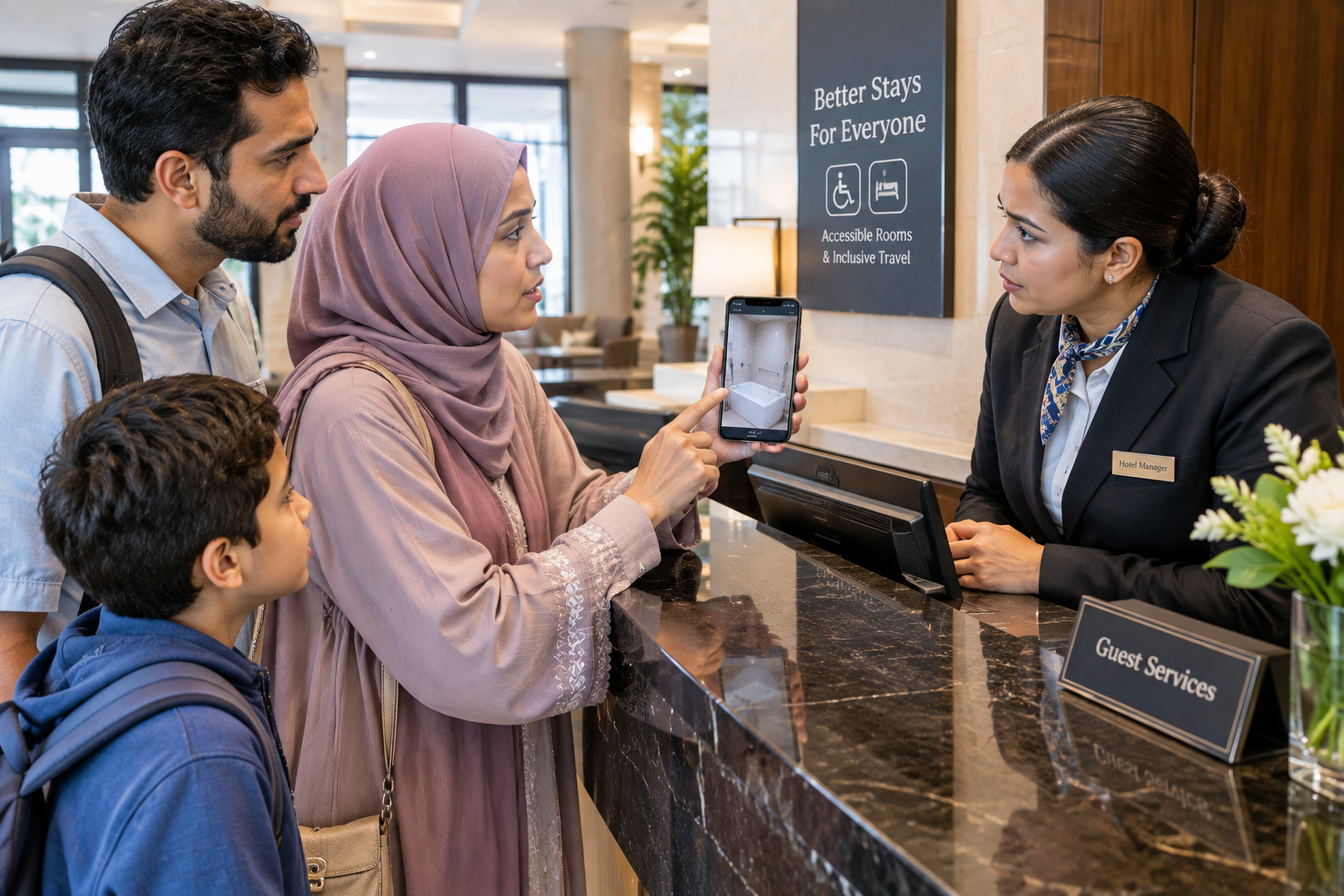
What specific questions should families ask hotel staff about accessibility?
The specific questions families should ask hotel staff about accessibility include exact bed heights, the type of shower bench, and whether there are steps on the path to the pool.
Don’t just ask, “Do you have an accessible room?” Instead, ask:
- “What is the exact height of the bed frame from the floor to the top of the mattress?”
- “Does the roll-in shower have a bolted, fold-down bench, or is it just a loose plastic chair?”
- “What is the walkway like from our room to the pool? Are there any curbs or steps?”
- “Can you reserve this exact room number for my family?”
- “Does the shower have absolutely no lip on the floor so a wheelchair can roll right in?”
Ask, “Can you block this specific room number for my reservation?” While they can’t always say yes, asking this proves you are a serious traveler. In some hotel computer systems, they can lock in a specific room for you, giving you the best guarantee possible.
Because many hotels in the USA have ADA-compliant rooms that actually just have bathtubs with a seat instead of a flat shower floor, you absolutely must ask, “Does the room have a true roll-in shower with no lip, or is it a tub?”
How can visual verification tools aid in confirming accessible accommodations?
Visual verification tools can aid in confirming accessible accommodations by showing you current, real-life photos or videos of the room, proving that the hotel’s words match reality.
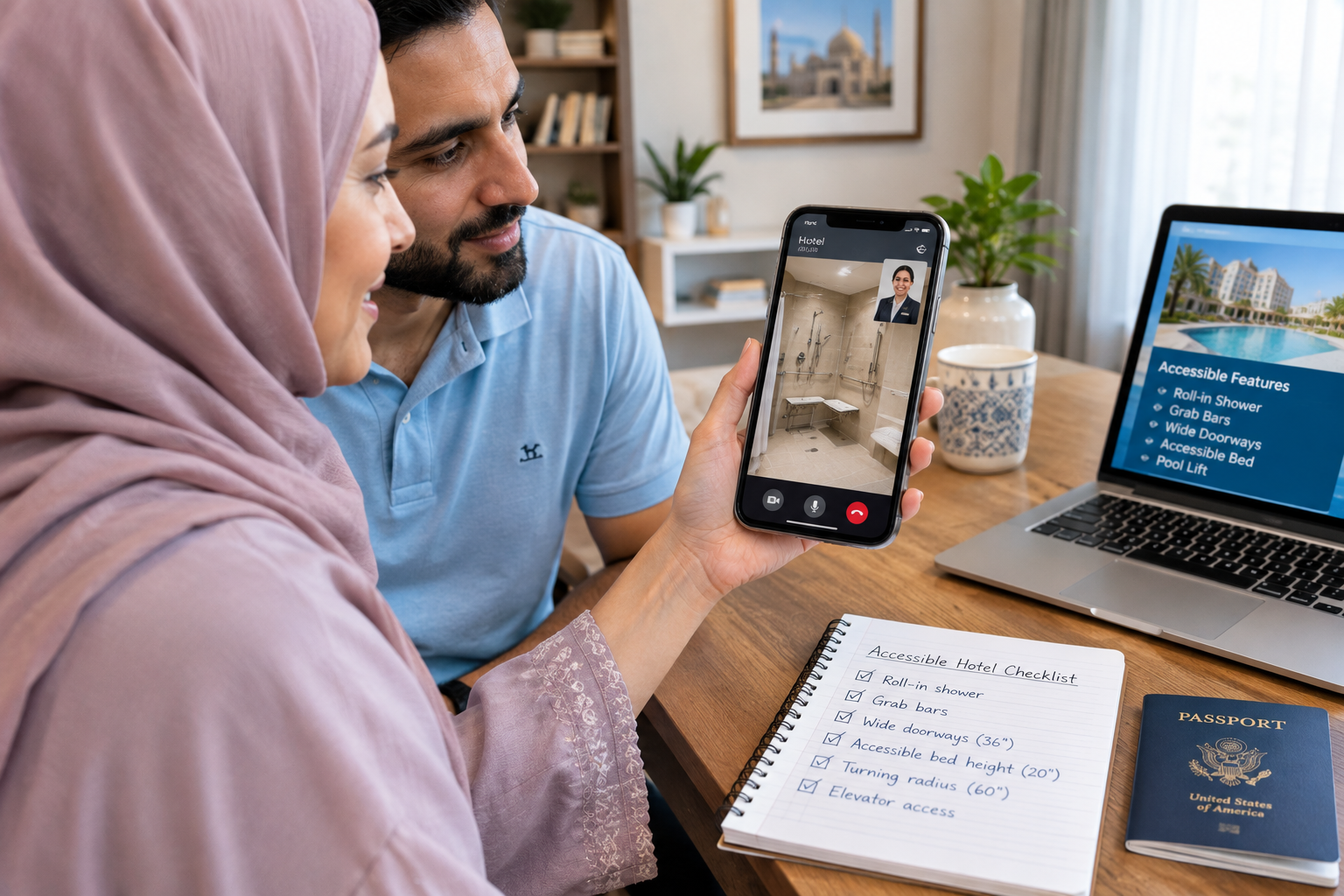
After a good phone call, ask the staff member to email you fresh photos of the bathroom, the space around the bed, and the lobby. If you want the ultimate proof, a live video call (like FaceTime or WhatsApp) to “tour” the room is the absolute best option.
When asking for photos, tell them clearly that you do not want the perfect, edited pictures from their website. Ask for photos taken “right now, with your phone” so you can see exactly what the room looks like today, including any broken features.
. What is the step-by-step process for booking accessible hotels for a family vacation?
The step-by-step process for booking accessible hotels for a family vacation involves writing down your exact needs, calling the hotel to ask specific questions, making the booking, and sending an email to get written confirmation.
This process begins with making a list of everything your family needs. Then, you find and check a good hotel using the tips we talked about. Finally, you book the room directly with the hotel and get them to promise in writing that they will meet your needs.
One crucial step that families often forget is calling the hotel again 48 to 72 hours before arriving. Call the front desk, give them your confirmation number, and ask them to read back your specific room type and accessibility features to catch any last-minute errors.
Booking Confirmation Email: This is not the automatic email receipt you get after paying. This is an email *you* send to the staff member you spoke with, listing everything you agreed on, and asking them to reply to confirm it in writing.
How should families prepare their specific accessibility requirements for booking?
Families should prepare their specific accessibility requirements for booking by creating a written list of ‘must-haves’ and ‘nice-to-haves’ to use as a script when calling the hotel.
Make a “Needs List” that includes essential things like “roll-in shower,” “bed height under 22 inches,” “clear space for a portable lift,” and “connecting room for a caregiver.” This list keeps you organized during your phone call.
By splitting your list into “Must-Haves” and “Nice-to-Haves,” you can make decisions faster. If a hotel has all your must-haves but is missing a nice-to-have, you can feel safe booking it. It also makes comparing two different hotels much easier.
What essential details must be confirmed during the accessible hotel booking process?
The essential details that must be confirmed during the accessible hotel booking process are the specific room type, the exact accessibility features, the room’s location, and the name of the agent you spoke with.
Before you give them your credit card, ask the agent to repeat the summary of your accessible room guarantee back to you. After that, make sure you write down your confirmation number and the agent’s name, which you will need for your email.
Ask about the hotel’s policy if they accidentally overbook. Ask, “If you overbook, what is your exact plan for moving a guest who requires an accessible room?” A trustworthy hotel will have a clear, safe plan for this exact scenario.
Some UK hotel brands may give you a connecting room for free for a caregiver if the person with a disability needs help. This is a very important detail to ask about during booking.
. How can families ensure their specific accessibility needs are communicated and guaranteed?
Families can ensure their specific accessibility needs are communicated and guaranteed by sending an email right after booking that lists everything discussed and asking the hotel to reply to confirm it.
This critical step adds to what you learned in how to request hotel accommodations for a special needs vacation, ensuring no details are missed.
After hanging up the phone, immediately send an email to the hotel (to the exact person you spoke to, if possible). Summarize your chat, list the guaranteed accessible features, and include your confirmation number. Ask them to reply, which acts as your written proof.
The subject line of your email is very important. Use something like: “Confirmation Required: Accessible Room Details for [Your Name] – Confirmation #[Number].” This subject tells the staff exactly what the email is about and shows it is urgent.
Paper Trail: A chain of written documents (like emails) that proves what was agreed upon. In accessible travel, this is your best tool to hold the hotel accountable.
Subject: Confirmation Required: Accessible Room Details for [Guest Name] - Confirmation #[Confirmation #]

Dear [Hotel Staff Name],

This email is to confirm my reservation for [Guest Name] at your hotel from [Dates of Stay]. Our confirmation number is #[Confirmation #].

During our phone conversation today, we specifically discussed and confirmed the following accessible features:
* [Confirmed Feature 1, e.g., Roll-in shower with grab bars]
* [Confirmed Feature 2, e.g., Bed height under 22 inches]
* [Confirmed Feature 3, e.g., Connecting room with two queen beds]

Please reply to this email to confirm your understanding and guarantee that these specific features will be available for our stay.

Thank you,
[Your Name]
What information about family accessibility needs is crucial to provide during booking?
The information about family accessibility needs that is crucial to provide during booking includes the specific type of disability, the number of guests, and exact equipment needs, like a power wheelchair.
Be clear and short. Instead of saying “We need an accessible room,” say, “We are a family of four. We need a room with two queen beds and a roll-in shower because my husband uses a large power wheelchair.”
Telling the hotel *why* you need something can be very helpful. For example, “We need the connecting room because my son needs medical help at night, and I need to get to him instantly.” This extra detail often makes the hotel take your request more seriously.
Why is obtaining written confirmation of accessible features vital for families?
Obtaining written confirmation of accessible features is vital for families because it gives you written proof of the hotel’s promise, which you can use to demand a fix if the room is wrong when you arrive.
A written confirmation (like an email reply) gives you power. Without it, the hotel can easily say they never made that promise, leaving your family stuck with a room that doesn’t work.
The written proof isn’t just for arguing with the hotel. If you booked through a vacation agent and something goes wrong, you can show them this email to prove the hotel messed up, making it easier to get a refund or help finding a new room.
. How can families avoid common mistakes when booking accessible hotels?
Families can avoid common mistakes when booking accessible hotels by never trusting vague promises, avoiding third-party booking sites for the final booking, and never assuming that “ADA-compliant” means it fits their family’s exact needs.
The biggest mistakes are trusting a tiny “accessible” checkbox on a booking website, booking too late, and failing to get a written promise. If you avoid these three traps, you are much more likely to have a perfect stay.
A very common mistake is thinking that every hotel in a big chain is the same. An accessible room at a brand-new hotel in Orlando can be completely different from an accessible room at the exact same brand of hotel in an old building in Boston. You must check each one carefully.
“Floating” Accessible Rooms: This is a trick where a hotel sells more accessible rooms than they actually have, hoping to somehow make it work when you arrive. Booking directly and confirming early helps defeat this bad practice.
What are the most frequent booking errors families make with accessible rooms?
The most frequent booking errors families make with accessible rooms are clicking ‘book’ on a website without calling the hotel, booking a room with only one bed when two are needed, and not getting written proof.
Other common mistakes include failing to tell the hotel exactly what kind of shower you need (a true roll-in shower vs. a bathtub with bars) and forgetting to ask about the height of the beds.
A very sneaky mistake is booking an “adjoining” room instead of a “connecting” room. Connecting rooms have a door directly between them inside. Adjoining rooms are just next to each other in the hallway. If you need a room for a caregiver, an adjoining room is completely useless.
How does last-minute booking hurt accessible hotel options for families?
Last-minute booking hurts accessible hotel options for families by wiping out the few available rooms and forcing you to accept bad locations or rooms out of desperation.
When you wait until the last minute to book, you have to take whatever single accessible room is left, even if it’s right next to a loud elevator. This takes away your power to choose and greatly increases the chance that your vacation will be ruined by a bad room.
Booking at the last minute also means you can’t use a specialized disability vacation agent, because they need time to do their research and make calls. It also makes it impossible to rent special medical equipment and have it delivered to the hotel before you arrive.
. What should families do if accessible hotel accommodations fall short upon arrival?
If accessible hotel accommodations fall short upon arrival, families should not unpack, take photos of the wrong features, and immediately go to the front desk with their written confirmation to ask for a fix.
Do not open your suitcases. Go straight back to the front desk, show them your printed email confirmation, and calmly explain that the room is not what they promised. Tell them exactly what is wrong and what you need them to do to fix it.
Before you even walk down to the lobby, use your phone to take clear photos or videos of the broken or wrong features in the room. This proof is super important if you have to complain to the hotel’s corporate office or your credit card company later.
Chargeback: This is when you call your credit card company to cancel a payment because the hotel didn’t give you what you paid for. It is a very powerful tool if the hotel completely fails you and refuses to give your money back.
What immediate steps should families take to address inaccessible hotel features?
The immediate steps families should take to address inaccessible hotel features are to document the problem with photos, present the written proof to the manager, and clearly state what needs to be fixed.
- Take pictures to prove the room is wrong.
- Show your written email promise to the top manager working that day.
- Clearly state the exact problem and how they need to solve it.
First, get your photo evidence. Second, ask to speak to the manager in charge, not the regular front desk worker. Third, be firm and clear: “You promised a roll-in shower, but this is a bathtub. You need to move us to the correct room immediately, or pay for us to stay at a nearby hotel that has one.”
Ask the manager, “What is your official ADA compliance rule for when this happens?” Asking this shows you know your rights and forces them to treat the issue as a serious legal problem, not just a minor customer complaint.
How can families escalate unresolved accessibility issues with hotel management or booking agencies?
Families can escalate unresolved accessibility issues with hotel management or booking agencies by calling the hotel chain’s corporate customer service line and filing a formal complaint using their photo evidence.
- Call the main corporate office for the hotel chain.
- Call the website or agent you used to book the trip.
- File an official ADA complaint with the government.
If the manager at the hotel won’t help you, your very next phone call should be to the massive corporate office that owns the hotel brand. Give them your confirmation number and tell them you have photos. If you used a vacation website to book, call them too and report the hotel.
When dealing with the big corporate office, use social media. A polite but firm message on X (Twitter) directly to the hotel brand, showing a picture of the problem, will usually get a much faster fix from their social media team than calling the regular 1-800 number.
. Logistics: Accessible Hotel Booking Checklist
| Checklist Item / Tactic | Status |
|---|---|
| Pre-Booking Phase: Document your family’s exact needs in a detailed list (must-haves and nice-to-haves). | ⬜ |
| During Booking Phase: Call the hotel’s front office/reservations, ask specific questions, get verbal confirmation, and obtain a confirmation number. | ⬜ |
| Post-Booking Phase: Send a follow-up email summarizing the conversation and confirmed features, requesting a written reply; re-confirm all details 48-72 hours before arrival. | ⬜ |
Resolution
Ultimately, booking accessible hotels for a family vacation is an act of careful planning that transforms a stressful gamble into a safe and successful foundation for a wonderful trip. The whole process relies on a simple routine: research carefully, verify everything directly on the phone, and demand written proof. By mastering these simple steps, families take control, lower their risks, and make sure their vacation is filled with happy memories, not hotel nightmares. The skills and confidence you gain from successfully booking one accessible vacation will make every future trip much easier to plan.