When should you apply for family vacation travel documents?
Table of Contents
You should apply for family vacation travel documents at least 6 to 9 months before your departure date. This elite planning window guarantees adequate time to secure new passports, complete complex visa applications, and absorb unexpected processing delays without risking your financial investment.
Before diving into the granular specifics of document timelines, it’s essential to understand how this fits into the broader process of How to Plan a Family Vacation Step by Step.
2. Why is early application crucial for family vacation travel documents?
This detailed guide forms a crucial part of learning How Do You Plan the Travel Documents for a Family Vacation? effectively.
Early application is crucial for family vacation travel documents because government processing times are long and unpredictable, creating significant risks of financial loss and trip cancellation.
The primary reason for early application is to buffer against variable processing times for passports and visas, which can take months. This foresight prevents the need for expensive expedited services and safeguards the entire vacation investment from being lost due to documentation delays.
Beyond standard processing times, factors like peak travel seasons (spring and summer) can create application backlogs, extending wait times unexpectedly. A family applying in January has a significant logistical advantage over a family applying in May for the same summer trip.
Processing Time: The period from when a government agency receives your application to when it is approved and mailed, which does not include the time it takes for mail delivery on either end.
Choose to begin the application process the moment you decide on an international destination region, even before booking flights or hotels. This action decouples the logistical stress of documents from the financial commitment of booking.
Understanding the necessity of an early start naturally leads to identifying the specific risks families face when this advice is ignored.
What risks do families face with last-minute family travel document applications?
The primary risks families face with last-minute document applications are catastrophic financial loss from non-refundable bookings and the high probability of forced vacation cancellation.
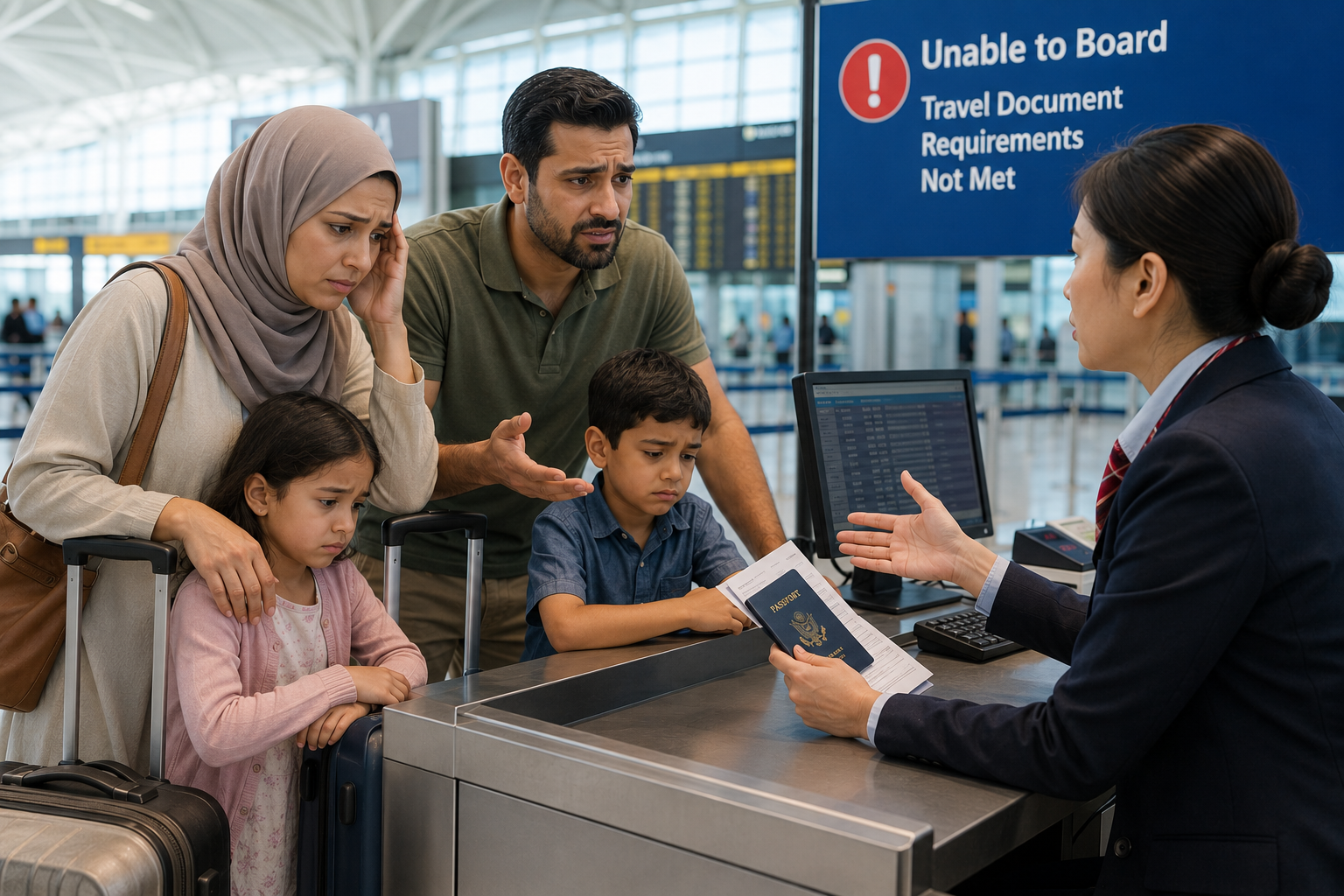
Procrastinating on applications exposes a family to paying hundreds of dollars in expediting fees per person, facing sold-out appointments at passport agencies, and discovering issues (like missing parental consent) with no time to resolve them. The ultimate risk is being denied boarding at the airport, forfeiting the entire cost of the trip. According to industry data, American families spend thousands on average for a summer vacation, an entire investment that is put at risk by a passport or visa delay. A comprehensive travel documents checklist can help avoid these issues.
A less-obvious risk is the “domino effect of denial,” where one family member’s document delay (e.g., a child’s passport) legally prevents the entire family from traveling, even if others have their documents ready.
What essential travel documents do families typically need for vacations?
For most international family vacations, the essential travel documents required are a valid passport for every family member, including infants, and potentially a tourist visa depending on the destination.
If only one parent is traveling, it’s vital to confirm: Do You Need a Permission Letter for a Family Vacation?
The core document is the U.S. passport. Beyond that, families must verify if their destination requires a visa, an International Driving Permit (IDP) for renting a car, or specific health certificates like vaccination proof. The U.S. Department of State issues millions of passports annually, underscoring the document’s central role in international travel and the high volume of applications that can lead to delays.
Many families overlook the need for a notarized travel consent letter if only one parent is traveling with a minor, a document often requested by foreign immigration officials to prevent parental kidnapping.
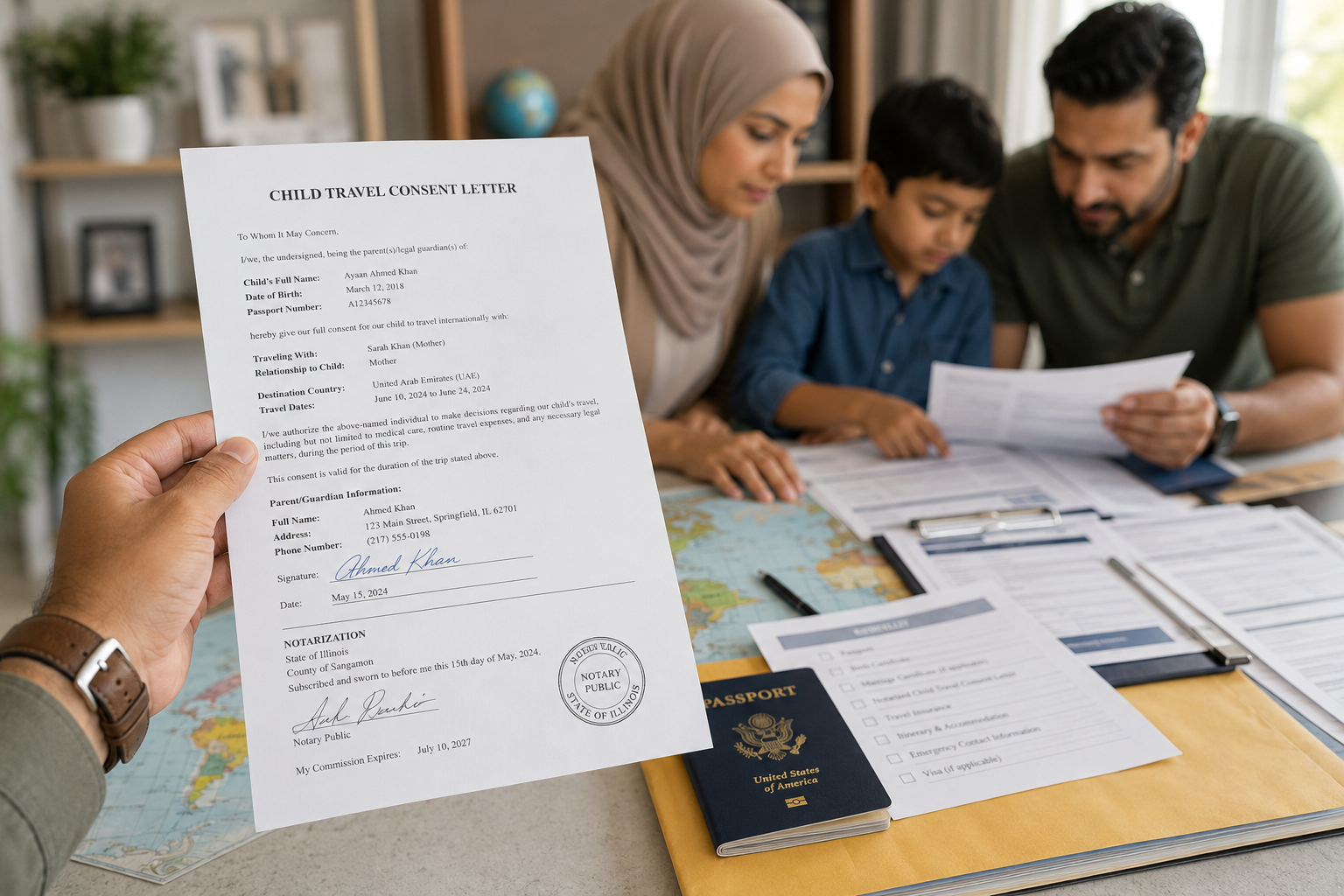
Essential Documents Checklist
- Valid Passport for every family member (including infants).
- Tourist Visa (if required by destination country).
- International Driving Permit (IDP) for car rentals.
- Health Certificates/Vaccination Proof (if applicable).
- Notarized Travel Consent Letter (if one parent is traveling with minors).
3. What factors influence the ideal application timeline for family vacation travel documents?
For many families, a primary concern revolves around the requirements for minors, often prompting the question: Do Children Need Passports for a Family Vacation?
To prevent unexpected issues with travel, understanding specific requirements such as What Are the Passport Validity Rules for Family Travel? is essential.
The ideal application timeline for family vacation travel documents is influenced by three primary factors: the travel destination, the age and citizenship status of each family member, and current government processing speeds.
Your destination dictates whether a simple passport is sufficient or if a complex, multi-week visa process is necessary. The age of family members, especially the need for new child passports, adds significant time and documentation requirements compared to simple adult renewals.
A crucial, often-missed factor is the “passport validity rule” (six-month rule), where many countries require a passport to be valid for six months *beyond* the planned departure date, potentially invalidating a seemingly current passport.
Passport Validity Rule: A common international travel requirement stipulating that a visitor’s passport must have a minimum of six months of validity remaining from the date of entry or departure from the foreign country.
If you have a child approaching age 16, prioritize their passport renewal immediately, as they will transition from a 5-year child passport to a 10-year adult passport, a process that cannot be done by mail.
Analyzing these broad factors allows us to drill down into how each one specifically impacts your family’s planning.
How does your family’s travel destination impact document application timing?
Your family’s travel destination directly impacts document application timing by determining whether a time-consuming visa application is required in addition to obtaining passports.
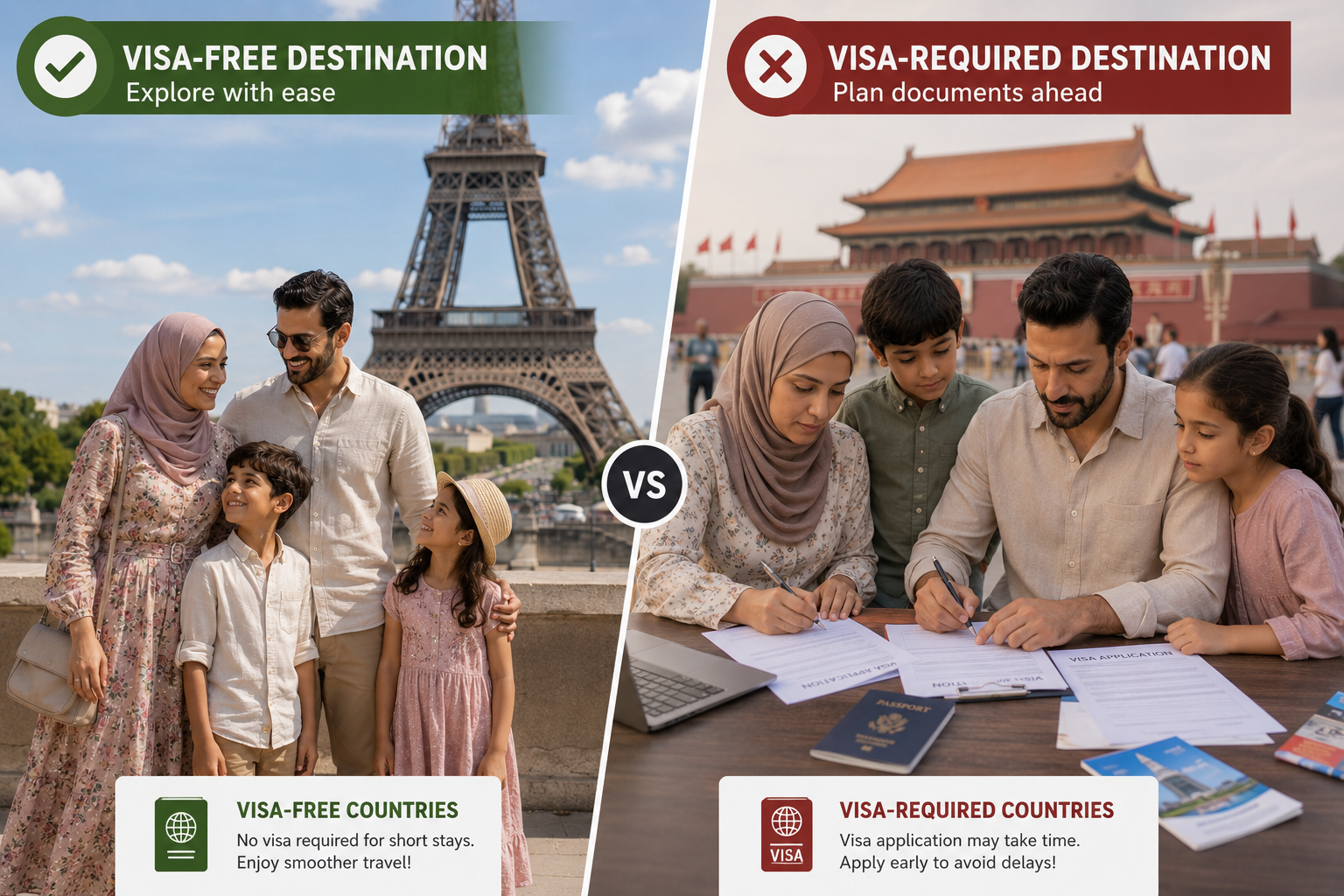
Traveling to visa-free regions for U.S. citizens, like most of Europe or Canada, means your timeline is dictated solely by passport processing. Destinations like China, India, Brazil, or Vietnam require separate visa applications that can add 1-3 months of processing time after you have the physical passport in hand. For the Schengen Area in Europe, standard visa processing is officially 15 calendar days, but authorities can extend this period to 45 days in individual cases, adding significant time to a family’s schedule.
Some countries have electronic travel authorizations (ETAs) like Europe’s upcoming ETIAS. While not a full visa, this is an additional required step that families must complete online before travel, adding another item to the pre-trip checklist.
Micro-Glossary
Visa-Free Travel: An international agreement allowing citizens from participating countries to enter another nation for tourism or business. This permits stays for a limited period, typically up to 90 days, without the necessity of obtaining a formal visa beforehand, simplifying short-term travel logistics significantly.
How do the ages of family members affect travel document application times?
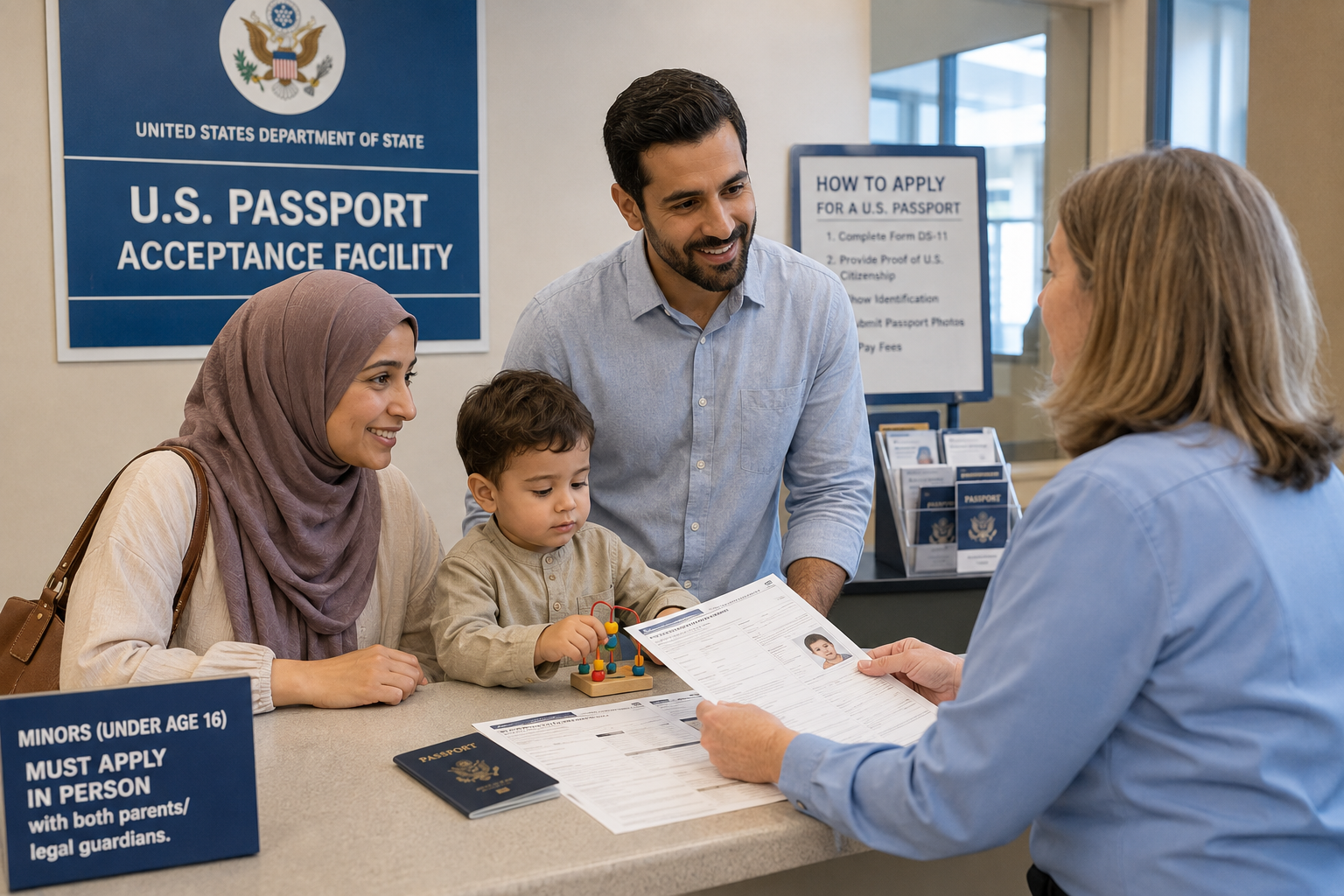
The ages of family members significantly affect travel document application times because all children under 16 require a new passport for every application, a process that cannot be done by mail and mandates the in-person appearance of the child and parents.
Unlike adult renewals which can be mailed, a child’s passport application (Form DS-11) requires a scheduled appointment at a Passport Acceptance Facility. It also demands original proof of citizenship and parental relationship, plus the consent of both parents, adding logistical hurdles and time. A U.S. passport issued to a child under age 16 is only valid for five years, unlike the 10-year validity for adult passports, requiring parents to track expiration dates much more frequently.
The “two-parent consent” rule is absolute. If one parent cannot attend the appointment, they must provide a signed and notarized consent form (DS-3053), a step that can cause significant delays if not prepared in advance.
What is the current processing speed for family vacation travel documents?
The current processing speed for family vacation travel documents, specifically U.S. passports, is dictated by the U.S. Department of State and fluctuates based on application volume.
Families must check the official U.S. Department of State website for the most up-to-date routine and expedited processing times before they apply. These times represent the period the application is at the agency and do not include mailing time, which can add several weeks to the total duration.
“Processing time” is a frequently misunderstood metric. It begins the day the agency *receives* the application, not the day you mail it, a distinction that can add 1-2 weeks of “in-transit” time to your personal timeline.
4. Which family travel documents require the longest application lead times?
For families planning international travel, a new passport and a consular-processed visa are the two family travel documents that require the longest application lead times.
A new passport application, especially for a child, is the first and longest hurdle, establishing the baseline for your timeline. A visa for a country that requires an in-person interview or extensive documentation runs a close second and can only be started *after* the passport is secured.
The acquisition of supporting documents, like a certified copy of a birth certificate from a state vital records office, can be a hidden bottleneck, sometimes taking 4-8 weeks itself and delaying the start of the primary passport application.
Consular Processing: A visa application process that requires review, and sometimes an in-person interview, at an embassy or consulate of the destination country, making it significantly longer than an electronic authorization.
Prioritize securing passports for every family member first. This document is the foundational key that unlocks all other necessary applications, like visas.
With this priority list established, it’s critical to understand the specific timing differences between new and renewal applications.
When should families prioritize applying for passports over other documents?
Families should always prioritize applying for passports over other documents because a valid passport is a mandatory prerequisite for nearly all other international travel documents, including visas.
The passport application should be the first action item on any family’s international travel checklist. Without a physical passport book with at least six months of validity, you cannot submit a visa application, book certain international flights, or prove citizenship for re-entry.
Even for “closed-loop” cruises that may not technically require a passport, having one is a critical safety net. If a family member has a medical emergency and needs to be flown home from a foreign port, a passport is non-negotiable.
How does renewing family passports compare to applying for new ones regarding timing?
Renewing an eligible adult family member’s passport is typically faster and logistically simpler than applying for a new one, as it can be done by mail without an in-person appointment.
An adult renewal using Form DS-82 by mail eliminates the need to schedule and attend an appointment at an acceptance facility. However, all child passports and first-time adult passports require the more time-consuming in-person process using Form DS-11. A key timing difference is that U.S. passports issued to children under 16 are valid for only five years, whereas passports issued at age 16 or older are valid for ten years, impacting how frequently a renewal process is required.
The key eligibility requirement for a mail-in renewal (Form DS-82) is that your most recent passport is in your possession, was issued when you were 16 or older, and was issued within the last 15 years. If any of these are not true, you must apply in person as if it were a new passport.
5. How do specific destination requirements influence when families should apply for travel documents?
Specific destination requirements are a primary driver of when families should apply for travel documents, directly controlling the complexity, cost, and length of the application process.
A destination’s visa policy is the most significant requirement influencing your timeline. Visa-free countries allow you to focus only on passport lead times, while visa-required countries add a second, often lengthy, application layer that must be factored in from the very beginning.
Beyond visas, some adventure-tourism destinations (e.g., for trekking in Nepal or visiting certain parts of Brazil) may require specific vaccination certificates or travel insurance policies that must be purchased and documented weeks or months in advance.
Visa-Free Travel: An international agreement allowing citizens from participating countries to enter another nation for tourism or business. This permits stays for a limited period, typically up to 90 days, without the necessity of obtaining a formal visa beforehand, simplifying short-term travel logistics significantly.
If your family desires a spontaneous international trip (less than 4 months away), choose a destination from the visa-free list for U.S. citizens to ensure feasibility.
This high-level overview of destination types makes it clear that understanding the visa process for your specific country of choice is the next critical step.
When should families apply for visas based on their chosen country?
Families should apply for visas based on their chosen country’s specific rules, typically beginning the process 3-4 months before departure, but only after all family members have secured their valid passports.
The ideal time to apply for a visa is a balancing act. You must apply early enough to accommodate consular processing, but not so early that the visa expires before your trip, as some visas are only valid for 90 days from the date of issue. Consulates typically do not allow a visa application to be submitted more than 60-90 days before the intended travel date, creating a firm start date for the visa timeline.
Do not assume all family members have the same visa requirements. Citizenship is the determining factor; if a family member holds a different passport (e.g., a non-U.S. citizen spouse or parent), their visa requirements for the destination may be completely different.
6. How can families create a practical timeline for applying for all travel documents?
Families can create a practical timeline for applying for all travel documents by using a “backward planning” method, starting with their departure date and working backward in phases of 9-12 months, 6-9 months, and 3-6 months out.
This structured timeline involves using the 9-12 month window for research and document gathering, the 6-9 month window for submitting primary applications like passports and visas, and the final 3-6 month window for follow-ups and secondary documents like IDPs. This phased approach prevents last-minute chaos.
A pro-tip for this timeline is to add digital calendar reminders for key dates, such as “Follow up on passport status” 8 weeks after application or “Draft child travel consent letter” 2 months before the trip. This automates the management process.
Backward Planning: A strategic project management technique starting with the final deadline, such as a vacation departure date, and then mapping out all necessary steps in reverse chronological order. This ensures timely completion of prerequisites, like document applications, by proactively identifying critical milestones and avoiding last-minute rushes.
Use the provided checklist as your master plan. Print it and post it where the family can see it to maintain focus and accountability throughout the process.
This master checklist provides the ‘what’ and ‘when’; now let’s detail the key milestones you’ll track along the way.
What are the key milestones in a family’s travel document application timeline?
The key milestones in a family’s travel document application timeline are: 1) Completion of Research, 2) Submission of All Applications, and 3) Confirmation of Receipt of all physical documents.
The first milestone is confirming all requirements for your specific trip. The second, and most critical, is the date all passport and visa applications have been successfully submitted. The final milestone is having every required document, for every family member, physically in your possession. Based on current processing data, creating milestones within a six-month window provides the minimum safe period to mitigate risks from unexpected travel document delays.
An unofficial but crucial milestone is the “Document Digitization” phase. Once all physical documents are received, scanning and saving secure digital copies to a cloud service (like Google Drive or Dropbox) creates a vital backup in case of loss or theft during travel.
7. What steps should families follow to efficiently apply for passports for all members?
To efficiently apply for passports for all members, families must follow a rigorous, methodical process of preparing forms, gathering original documents, and attending in-person appointments for any new applicants.
The process involves correctly completing the appropriate form online (DS-11 for new, DS-82 for renewal), obtaining compliant passport photos, gathering original supporting documents like birth certificates, and scheduling/attending an appointment at a passport acceptance facility for all first-time or child applicants. This structured approach minimizes errors and delays.
The “Execution Fee” is a separate payment made directly to the passport acceptance facility (e.g., a Post Office) that cannot be bundled with the main application fee sent to the Department of State. Forgetting to prepare this separate payment can derail an appointment.
Passport Acceptance Facility: An authorized location (often a post office, public library, or clerk of court) that can accept first-time passport applications, verify identity, and forward the materials to the Department of State.
To ensure efficiency, batch the tasks: have all family members get their photos taken on the same day, and fill out all forms in one sitting to ensure consistency and avoid mistakes.
Successfully navigating these application steps hinges on correctly managing the large volume of required supporting documentation.
How should families manage the supporting documentation required for travel document applications?
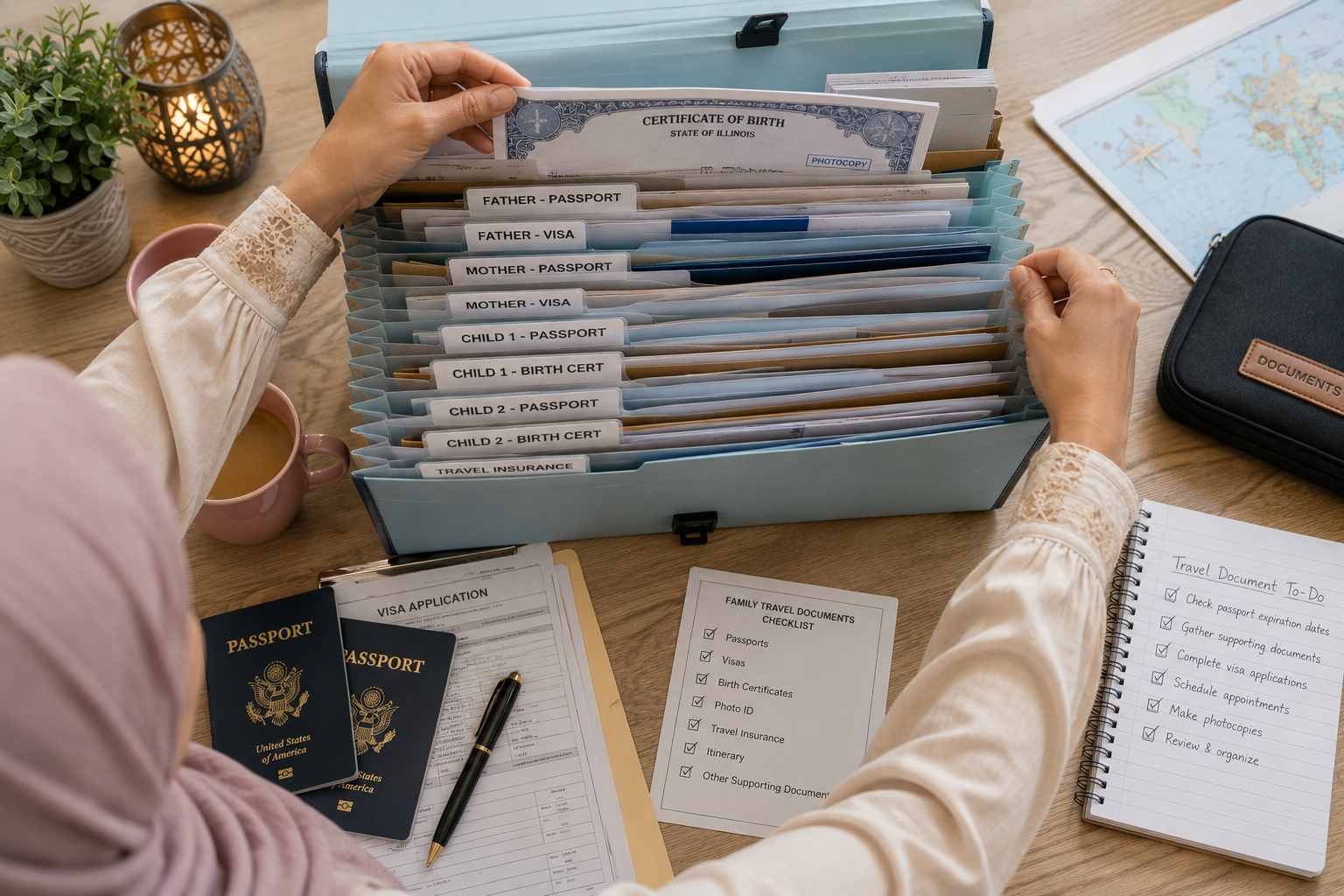
Families should manage the supporting documentation required for travel document applications by creating a centralized “document hub,” either a physical folder or a secure digital folder, for each family member.
The best practice is to use an accordion file with a labeled section for each family member. In each section, keep the original documents (birth certificate, old passport), copies of those documents, completed application forms, and passport photos together to prevent loss and ensure you have everything for your appointment. Incorrect photos are the leading cause of application suspensions.
When making copies, create two sets: one set to submit with the applications, and a second “travel set” to carry separately from the original documents during your vacation as a backup.
8. What should families do if they face urgent travel needs or delayed document applications?
If families face urgent travel needs or delayed document applications, they must immediately contact the National Passport Information Center to officially upgrade their service to expedited or schedule an Urgent Travel Service appointment.
For delayed applications already in the system, you can call to pay for expedited service and 1-2 day return delivery. For new, urgent needs (travel within 14 days), you must try to secure a limited, in-person appointment at a passport agency or center.
The most effective way to secure a rare Urgent Travel Service appointment is to call the automated system at the exact time new appointments are released, typically early in the morning. Persistence is key as slots are taken in seconds.
Urgent Travel Service: An in-person appointment at a passport agency for U.S. citizens with proof of international travel booked within 14 calendar days, designed for life-or-death emergencies or other immediate travel needs.
If you have a life-or-death emergency, you have access to a different, more accommodating appointment system. Be prepared to provide documented proof of the emergency.
Understanding the specific conditions for using these emergency services is the next critical step.
When can families use expedited services for passport applications?
Families can use expedited services for passport applications at the time of submission or by calling to upgrade an existing application, a choice that significantly reduces the standard processing time for an additional government fee.
You should elect for expedited service if your travel date is outside the standard processing window but closer than 14 days away. This service costs extra per application and reduces the wait time, but it is not an instantaneous solution and still involves several weeks of processing. Expedited service reduces the official processing period to 5 to 7 weeks and costs an additional $60 per application.
Paying for 1-2 day delivery on top of the expediting fee is a smart investment. It cuts down on mailing time on both ends of the process, potentially saving over a week of total time for a marginal extra cost.
How can families resolve issues with incorrect or incomplete travel document applications?
Families can resolve issues with incorrect or incomplete travel document applications by immediately following the instructions in the official letter or email they receive from the processing agency.
When an application is returned, it will be accompanied by a letter detailing the specific error (e.g., incorrect photo, missing signature). The family must correct that specific error and resubmit the entire package as instructed; do not just send the corrected item alone.
A common point of failure is the passport photo. Photos are frequently rejected for being too old, having a non-white background, or the applicant wearing glasses. Using a professional service that guarantees compliance is the best way to avoid this specific issue.
How can families avoid common mistakes when applying for family vacation travel documents?
Families can avoid common mistakes when applying for family vacation travel documents by meticulously proofreading all forms, using professional photo services, and confirming all requirements before any submission.
The most effective way to avoid errors is to use the official government checklists and to double-check every field on the application forms against original documents like birth certificates. Simple errors like typos in names or dates are a primary reason for rejection.
A common but easily avoidable mistake is signing the form in the wrong place or at the wrong time. The Form DS-11, for example, must be signed in the presence of the acceptance agent, not beforehand at home.
9. Logistics: Family Travel Document Application Planning Checklist
| Checklist Item / Tactic | Status |
|---|---|
| Step 1: Research destination entry requirements (passports, visas, health). | ⬜ |
| Step 2: Gather all necessary original documents for each family member, such as birth certificates, old passports, and marriage certificates. | ⬜ |
| Step 3: Accurately fill out the appropriate passport forms (DS-11 for new applicants, DS-82 for renewals) and any required visa application forms. | ⬜ |
| Step 4: Get professional, compliant passport photos for all applicants to avoid rejection due to photo issues. | ⬜ |
| Step 5: Book necessary appointments at a Passport Acceptance Facility for new or child passport applications. | ⬜ |
| Step 6: Submit all passport and visa applications, ensuring all fees are paid and all required documents are included. | ⬜ |
| Step 7: Monitor the status of all applications regularly and respond promptly to any requests for additional information. | ⬜ |
| Step 8: Upon receipt, immediately verify all details on your new passports and visas are correct and valid for your travel dates. | ⬜ |
| Step 9: Scan and securely save digital copies of all final travel documents as a backup. | ⬜ |
| Step 10: Understand options for expedited or urgent services in case of unforeseen delays or emergencies. | ⬜ |
Sources
- https://sehlmeyertravel.com/travel-documents-checklist/
- https://www.facebook.com/travelgov/posts/parents-dont-let-lack-of-preparation-ruin-your-family-vacation-children-under-16/1262089415954106
- https://www.ricksteves.com/travel-tips/trip-planning/travel-documents
- https://www.generalitravelinsurance.com/travel-resources/travel-documents.html
Resolution
Just as important as securing your documents is considering How to Plan Travel Insurance for a Family Vacation to protect your investment. The clear final thought on applying for family vacation travel documents is that a proactive approach, initiated 6 to 9 months in advance, is the sole strategy to protect a family’s financial investment and ensure travel plans materialize. This early start transforms the complex process of passport processing, visa requirements, and child applications into a calm, organized component of vacation planning. This isn’t just a bureaucratic process; it’s the foundational step in your family’s travel safety and security. Having all documents in order is as critical as booking a safe hotel or buying travel insurance. Your final action is to set a calendar alert for 9 months before your tentative travel period, labeled “Start Family Passport & Visa Process.”