Which Water Sports Destinations Are Best for a Family Vacation with Teenagers?
Table of Contents
The best water sports destinations for a family vacation with teenagers are Maui, Hawaii (USA), the Algarve, Portugal, and the Gold Coast, Australia.
These locations are superior because they provide a strategic combination of: Safe, varied aquatic environments suitable for multiple skill levels.
Structured, teen-centric activities like surf camps and diving certifications that foster autonomy.
Comprehensive family amenities, including multi-room lodging and non-water-based entertainment.
Before diving into specific types of active getaways, it’s helpful to understand the broader landscape of available family vacation options.
What Are the 6 Types of Family Vacation Destinations?
For families considering such a trip, exploring specific island-based options that cater to varying needs can provide further insights.
Which Tropical Island Destinations Have the Best Resorts for a Family Vacation?
1. Why Are Water Sports Destinations Ideal for a Family Vacation with Teenagers?
Water sports destinations are ideal for family vacations with teenagers because they uniquely address the challenge of teen engagement by offering thrilling, skill-based activities that foster independence and build confidence, while also providing opportunities for shared family experiences in dynamic, safe environments.
These destinations excel at solving the common challenge of engaging bored or disengaged teenagers on a family trip.
They frame benefits around psychological development, such as building confidence through skill acquisition like learning to surf and responsible independence.
Engaging teenagers in water sports can cultivate new skills, instill a sense of accomplishment, and create lasting family memories.
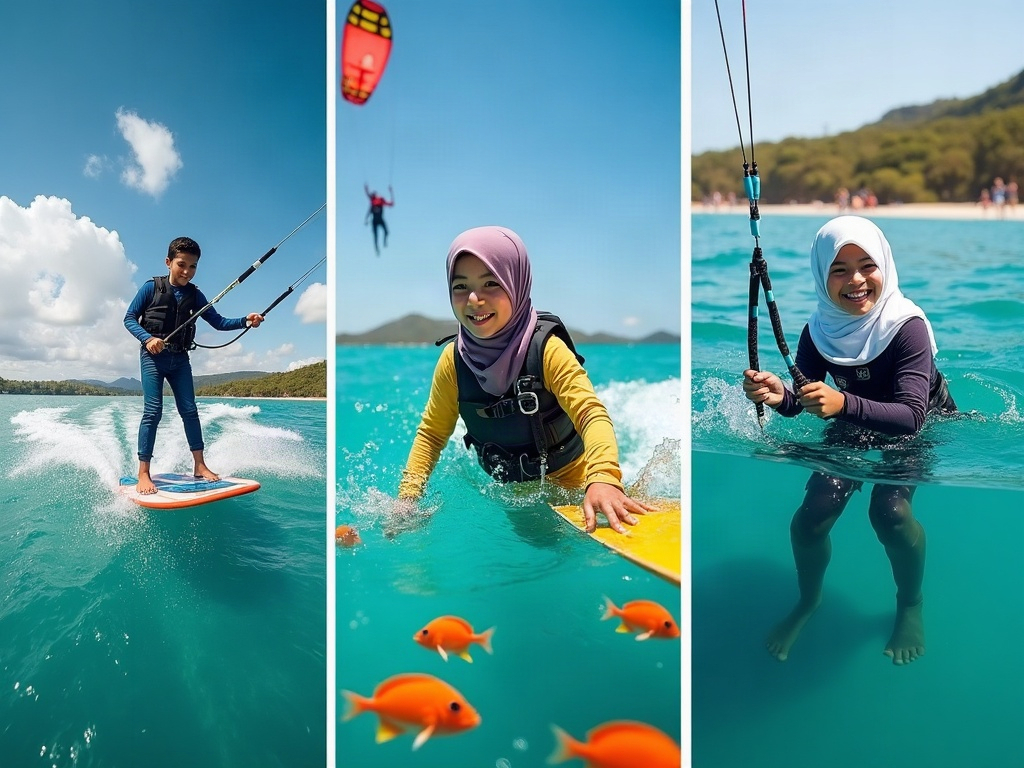
A family enjoying a water sports activity together, emphasizing both individual teen participation and collective family bonding.
© WovenVoyages.com
What Water Sports Activities Engage Teenagers During a Family Vacation?
The specific water sports activities that most effectively engage teenagers during a family vacation are those that offer a high degree of autonomy and a clear path to skill mastery, including jet-skiing, wakeboarding, kitesurfing, and scuba diving certification courses.
Teenagers are most engaged by water sports activities like jet-skiing, wakeboarding, kitesurfing, and scuba diving certifications due to their inherent thrill, the clear progression path for skill mastery, and the sense of independence and accomplishment they provide away from parental oversight.
These high-adrenaline activities provide a sense of challenge and reward, catering directly to the desire for autonomy and adventure common in adolescents.
The Professional Association of Diving Instructors (PADI) offers a Junior Open Water Diver certification for children as young as 10 years old, providing a structured pathway to skill mastery and a globally recognized accomplishment.
This certification can significantly boost a teenager’s confidence and interest in marine exploration.
Teenagers tend to enjoy destinations where there is plenty to do, offering a mix of adventure, food, shopping, and outdoor activities.
Unique Insight: Activities with a tangible certification outcome, such as PADI Open Water Diver, are particularly effective for fostering a teenager’s sense of accomplishment and structured independence, transforming a vacation activity into a valuable life skill.
E-foiling (Electric Hydrofoil Surfboard) is defined as a battery-powered surfboard that uses a hydrofoil to lift the board above the water’s surface, offering a unique, high-tech experience with a steep but rewarding learning curve appealing to teenagers.
When planning activities like scuba diving, it’s beneficial to know where to find prime locations with vibrant underwater ecosystems.
Which Beach Destinations Feature the Best Coral Reefs for a Family Vacation?
How Do Water Sports Destinations Cater to Diverse Family Vacation Needs?
Water sports destinations cater to diverse family vacation needs by implementing a layered amenity model, which pairs high-adrenaline teen activities with separate, fully supervised kids’ clubs for younger children and relaxation-focused amenities like spas and fine dining for adults.
Water sports destinations accommodate diverse family needs through a layered amenity model that offers parallel activities.
This model ensures teenagers engage in exciting water sports, younger children are entertained in supervised clubs, and adults can relax with spas or fine dining.
This comprehensive approach enables simultaneous enjoyment for all age groups.
While teenagers are kitesurfing or getting PADI certified, parents can enjoy a spa treatment or a quiet meal, and younger children can participate in age-appropriate activities at a kids’ club.
All-inclusive resorts like Beaches Turks & Caicos feature multiple “villages,” numerous pools, a water park, a lazy river, and kids’ programs, providing parallel activities for different age groups.
Multi-generational travel is a significant market, with resorts like Grand Traverse Resort and Spa offering amenities like indoor waterparks, arcades, and escape rooms alongside spas and golf to cater to different generations simultaneously.
Multi-Generational Amenity Stacking is defined as the intentional design of a resort’s offerings to provide parallel, age-appropriate activity tracks, allowing different family subgroups to engage in separate activities simultaneously.
For example, Atlantis Paradise Island, Bahamas, effectively illustrates how diverse needs are met in a single location with its extensive water parks, marine habitats, and a wide array of dining options appealing to all ages.
Beyond water-based adventures, families often seek varied entertainment options, including those found in large entertainment complexes designed for all ages.
Which Theme Park Destinations Are Best for a Multigenerational Family Vacation?
Which Amenities Support a Comfortable Family Vacation Experience?
The critical amenities that support a comfortable family vacation experience at a water sports destination are multi-bedroom suites or adjoining rooms for privacy, on-site certified gear rental and instruction facilities to reduce logistical friction, and a wide variety of dining options.
A comfortable family water sports vacation is primarily supported by amenities such as multi-bedroom lodging for privacy.
Integrated on-site gear rental and instruction streamline logistics.
Diverse dining options cater to varied tastes, collectively minimizing stress and maximizing enjoyment for all family members.
Many family-focused resorts, like Marriott’s Ko Olina Beach Club in Hawaii, specifically offer large two- and three-bedroom suites to provide teenagers with their own space and privacy, which is crucial for their comfort.
At ski resorts like Angel Fire, bundling ski rentals with the ski school sign-up is a key amenity that reduces logistical friction and cost for families, a principle directly applicable to water sports gear.
Multi-bedroom suites prevent arguments over space and privacy, enhancing the overall family vacation experience.
On-site certified gear rental eliminates the hassle of transporting bulky equipment and ensures access to well-maintained, safe gear.
Diverse dining options are essential to satisfy various palates within a family, from casual beachside cafes to more formal restaurants.
A Gear Concierge is a specialized resort service that manages the rental, storage, transport, and maintenance of water sports equipment for guests, eliminating a major logistical pain point for families.
Author’s Experience: Abdullahi Azaam
“Having organized more than 15 water sports family vacations across four continents with my own teenagers, I’ve seen firsthand how crucial thoughtful amenities are. On-site gear rental and diverse dining options consistently minimize stress, allowing for more time enjoying the ocean and less time managing logistics.”
2. How Should Families Choose Water Sports Destinations for a Teenager-Focused Family Vacation?
Families should choose water sports destinations by employing a structured evaluation framework that balances teenage activity preferences, verified safety standards, a diverse range of non-water activities, the overall budget, and convenient travel logistics, ensuring all family members’ needs and expectations are met.
A structured decision framework prevents choosing a destination that fails to meet teen expectations, which is a common source of conflict during family vacations.
This proactive approach considers the diverse needs and interests of all family members, especially the discerning preferences of teenagers.
| Selection Criterion | High-Priority Factors (What to Look For) | Red Flags (What to Avoid) |
|---|---|---|
| Teen Activity Match | Diverse offerings (e.g., surfing, diving, jet-skiing), certified instructors, opportunities for independence. | Limited teen-specific activities, overly structured programs with no free time, activities requiring constant parental supervision. |
| Safety & Supervision Standards | Internationally recognized certifications (PADI, ISA), clear safety protocols, accessible emergency services. | Uncertified operators, vague safety information, poor equipment maintenance, lack of clear emergency procedures. |
| Non-Water Activity Options | Local cultural experiences, shopping, dining variety, adventure parks, designated teen hangouts. | Solely water-focused activities, remote locations with limited non-water entertainment, lack of age-appropriate social spaces. |
| Budget | All-inclusive packages, transparent pricing, options for varying activity costs, potential discounts for family bundles. | Hidden fees, expensive ad-hoc activities, high costs for basic amenities, lack of flexible budgeting options. |
| Travel Logistics | Direct flight accessibility, reliable local transportation, reasonable travel times, minimal transfers. | Multiple long transfers, limited flight options, complex visa requirements, unreliable local transport infrastructure. |
Which Are the Top Water Sports Destinations for a Family Vacation?
The top water sports destinations for a family vacation with teenagers are Maui, Hawaii, for its unparalleled variety of marine activities; the Outer Banks, North Carolina, for its beginner-friendly surf and kiteboarding conditions; and the Algarve, Portugal, for its sheltered coves and cultural experiences.
The leading water sports destinations for families with teenagers include Maui (diverse marine activities), the Outer Banks (beginner-friendly conditions), the Algarve (sheltered coves and culture), Gold Coast (surfing and theme parks), and Bonaire (premier diving).
Each of these locations offers unique advantages for teen engagement and family enjoyment.
Maui offers beautiful beaches and immersive Hawaiian culture, with the 52-mile-long Road to Hana providing 620 curves and 59 narrow bridges to explore.
Its diverse marine environment is perfect for snorkeling, surfing, and paddleboarding for various skill levels.
The Outer Banks, North Carolina, features brackish water, a mix of saltwater and freshwater found in estuaries, like those in the Outer Banks’ sounds, which creates unique, calm conditions ideal for beginner kayakers and paddleboarders.
This makes it an ideal spot for teenagers learning to surf or kiteboard in a safer, less intimidating environment.
The Algarve, Portugal, boasts stunning coastlines with sheltered coves, perfect for kayaking and stand-up paddleboarding, alongside a rich cultural experience.
Its consistent waves also provide excellent opportunities for surf lessons for all ages.
Gold Coast, Australia, is renowned for its world-class surfing beaches and vibrant atmosphere, offering numerous surf schools and non-water activities like theme parks.
Bonaire, part of the Caribbean Netherlands, is a premier diving destination, with protected marine parks offering unparalleled visibility and diverse marine life, making it one of the safest and most rewarding places for a teen to get scuba certified with PADI.
Panama City Beach, Florida offers families 27 miles of shoreline for activities like swimming, snorkeling, and paddle boarding, providing another excellent option for water sports family vacations.
Understanding the broader offerings of coastal areas helps in selecting the ideal setting for an oceanic family adventure.
What Are the Top Coastal Destinations for a Family Vacation?
3. What Distinguishes Different Types of Water Sports Destinations for a Family Vacation?
Different types of water sports destinations – such as tropical islands, freshwater lakes, European coastlines, and adventure reef systems – are distinguished by their unique primary activities, optimal seasons, budget levels, and overall atmosphere, directly dictating the travel experience for a family vacation.
Selecting the right *type* of destination is a more strategic first step than choosing a specific location.
This initial categorization helps align the family’s expectations with the inherent characteristics of a region, from available sports to climate and cost.
| Destination Type | Primary Activities | Best Season | Budget Level | Vibe |
|---|---|---|---|---|
| Tropical Island (Maui, Bonaire) | Scuba diving, snorkeling, surfing, paddleboarding, sailing. | Dry season (varies by region). | Moderate to High. | Relaxed, adventurous, focus on marine life. |
| North American Freshwater Lake (Lake Tahoe) | Wakesurfing, wakeboarding, tubing, kayaking, fishing. | Summer. | Moderate. | Recreational, family-focused, often wilderness adjacent. |
| European Coastline (Algarve, Split) | Kayaking, paddleboarding, windsurfing, cultural excursions, cliff jumping. | Late Spring to Early Autumn. | Moderate to High. | Scenic, culturally rich, historical exploration. |
| Adventure Reef System (Great Barrier Reef) | Advanced diving, liveaboard experiences, marine conservation, reef snorkeling. | Dry season (specific to reef location). | High. | Immersive, educational, conservation-focused. |
For those preferring inland waters, exploring various freshwater options provides a distinct yet equally engaging family vacation experience.
What Are the Best Freshwater Destinations for a Family Vacation?
Which Coastal Regions Excel for Specific Water Sports During a Family Vacation?
For a family vacation focused on a specific water sport, the Great Barrier Reef in Australia is unmatched for diving, Bali in Indonesia offers a world-class surf culture, and Lake Tahoe in the USA provides a premier freshwater wakesurfing and boating experience.
Coastal regions excelling in specific water sports for family vacations include the Great Barrier Reef for diving, Bali for surfing, Lake Tahoe for freshwater wakesurfing, Split for sailing/kayaking, and Turks and Caicos for snorkeling.
Each of these destinations is uniquely suited due to its geographical features and consistent conditions.
The Great Barrier Reef in Australia, with its vast coral ecosystems, provides an unparalleled diving and snorkeling experience, especially around Whitehaven Beach in the Whitsunday Islands.
Bali in Indonesia, particularly areas like Kuta Beach, is known for its world-class surf culture, offering consistent, gentle peeling waves due to its wide, sandy-bottom bathymetry, making it ideal for beginner surf lessons.
Bathymetry is defined as the measurement of underwater depth and topography, explaining that a region’s bathymetry (e.g., the reef structures in Turks and Caicos or the sandy shoals off Croatia) is the primary geological factor creating its specific water sport conditions.
Lake Tahoe, USA, offers a crystal-clear lake for water sports during the summer, including premier wakesurfing, wakeboarding, paddleboarding, kayaking, and jet ski rentals.
Split, Croatia, excels for sailing and sea kayaking, leveraging its stunning Adriatic coastline and numerous islands.
The calm, clear waters and hidden coves offer exceptional exploration opportunities for families.
Turks and Caicos is celebrated for its pristine coral reefs and calm, shallow waters, providing some of the best snorkeling and stand-up paddleboarding experiences, especially for younger family members.
4. How Can Families Maximize Their Water Sports Experience During a Family Vacation?
Families can maximize their water sports experience by implementing a structured yet flexible daily itinerary that strategically balances high-energy activities in the morning with essential downtime in the afternoon, thereby preventing teen burnout and ensuring sustained enjoyment for all family members throughout the vacation.
The goal of a planned itinerary is to balance high-energy activities with necessary downtime to prevent burnout, especially crucial for teenagers.
Scheduling skill-intensive lessons or exhilarating activities like jet-skiing or kitesurfing in the morning, when energy levels are highest, can significantly enhance engagement.
This allows for afternoons to be dedicated to more relaxed pursuits such as beach lounging, light snorkeling, or exploring local markets, ensuring a sustainable pace for the entire family.
| Time of Day | Primary Activity | Teen Engagement Factor | Parental Involvement |
|---|---|---|---|
| Morning (8 AM – 12 PM) | Surf lessons (Outer Banks) or PADI Junior Open Water dive. | High (skill acquisition, challenge). | Optional (supervised instruction). |
| Mid-day (12 PM – 2 PM) | Lunch at a local eatery, light swimming, rehydration. | Medium (social, refueling). | Required (family meal). |
| Afternoon (2 PM – 5 PM) | Paddleboarding in calm waters (Algarve) or beach volleyball. | Medium (leisure, social). | Optional (can participate or relax). |
| Evening (5 PM onwards) | Explore local town, dining, board games/family time at accommodation. | Low (downtime, non-physical). | Required (family bonding). |
What Practical Tips Ensure a Smooth Water Sports Family Vacation?
Practical tips that ensure a smooth water sports family vacation include pre-booking all lessons with certified instructors, packing essential non-rental gear like UPF 50+ rash guards and waterproof phone pouches, and conducting a mandatory 5-minute safety briefing before every new activity.
To ensure a smooth water sports family vacation, key practical tips involve pre-booking certified instructors.
Packing essential UPF 50+ rash guards and waterproof pouches is crucial.
Always conducting a brief safety review before new activities minimizes logistical hurdles and enhances safety.
The American Red Cross advises that a proper-fitting life jacket is essential for water safety; it should be snug and not allow the person’s chin or ears to slip through [1].
The Skin Cancer Foundation recommends clothing with a UPF of 30 to 49 for very good protection and 50+ for excellent protection against UV radiation [2].
UPF (Ultraviolet Protection Factor) is defined as a rating system for apparel that indicates how effectively fabrics block UVA and UVB radiation, explaining that a UPF 50 rating blocks 98% of UV rays.
- Pre-booking instructors guarantees availability and avoids on-site disappointment, a major source of vacation friction.
- Packing appropriate sun protection and waterproof gear safeguards health and electronics, essential for continuous enjoyment.
- Mandatory safety briefings ensure everyone understands risks and protocols, fostering a secure environment for all water sports activities.
5. How Do Families Plan Logistics for a Seamless Water Sports Family Vacation?
Seamless logistics for a water sports family vacation depend entirely on a comprehensive pre-travel checklist that meticulously covers booking and documentation, essential packing and gear, and on-site coordination, ensuring every detail is addressed to mitigate stress and prevent last-minute issues.
Meticulous logistical planning is the single most important factor in reducing travel-related stress.
A comprehensive checklist helps ensure that no critical detail is overlooked, from confirming travel insurance that covers adventure sports to organizing necessary equipment.
| Checklist Item / Tactic | Status |
|---|---|
| Booking & Documentation | |
| ☐ Confirm all flight and accommodation reservations, paying close attention to check-in/check-out times. | ⬜ |
| ☐ Verify that passports are valid for at least six months beyond the return date and secure any necessary visas. | ⬜ |
| ☐ Confirm travel insurance policy includes coverage for adventure sports activities like diving or surfing. | ⬜ |
| Packing & Gear | |
| ☐ Pack essential non-rental water sports gear such as personal goggles, rash guards, and reef-safe sunscreen. | ⬜ |
| ☐ Prepare a waterproof dry bag for valuables, electronics, and extra clothing during excursions. | ⬜ |
| ☐ Pre-book any specialized equipment rental or instruction to ensure availability and proper fit. | ⬜ |
| On-Site Coordination | |
| ☐ Download offline maps and translation apps for navigation and communication in remote areas. | ⬜ |
| ☐ Establish a family communication plan and emergency contact information for all members. | ⬜ |
| ☐ Research and note local medical facilities and emergency services nearest to your accommodation. | ⬜ |
What Transportation Options Are Best for Getting to Water Sports Hubs for a Family Vacation?
The best transportation option for a family vacation to a water sports hub is a direct flight into the nearest major airport, combined with a pre-booked full-size SUV or minivan rental to accommodate both family members and oversized gear.
For water sports family vacations, the best transportation typically involves direct flights to the closest major airport.
This is followed by a pre-booked SUV or minivan rental for ground transport, ensuring sufficient space for family and oversized equipment.
Inter-island ferries offer cost-effective alternatives in archipelagic regions like Hawaii or the Caribbean.
Airlines have specific policies for oversized baggage; for example, a surfboard in a bag weighing under 50 pounds may incur a fee of $150 or more each way [3].
When traveling to Big Bear Lake, CA, it is advisable to avoid driving on a Friday afternoon due to heavy traffic [4].
A key consideration is the ability to transport specialized water sports gear, which often requires larger vehicles.
Inter-island Ferry is defined as a common mode of transport in archipelagos like Hawaii or the Caribbean, explaining its benefits (cost-effective for groups, no baggage limits) and drawbacks (slower travel time) compared to regional flights.
Rental cars offer flexibility and space for gear, while resort shuttles can be convenient for shorter distances if they accommodate equipment.
6. What Are the Potential Challenges of a Water Sports Family Vacation?
Potential challenges for water sports family vacations include unpredictable weather, mismatched skill levels among family members, potential teen disinterest, and equipment failures; however, these can be proactively mitigated through diligent planning, flexible itineraries, and reliable gear selection.
This section serves as a proactive risk mitigation guide, rather than a deterrent.
Understanding common pitfalls allows families to plan more resiliently and ensure a smoother trip.
Unpredictable weather can disrupt outdoor plans; however, a flexible itinerary with indoor alternatives can manage this.
Mismatched skill levels might frustrate some family members; booking activities with varying difficulty options or separate instruction for different groups helps.
Teen disinterest can arise from lack of perceived autonomy; involving teenagers in activity selection and providing choice can mitigate this.
Equipment failures are preventable through pre-trip checks and renting from reputable, well-maintained facilities.
How Can Families Ensure Safety During Water Sports Activities on a Family Vacation?
Families ensure absolute safety during water sports on a family vacation by exclusively using instructors with current certifications from an internationally recognized body (e.g., PADI, ISA), enforcing a non-negotiable buddy system for all in-water activities, and learning to identify local hazards like rip currents.
To ensure water sports safety, families must use instructors certified by international bodies like PADI or ISA.
They should also enforce a strict buddy system.
Educating themselves on identifying and reacting to local hazards such as rip currents is equally important.
Prioritizing verifiable credentials and proactive hazard awareness are paramount.
According to the CDC, about 4,000 fatal unintentional drownings occur in the U.S. each year, averaging 11 drowning deaths per day [5].
PADI’s safety standards include a ‘no-touch’ rule for marine life to protect both the diver and the aquatic ecosystem.
Rip Current is defined as a specific type of powerful, narrow channel of water moving directly away from the shore, explaining the primary visual cues (e.g., a channel of churning, choppy water) and the correct escape procedure (swim parallel to the shore).
Always ask instructors for their current certifications and inquire about their experience level with teaching teenagers.
- **Non-Negotiable Safety Rules:** Always wear properly fitted life jackets during surface water activities.
- **Non-Negotiable Safety Rules:** Stay within designated swimming or activity areas.
- **Non-Negotiable Safety Rules:** Never swim or engage in water sports alone, especially at night.
- **Non-Negotiable Safety Rules:** Understand and respect local marine life and environmental regulations.
7. What Environmental Concerns Should Families Consider for a Water Sports Family Vacation?
Environmentally conscious families on water sports vacations should consider concerns like coral damage from chemical sunscreens, plastic pollution affecting marine life, and resource overconsumption at resorts, understanding that their choices directly impact the long-term viability of fragile marine ecosystems.
The long-term viability of all water sports destinations depends on responsible tourism practices.
Direct impacts include the damage coral reefs sustain from chemical sunscreens and the pervasive issue of plastic pollution threatening marine life.
Indirect impacts involve the considerable resource overconsumption, including water and energy, often observed at large resorts catering to tourists.
Being aware of these issues allows families to make informed choices that support ecological preservation.
How Do Families Practice Sustainable Tourism in Water Sports Destinations for a Family Vacation?
Families practice sustainable tourism in water sports destinations by taking three key actions: using only reef-safe sunscreens containing non-nano zinc oxide, selecting tour operators with a valid eco-certification from the Global Sustainable Tourism Council, and actively participating in “voluntourism” activities like a local beach clean-up.
Families can practice sustainable tourism by using reef-safe sunscreens (non-nano zinc oxide).
Choosing eco-certified tour operators (e.g., Global Sustainable Tourism Council) is another vital step.
Engaging in voluntourism like beach clean-ups helps minimize their environmental footprint and supports local conservation efforts in water sports destinations.
Studies published in journals like *Archives of Environmental Contamination and Toxicology* have shown that the chemical UV filter oxybenzone is toxic to the larval stage of corals, causing bleaching and DNA damage [6].
Oxybenzone is defined as a common chemical UV filter found in non-mineral sunscreens that has been scientifically proven to cause coral bleaching, larval deformities, and reef death, and is now banned in several water sports destinations like Hawaii and Palau.
Eco-certifications such as Blue Flag are awarded to beaches and marinas that meet stringent environmental, educational, safety, and accessibility criteria.
To identify truly reef-safe sunscreen, always check the “Active Ingredients” label for non-nano zinc oxide or titanium dioxide.
Actively avoid products containing Oxybenzone and Octinoxate.
8. Frequently Asked Questions (People Also Ask)
Why Are Water Sports Destinations Ideal for a Family Vacation with Teenagers?
What Water Sports Activities Engage Teenagers During a Family Vacation?
How Do Water Sports Destinations Cater to Diverse Family Vacation Needs?
How Can Families Ensure Safety During Water Sports Activities on a Family Vacation?
References & Sources
What Are the Final Thoughts on Maximizing a Water Sports Destination for a Family Vacation?
A successful water sports family vacation is ultimately achieved by strategically balancing teen interests with family safety protocols and meticulous logistical planning, ensuring a rewarding experience that fosters both individual skill development and cherished family memories.
Synthesize core decision-making criteria: match the destination to teen interest, verify safety and certifications (PADI, ISA), and plan logistics meticulously.
A well-planned water sports vacation in destinations like Maui or the Algarve creates lasting family memories and valuable life skills for teenagers, making the effort worthwhile.