How to Find an Open Pharmacy While on Vacation?
Table of Contents
Finding an open pharmacy while on vacation is an essential skill that transforms potential health hurdles into easily managed situations, ensuring your family’s travel plans stay on track. This proactive capability builds confidence and secures your well-being, proving to be a critical part of planning, which aligns closely with understanding how to plan for family vacation health for comprehensive preparation.
This guide systematically addresses the challenges of accessing medication abroad by outlining critical pre-travel preparations, effective methods for locating pharmacies, nuanced differences in services, and robust emergency protocols to ensure your family’s well-being.
1. Why is finding an open pharmacy while on vacation crucial?
Finding an open pharmacy while on vacation is crucial because immediate access to medication is the frontline defense for managing unexpected illnesses, injuries, or chronic conditions that can arise during travel.
The criticality of finding an open pharmacy on vacation stems from the need to address health issues promptly, from a child’s sudden fever to a lost prescription. Lacking immediate access can escalate a minor problem into a major travel disruption, affecting the family’s safety and budget.
Beyond common ailments, different climates and activities on vacation expose families to unique risks (e.g., severe sunburn, insect-borne illnesses, food poisoning) that often require specific over-the-counter treatments unavailable in a standard travel kit.
Reciprocal Healthcare Agreement: A formal arrangement between countries that may allow travelers to access healthcare, including pharmacy services, at the same cost as a local resident.
What health risks can arise without immediate pharmacy access on vacation?
The health risks that can arise without immediate pharmacy access on vacation include the rapid worsening of common illnesses like colds or fevers, the escalation of allergic reactions into severe states, and the dangerous interruption of vital treatments for chronic conditions.
Without prompt access to a pharmacy, a child’s fever can become dangerously high, a minor infection can require an emergency room visit, and running out of essential prescription medication can trigger a medical crisis. These risks turn a manageable issue into a vacation-ending emergency. To build a defense against these issues from the start, consider practical strategies on how to prevent kids from getting sick on vacation to keep everyone healthy.
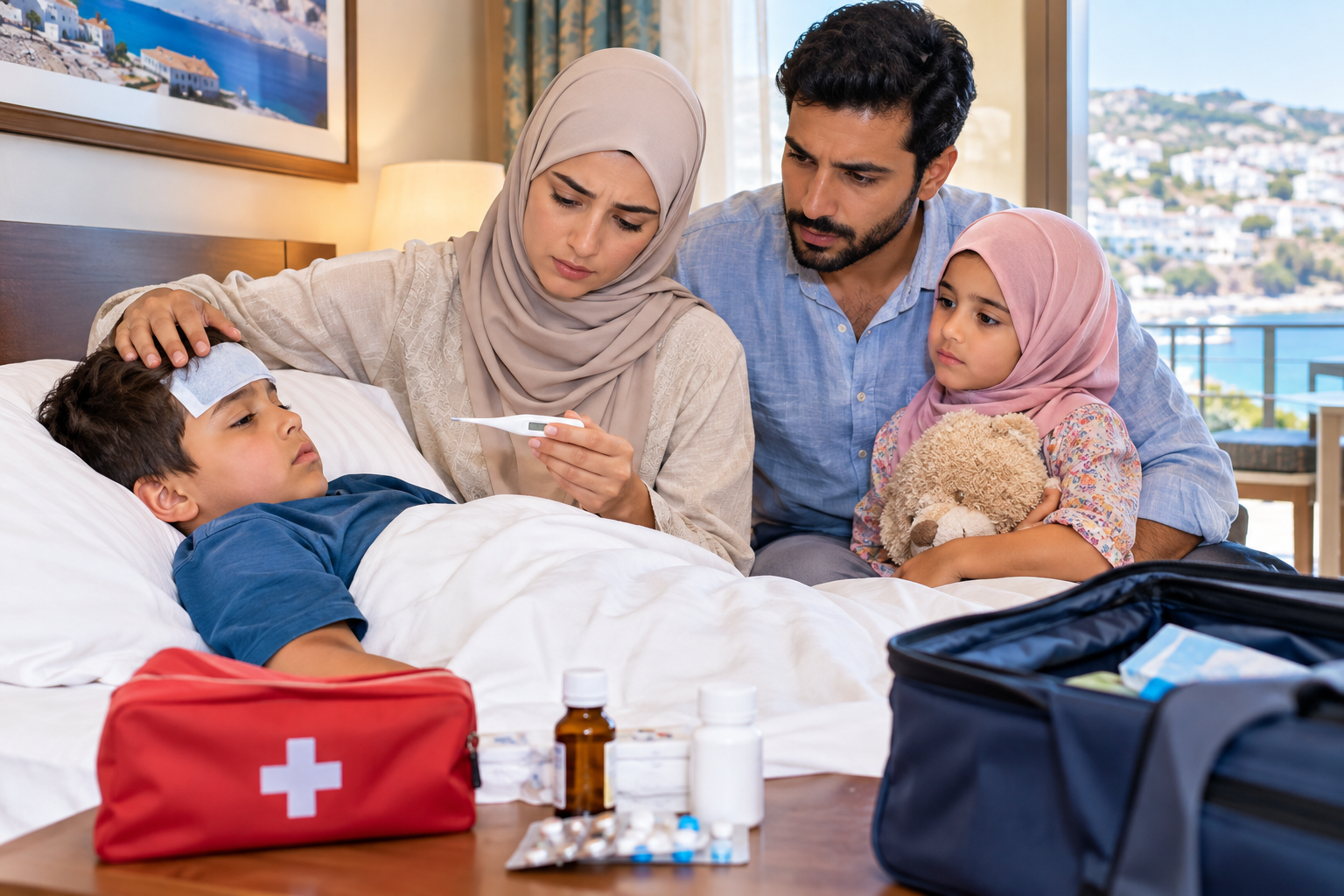
According to the CDC, as many as 75% of travelers to developing countries will experience a travel-related health problem, making pharmacy access a critical component of trip planning.
The psychological stress on a parent trying to manage a sick child’s symptoms without access to basic remedies (like pediatric analgesics or rehydration salts) is a significant secondary health risk.
How do international pharmacy operating hours and regulations impact travelers?
International pharmacy operating hours and regulations impact travelers by frequently restricting access through limited weekend hours, mandatory midday closures, and differing legal classifications for medications that dictate what can be purchased over-the-counter.
Unlike the 24/7 availability common in the U.S., many European and Asian pharmacies close for several hours midday, are closed on Sundays, and operate on a rota system for after-hours emergencies. Furthermore, medications that are OTC at home may require a prescription abroad, creating an unexpected barrier.
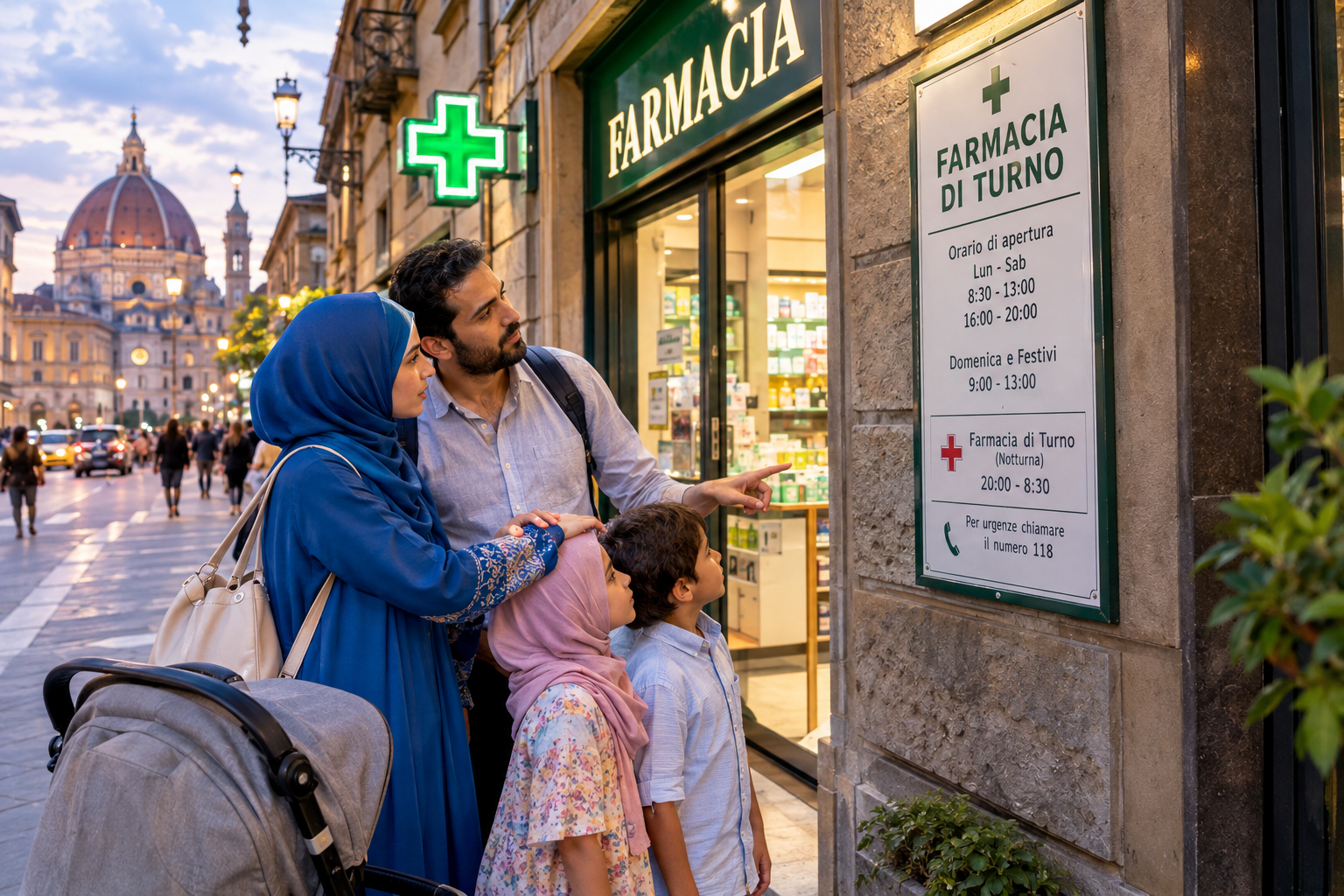
In many European countries like Italy and Spain, systems like the “farmacia di turno” or “pharmacy on duty” are legally mandated to ensure 24/7 access to pharmacy services.
In many countries, a “farmacia di turno” (pharmacy on duty) system exists where one pharmacy in a district remains open after hours or on holidays; the schedule is typically posted on the doors of all local pharmacies.
2. What essential information should you gather before needing a pharmacy on vacation?
The essential information you should gather before needing a pharmacy on vacation includes digital and physical copies of all active prescriptions, a formal physician’s letter for any controlled substances, and a master list of the generic names for all your family’s medications.
The essential information to gather is a “travel medical portfolio.” This includes each family member’s prescriptions with dosages, the generic and brand names of medications, your doctor’s contact details, and a copy of your travel insurance policy.
Photograph every prescription bottle and the medication itself. This visual aid can overcome language barriers with a foreign pharmacist and help confirm the correct drug and dosage form (e.g., tablet vs. capsule).
Generic Drug Name: The official, non-proprietary chemical name of a medication (e.g., ‘ibuprofen’) which is universally recognized by pharmacists, as opposed to a brand name (e.g., ‘Advil’) which can vary by country.
Which prescription details are necessary for international travel?
The prescription details necessary for international travel are the universal generic name of the drug, the exact prescribed dosage in metric units (like mg), the specific medical condition it treats, and the prescribing physician’s full contact information on official letterhead.
For a prescription to be recognized internationally, it must contain the drug’s generic (chemical) name, not just the brand name. You also need the exact dosage and a letter from your doctor explaining the medical necessity, especially for controlled substances or injectable medications. To guarantee your documentation is complete, examining which medical paperwork is needed for a family vacation is a highly recommended step before your trip.
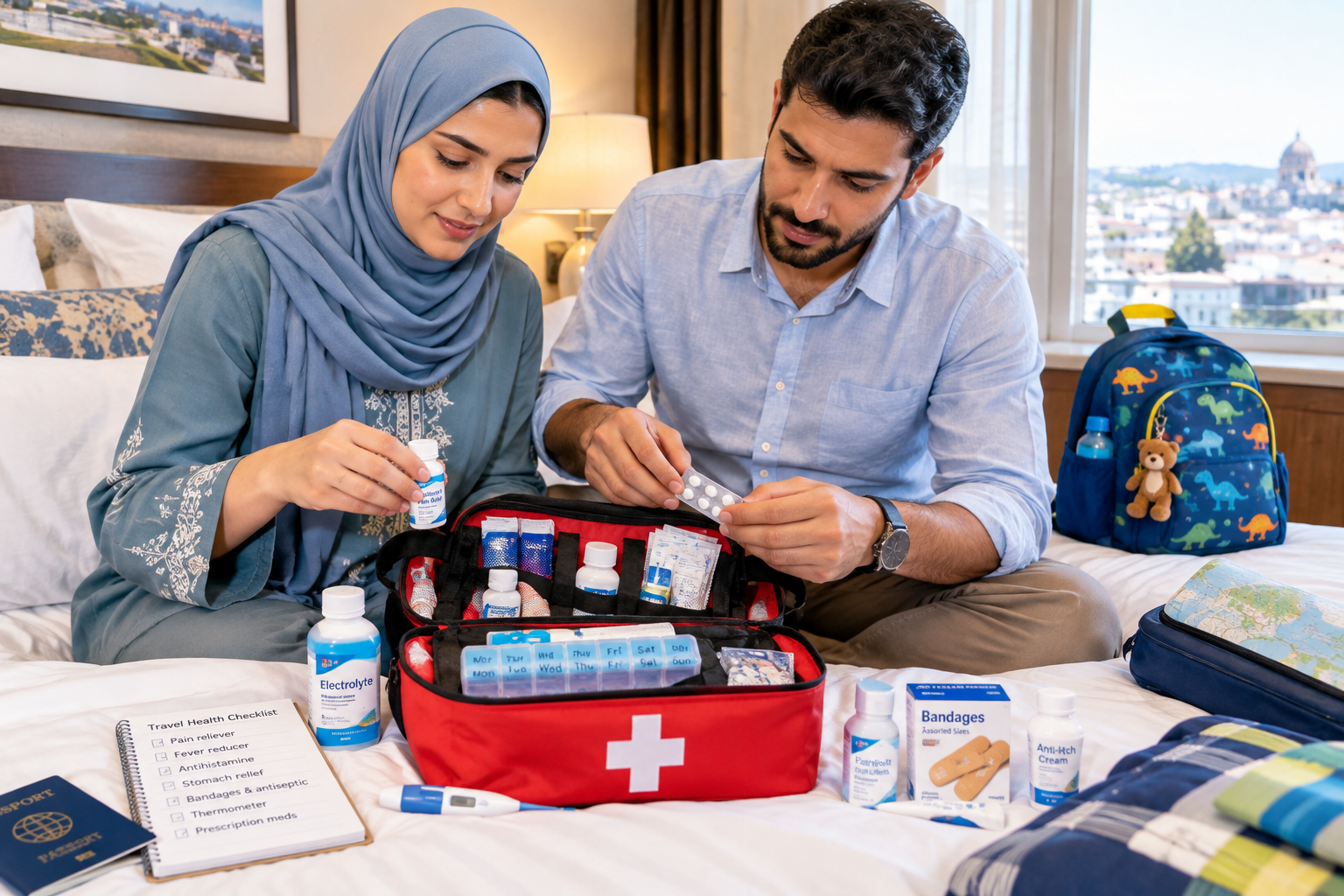
The International Association for Medical Assistance to Travellers (IAMAT) explicitly recommends that “your doctor’s note should be on letterhead and include the generic and brand names of the drug, your medical condition, and the dosage.”
Many countries’ customs regulations require that the quantity of medication you carry does not exceed a “reasonable personal use” amount, often defined as a 30- or 90-day supply. A doctor’s letter helps justify carrying larger quantities for extended trips.
How can you prepare for common over-the-counter medication needs abroad?
You can prepare for common over-the-counter medication needs abroad by proactively assembling a personalized travel first-aid kit stocked with familiar, home-country brands of pain relievers, allergy medicines, and digestive aids tailored to your family’s specific dosages.
To prepare for OTC needs, pack a compact kit with items for pain/fever (children’s ibuprofen/acetaminophen), allergic reactions (antihistamine), minor cuts (bandages, antiseptic), and stomach issues (rehydration salts, anti-diarrhea medicine). This avoids the stress of finding a pharmacy for minor issues. Taking the time to properly structure this kit is vital; finding out what to include in a family vacation first-aid kit gives you a perfect blueprint.
According to the CDC, as many as 75% of travelers to developing countries will experience a travel-related health problem, making access to OTC remedies a critical part of planning.
Decant liquids into smaller, travel-sized (under 100ml/3.4oz) containers and use a pill organizer to save space, but take photos of the original packaging with dosage information first. This is a critical step for airport security and proper administration.
3. Which methods help you reliably locate an open pharmacy while on vacation?
The methods that help you reliably locate an open pharmacy while on vacation include utilizing digital mapping apps with active hours filters, consulting knowledgeable hotel concierges, and identifying designated after-hours emergency chemists.
To reliably find an open pharmacy, use a combination of digital and human resources. Start with a Google Maps search for “pharmacy near me open now,” but cross-reference this with advice from your hotel concierge, who will know about local closures and the best 24-hour options.
Local non-pharmacy businesses, like a tobacconist (“Tabac” in Spain/Italy) or a drugstore (“Drogerie” in Germany), often sell a limited range of basic OTC items and can be a useful first stop for non-prescription needs when a full pharmacy is closed.
Concierge: A hotel staff member whose job is to assist guests by making reservations, providing local information, and arranging transportation; they are an invaluable source of hyper-local, real-time knowledge.
How do digital map applications compare to traditional search methods for pharmacies?
Digital map applications compare to traditional search methods by offering superior speed, real-time operating hours, and turn-by-turn navigation, whereas traditional methods like speaking to a hotel desk clerk provide essential local nuance and verified trust that algorithms might miss.
Digital maps like Google Maps excel in speed and data, allowing you to filter for “open now” and see user ratings. However, traditional methods, such as asking a hotel concierge, can provide crucial nuance, like which pharmacist speaks English or which location is best for pediatric needs.
Google Maps is the most popular navigation app globally, with its massive user base ensuring local business data, including pharmacy locations and hours, is frequently updated and robust.
The “Popular times” feature in Google Maps is an underutilized tool that can help a parent estimate wait times at a pharmacy, which is critical when dealing with an impatient, sick child.
What role do local accommodations play in finding pharmacies near you?
Local accommodations play a vital role in finding pharmacies near you by acting as a hub for trusted, hyper-local intelligence, offering directions to the correct on-duty after-hours pharmacy and insights on which locations carry specialized items or have English-speaking staff.
Your hotel concierge or vacation rental host is your most valuable on-the-ground asset. They can call a pharmacy to confirm it’s open, tell you which one is on the after-hours “rota,” and even help with translation or arranging a taxi.
Many major travel insurance policies include 24/7 assistance hotlines that can provide critical services, such as a “doctor locator” to find a local physician—a service a concierge can help facilitate.
High-end hotels often have relationships with specific doctors who can make “house calls” to the hotel room and provide a prescription on the spot, bypassing the need to find a separate clinic first. This is a premium service but invaluable for families.
4. Which types of pharmacies offer specific services travelers might need?
The types of pharmacies that offer specific services travelers might need include large retail chains for extensive over-the-counter selections and extended hours, independent neighborhood pharmacies for personalized consultations, and hospital-based pharmacies for urgent or highly specialized prescriptions.
Choose a pharmacy type based on your need. Large chains (like Boots in the UK or CVS in the US) offer reliable stock and long hours, while smaller independent pharmacies provide expert, personalized service, and hospital pharmacies are essential for urgent, complex medication needs after a clinic visit.
In some countries, pharmacies are integrated into large supermarkets or hypermarkets (e.g., Carrefour in France), which is extremely convenient for families needing to buy groceries, baby supplies, and OTC medications in a single stop.
Formulary: A list of prescription drugs approved to be prescribed or dispensed at a particular hospital or by a specific health insurance plan. A foreign hospital’s formulary may not include the exact brand of medication you use at home.
When should you choose a chain pharmacy versus an independent one abroad?
You should choose a chain pharmacy abroad when you require predictable inventory, recognizable brands, and late-night operating hours, whereas an independent pharmacy is better when you need specialized medical advice or a higher likelihood of receiving personalized language assistance.
Opt for a chain pharmacy abroad for predictable inventory, competitive pricing, and longer hours for routine needs, but choose an independent pharmacy for complex medical questions, personalized advice, or when seeking a pharmacist who might offer more nuanced assistance with language barriers.
Many large retail pharmacy chains, such as CVS or Walgreens, can transfer prescriptions to their locations nationwide, a key advantage when traveling domestically.
Independent pharmacists are often the owners and have deep community ties, making them more willing to spend extra time helping a tourist navigate the local healthcare system. This human element is a key differentiator.
What specialized health services can international pharmacies offer?
The specialized health services that international pharmacies can offer frequently extend beyond dispensing pills to include basic clinical health screenings, the administration of travel vaccinations, and minor ailment consultations that can save a trip to a doctor.
Many international pharmacies, particularly in the UK and parts of Europe, are expanding their services. Pharmacists there can often provide consultations for minor issues like urinary tract infections or skin rashes, and some larger locations offer blood pressure checks or cholesterol screenings.
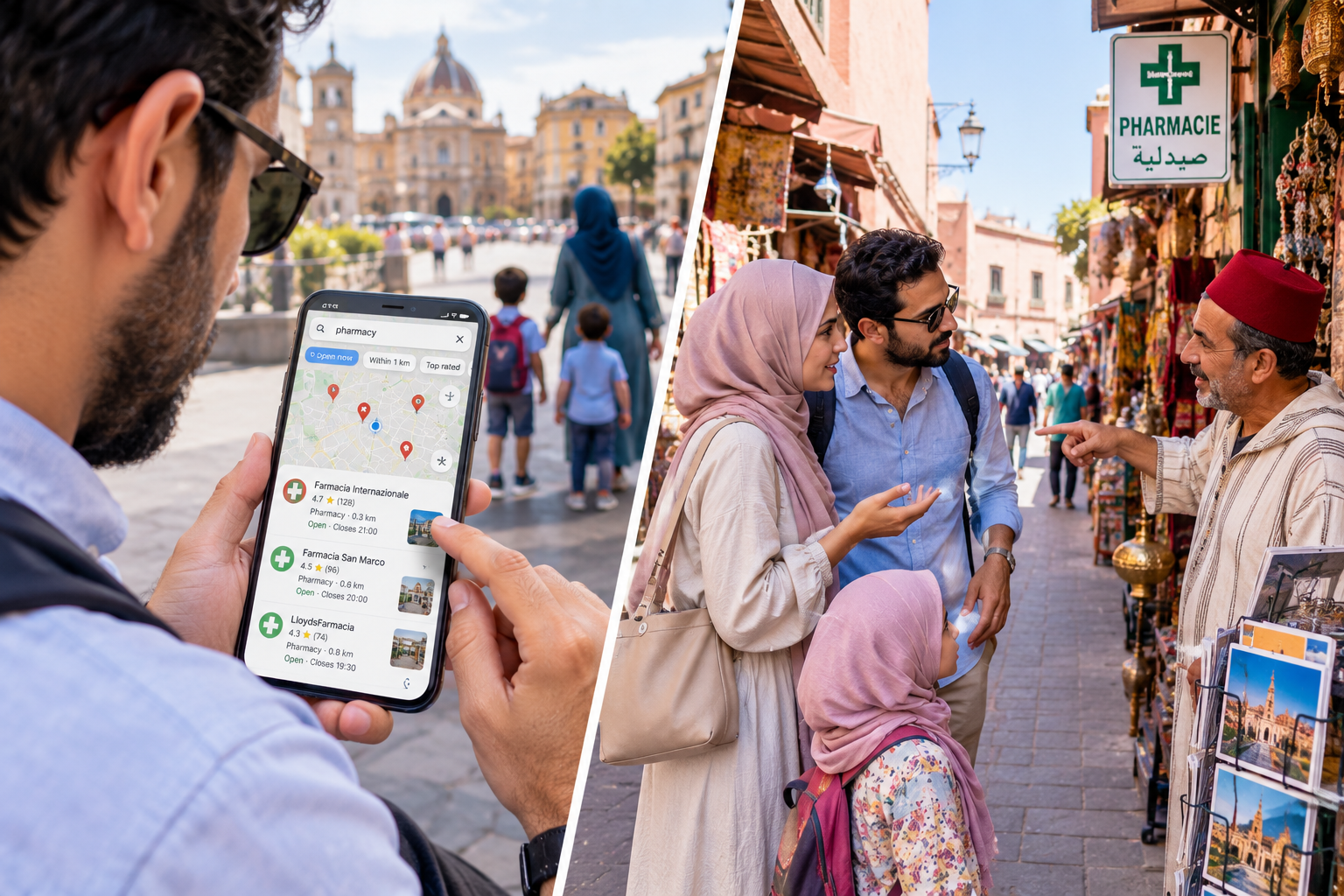
As an example of specialized services, many US pharmacies offer over 14 types of vaccines, including for Cholera, Rabies, and COVID-19, often covered by insurance.
The “Minor Ailment Scheme” in the UK allows pharmacists to treat certain conditions and even prescribe medication without a doctor’s appointment, a service that can be accessible to tourists and is a massive time-saver for a traveling family.
5. How do you effectively use your smartphone to find an open pharmacy on vacation?
To effectively use your smartphone to find an open pharmacy on vacation, you must leverage mapping applications equipped with offline capabilities, employ strict “open now” filtering, and enter the correct, localized search terms for the country you are in.
The most effective way is a three-step process: 1) Open Google Maps and search “pharmacy open now” or the local equivalent. 2) Check the listed hours and recent reviews for confirmation. 3) Use the app’s walking or driving directions for immediate navigation.
Before you travel, download an “offline map” of your destination city in Google Maps. This allows you to search for locations and navigate without needing an expensive international data plan or unreliable Wi-Fi.
Geotagging: The process of adding geographical identification metadata to media such as photos. Reviews and photos on Google Maps are often geotagged, confirming the reviewer was physically at the location and adding to the trustworthiness of their information.
What specific search terms should you use in different languages for pharmacies?
The specific search terms you should use include “Apotheke” in German-speaking countries, “farmacia” in Spanish and Italian, “chemist” in the UK, and “pharmacie” in French environments to ensure accurate local map results.
To get accurate results in a foreign country, you must use the local term for pharmacy in your search. For example, use “Apotheke” in Germany, “farmacia” in Italy, “chemist” in the UK or Australia, and “yakkyoku (薬局)” in Japan.
The World Health Organization (WHO) notes that poor communication is a leading cause of patient harm and medication errors globally, a risk significantly amplified by language barriers abroad.
Adding a modifier for after-hours service is a pro-level tip. For example, search “Notdienst Apotheke” in Germany or “pharmacie de garde” in France to find the specific location designated for emergency service.
How can mapping applications guide you to the nearest open pharmacy quickly?
Mapping applications guide you to the nearest open pharmacy quickly by analyzing real-time traffic density, proposing the fastest multi-modal transport options (walking versus transit), and utilizing street-level imagery so you recognize the exact storefront upon arrival.
Once you’ve selected a pharmacy in Google Maps, tap the “Directions” button. The app will show the fastest route based on current traffic and provide turn-by-turn navigation, which is essential when navigating an unfamiliar city with a sick family member.
In a major city like New Orleans, mapping applications can sort through dozens of pharmacy locations to instantly isolate the handful featuring 24-hour drive-thru service for urgent needs.
Use the “Share location” feature to send the pharmacy’s address and your ETA to another family member. This ensures someone else knows where you are going in an emergency and can coordinate if needed.
Author’s Experience
“During a trip to Italy, my child developed a fever on a Sunday. Finding a ‘farmacia di turno’ using local advice and Google Maps was a lifesaver. That experience reinforced the absolute necessity of preparedness, ensuring we had the right medication quickly.”
6. Logistics: Smartphone Pharmacy Search Steps
| Checklist Item / Tactic | Status |
|---|---|
| STEP 1: Enable location services and download offline maps for your destination. | ⬜ |
| STEP 2: Search for “pharmacy open now” or the local equivalent in Google Maps. | ⬜ |
| STEP 3: Use mapping app directions, paying attention to public transit and pedestrian routes. | ⬜ |
7. What steps should you take when trying to fill a prescription at a foreign pharmacy?
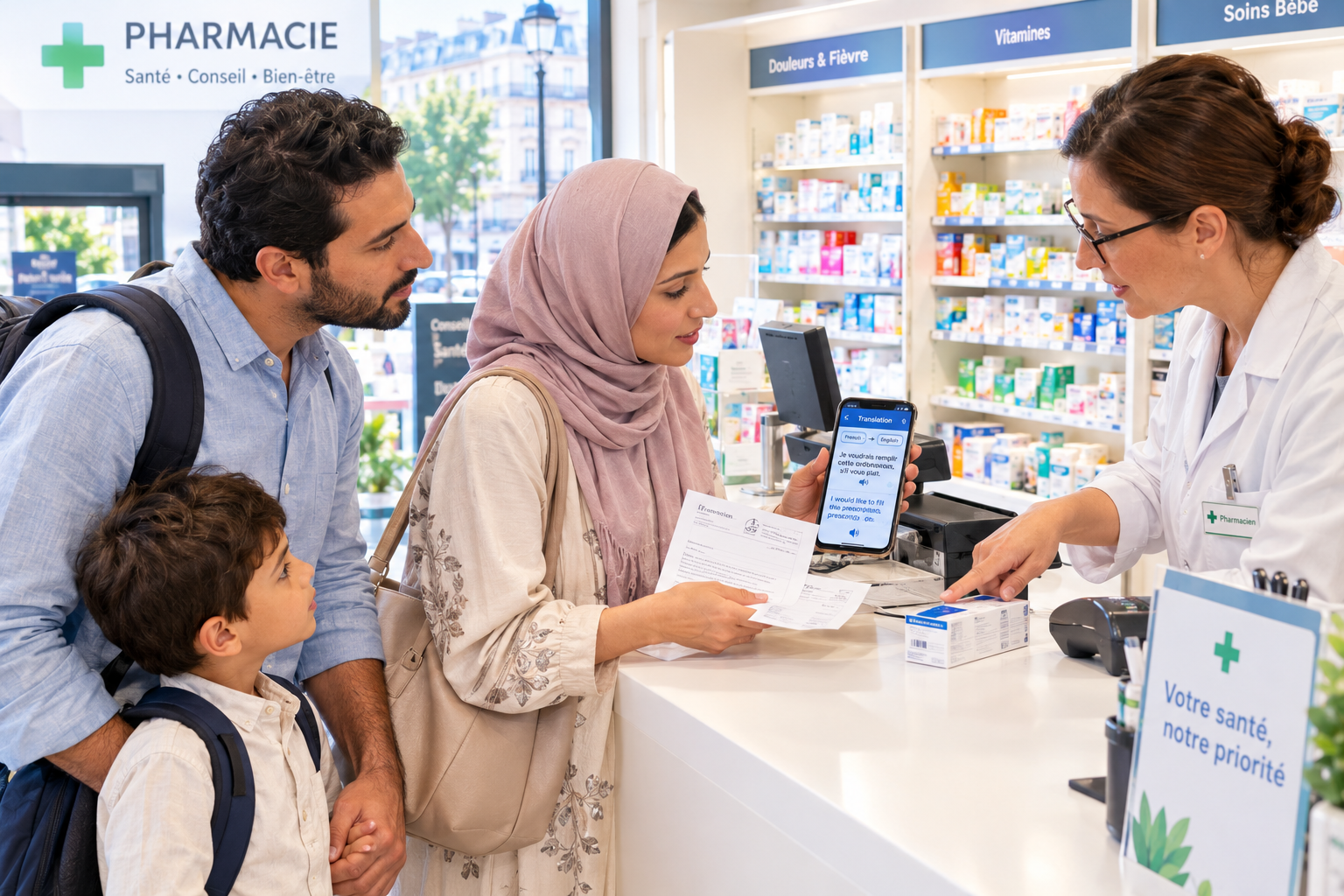
The steps you should take when trying to fill a prescription at a foreign pharmacy involve presenting your physically signed original prescription alongside your passport, clearly stating the chemical generic drug name, and using a translation tool to confirm the exact dosage before payment.
When filling a prescription at a foreign pharmacy, present your original prescription, physician’s letter, and passport; clearly state the generic drug name; use a translation app to confirm availability; and always verify the new dosage instructions before payment to ensure correct medication.
Do not assume the pharmacist will accept a digital copy of a prescription; many countries’ regulations require a physically signed paper original. Also, be prepared for the medication to look different—foreign pills often have different shapes, colors, or packaging.
Pharmacopoeia: An official publication containing a list of medicinal drugs with their effects and directions for their use. Different countries follow different pharmacopoeias, which is why drug availability and brand names vary.
How do you ensure your prescription is recognized internationally?
You ensure your prescription is recognized internationally by carrying the original, wet-ink paper copy, accompanied by a clearly typed letter from your doctor on official hospital letterhead that details the medical necessity and generic chemical name.
A prescription’s international recognition depends on its clarity and supporting documentation. The key is having the drug’s generic name, dosage, and your doctor’s full contact details, all typed clearly, as handwritten US prescriptions can be illegible and are often not accepted.
The U.S. Department of State warns travelers that “many medicines from the United States are unavailable in other countries in the same form or may be illegal.”
For an even higher level of acceptance, ask your doctor to include your diagnosis (the reason for the medication) in the letter. A foreign pharmacist is more likely to find an appropriate equivalent if they understand the medical context.
What payment options are typically accepted at pharmacies abroad?
The payment options typically accepted at pharmacies abroad are universally recognized credit cards like Visa or Mastercard and the destination’s local cash currency, whereas foreign debit cards and mobile tap-to-pay systems are significantly less reliable.
Most pharmacies in major international cities accept Visa and Mastercard. However, it is crucial to carry enough local cash to cover the expense, as smaller independent pharmacies may be cash-only, and your travel insurance will likely require you to pay upfront and file a claim later.
Many insurance plans prefer and are more cost-effective with a 90-day supply of maintenance medications, which travelers should secure before a trip to minimize out-of-pocket expenses abroad.
When paying with a credit card, the terminal may ask if you want to pay in your home currency or the local currency. Always choose the local currency to avoid “Dynamic Currency Conversion” fees, which can add 3-5% to the cost.
8. How can you overcome language barriers when seeking pharmacy assistance on vacation?
You can overcome language barriers when seeking pharmacy assistance on vacation by preemptively downloading robust translation apps with offline capabilities, carrying a professionally written list of your child’s symptoms and generic drug needs, and being prepared to employ universally understood visual gestures.
Overcoming language barriers at a foreign pharmacy requires a multi-pronged approach: utilize translation apps (especially camera and conversation modes), carry written lists of generic drug names and symptoms, and be prepared to use universal gestures, enhancing clarity for crucial medical communication.
The “camera” function in Google Translate is the most powerful tool. You can point your phone’s camera at a medication box or instruction leaflet, and it will translate the text on your screen in real time, allowing you to verify the drug and understand the dosage.
Phrasebook: A small book containing a list of common phrases in a foreign language along with their translations. A medical-specific phrasebook can be a low-tech, reliable backup to a translation app.
What translation tools are most effective for medical needs at a pharmacy?
The most effective translation tools for medical needs at a pharmacy are comprehensive smartphone applications such as Google Translate that offer integrated text, live voice conversation, and augmented-reality camera translation capabilities to decipher foreign medication labels instantly.
Google Translate is the most effective and widely accessible tool due to its multi-modal features. Its conversation mode allows for spoken dialogue, while the camera mode is invaluable for instantly translating packaging and instructions, a critical need for ensuring medication safety.
The World Health Organization (WHO) identifies poor communication as a leading global cause of patient harm, a risk that is significantly heightened for travelers dealing with language barriers.
For sensitive or complex medical discussions, consider a service like Jeenie, which provides on-demand access to live human interpreters via video call on your smartphone. It has a cost but offers a level of nuance and accuracy that machine translation cannot match for critical conversations.
How can phrasebooks help communicate pharmacy requirements to local staff?
Phrasebooks help communicate pharmacy requirements to local staff by offering a battery-free, fail-safe collection of pre-translated, grammatically precise sentences tailored specifically for common medical scenarios, eliminating the ambiguity of machine translation errors.
A medical phrasebook is a crucial, battery-free backup. You can simply point to the phrase for “I need something for a fever” or “My child has an earache,” which is often clearer and less prone to error than a poorly translated app sentence.
The CDC directly advises travelers to “have a plan for how to obtain care while abroad,” which includes pre-translating key medical phrases and medication names into the local language.
The true value of a phrasebook is not just the phrases but the “pointing” factor. The act of pointing to a professionally translated sentence in a book feels more official and is often more easily understood by an older pharmacist than a glowing phone screen.
9. What should you do if you cannot find an open pharmacy or your medication while traveling?
If you cannot find an open pharmacy or your medication while traveling, your immediate next steps are to dial your travel insurance’s 24/7 global assistance hotline, proceed to the nearest hospital’s emergency room for critical issues, or contact your country’s local embassy for vetted medical referrals.
In this emergency situation, immediately call the 24/7 assistance number on your travel insurance card, as they can direct you to emergency medical services. If the need is life-threatening or urgent, go directly to the nearest hospital emergency department (“Urgencias” in Spanish, “Pronto Soccorso” in Italian).
Many travel insurance providers partner with global assistance companies like International SOS, which have their own network of vetted doctors and clinics. Calling them first can be much faster than navigating the local public system on your own.
Case Officer: A representative from a travel assistance or insurance company assigned to manage your specific medical incident. This person becomes your single point of contact to coordinate care, payment, and communication.
When should you contact your travel insurance for pharmacy-related issues?
You should contact your travel insurance for pharmacy-related issues the moment you anticipate a significant out-of-pocket prescription expense, face a language barrier preventing care, or find yourself entirely unable to source a medically necessary, life-sustaining drug.
Contact your travel insurance’s 24/7 helpline immediately if you need to fill a high-cost prescription, if you require assistance locating a specialist or clinic to obtain a new prescription, or if you have lost essential medication. Do not wait until after you’ve paid to find out if it’s a covered expense.
Many major travel insurance policies include 24/7 assistance hotlines that can provide critical services, such as a “doctor locator” to find a local physician who can issue a valid local prescription.
Many policies require “pre-authorization” for non-emergency medical expenses over a certain amount. Calling first ensures your claim won’t be denied later on a technicality, protecting your family’s finances.
How can embassies or consulates assist with emergency medication needs abroad?
Embassies or consulates can assist with emergency medication needs abroad primarily by acting as an information hub, providing lists of vetted local doctors and hospitals, and serving as a liaison to help contact family back home or arrange emergency fund transfers.
An embassy is a resource for information, not a source of medication or medical care. They can give you a list of reputable local English-speaking doctors who can write a new prescription, but they will not provide or pay for the medication itself.
The U.S. Department of State provides explicit warnings to travelers that many common medicines may be considered illegal or unavailable abroad, underscoring the need for official documentation.
The primary role of a consular officer in a medical emergency is to ensure you are receiving treatment equal to that of a local citizen and to assist if you are unfairly detained or treated. They are your legal and logistical safety net, not a medical one.
Resolution
In conclusion, successfully finding an open pharmacy while on vacation relies on proactive pre-travel preparation, effectively leveraging digital tools like mapping apps, understanding local pharmacy customs, and having a clear emergency plan, transforming potential crises into manageable situations for a safer family trip. The confidence gained from having a robust pharmacy-finding plan reduces travel anxiety for the entire family, allowing parents to relax and enjoy the vacation knowing they are prepared for minor health challenges. The final decision is to internalize this process, turning it into a standard part of your family’s pre-travel checklist for every future vacation. With these strategies, you are fully equipped to handle any minor medical need, ensuring your family’s vacation remains healthy, safe, and memorable.
For a comprehensive guide to all aspects of your journey, exploring our full resource on planning a family vacation step by step builds upon these essential health foundations.