How to Leave the Hotel on Time on Family Vacation
Table of Contents
Leaving the hotel on time for family vacations is crucial because it directly prevents financial penalties like late fees or missed transport costs, mitigates travel-day stress, and protects the schedule for onward travel.
Mastering your family’s hotel departure ensures a smooth transition, but understanding the entire family vacation planning process step by step ensures every part of your trip is seamless.
1. Why Is Leaving the Hotel on Time Crucial for Family Vacations?
Leaving the hotel on time is crucial for family vacations because it directly prevents financial penalties, mitigates travel-day stress, and protects the schedule for onward travel.
An on-time departure avoids costly late check-out fees and missed flight or transportation costs. It also ensures the final hours of a vacation are calm and organized, preserving positive family memories. Beyond obvious flight times, an on-time departure is critical at destinations with unique logistical challenges. For example, leaving a ski resort on a Sunday requires beating mountain pass traffic, while departing a remote island resort means aligning perfectly with a once-a-day ferry schedule. Prioritize a rigorously planned on-time departure if your travel day includes fixed, non-refundable transport like flights, trains, or cruises, or if you face a long drive with known traffic choke points. Understanding these high stakes makes pre-planning essential, leading directly into strategies for preparing the night before check-out.
Define “Hotel Folio” as the itemized statement of all charges incurred during a hotel stay, including room rate, taxes, in-room dining, and incidentals.
What Are the Hidden Costs of Late Hotel Departures?
Hidden costs of late hotel departures include substantial late check-out fees (50-100% of nightly rate), rebooking penalties for missed transport, inflated costs for last-minute travel solutions, and loss of value from pre-paid activities due to time crunch. A late departure can trigger an automatic late check-out fee, often equivalent to 50-100% of the nightly rate. It can also force families to pay premium prices for last-minute transportation or meals due to a compressed schedule.
A late check-out fee can range anywhere from $20 to the cost of an additional night’s stay. SmarterTravel
A significant hidden cost is “decision fatigue.” When rushed, parents are more likely to make poor financial choices, such as taking an overpriced taxi instead of a pre-booked shuttle or buying expensive airport food instead of eating packed snacks.

Timely departures prevent hidden costs and reduce travel day stress.
© WovenVoyages.com
Rushing eliminates the opportunity to use money-saving options like public transport or pre-booked airport transfers.
How Does Timely Departure Enhance the Family Vacation Experience?
A timely hotel departure enhances the family vacation experience by fostering a calm and controlled travel pace, enabling relaxed meals, unhurried transit, and reducing parent-child conflict, ultimately preserving positive memories and minimizing stress. By leaving on time, families replace chaos and anxiety with a relaxed travel pace. This allows for a final pleasant meal, unhurried travel to the airport or next destination, and a reduction in parent-child conflict.
According to one 2023 study, 47% of travelers are planning a multigenerational trip, making the seamless coordination of multiple family units a high-stakes priority. Kayak
A timely departure creates “buffer time,” an un-scheduled block that can be used opportunistically. This buffer allows for unexpected bathroom stops, a final photo opportunity, or simply absorbing a rental car return delay without stress, turning a potential crisis into a minor inconvenience.
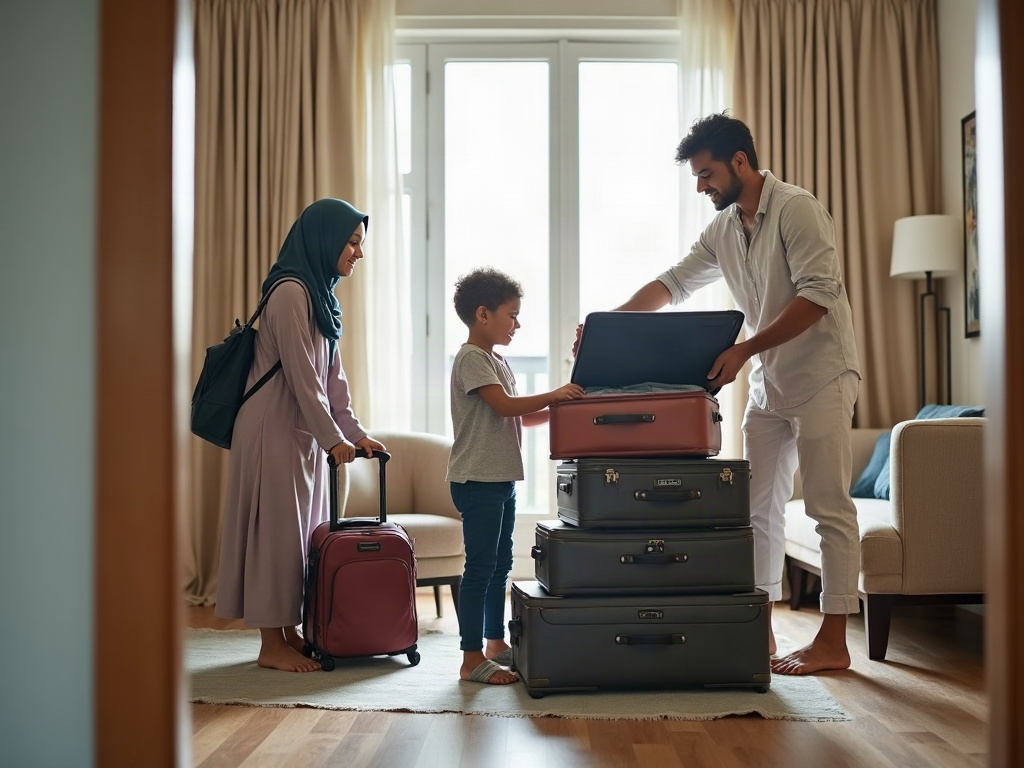
A relaxed morning sets a positive tone for the entire travel day.
© WovenVoyages.com
This organized process models effective life skills for children, teaching them the value of planning and cooperation.
2. How Can Families Prepare the Night Before Hotel Check-Out?
Families can prepare for an on-time hotel check-out by systematically pre-packing non-essentials, staging luggage, and settling the hotel bill the night before.
The most effective night-before preparation involves reducing the next day’s tasks to only waking, dressing, eating, and leaving. This is achieved by packing almost everything, organizing bags by the door, and resolving any administrative issues with the front desk in advance. Introduce the concept of a “Departure Eve Power Hour.” Frame this not as a chore but as a focused, 60-minute family activity where everyone has a role. This gamifies the process and concentrates the effort into a single, manageable block of time. Implement a comprehensive night-before routine if you have an early morning flight, are traveling with multiple young children, or are staying in a large, complex resort where moving luggage takes significant time. These three core night-before actions—packing, staging, and settling—form the foundation for a successful departure, making the next morning’s decisions for yourself in advance, reducing cognitive load on travel day.
Define “Luggage Staging” as the process of consolidating all packed bags, carry-ons, and loose items in a designated area near the hotel room door to streamline loading and prevent items from being left behind.
What Items Should Families Pack First the Evening Before?
Families should pack non-essential items first the evening before departure. This includes all clothing not worn for travel, souvenirs, most toys, and any electronics or chargers not required overnight, streamlining morning tasks. The evening before, you must pack all clothing except the next day’s travel outfits. This includes packing all purchased souvenirs, books, toys (except one for the morning), and any electronics and chargers not needed overnight.
Travelers commonly forget toiletries in the shower and phone chargers in out-of-sight electrical outlets, making these the first items to seek and pack the night before. Beaches Blog
The most overlooked items to pre-pack are “destination-specific gear.” For a beach vacation, this means sandy towels, fins, and snorkels are packed first. For a ski trip, it means ski jackets, helmets, and boots are consolidated and packed away, not left out to be tripped over.

Visual guides help ensure nothing is left behind during the night-before pack.
© WovenVoyages.com
Explicitly state NOT to pack travel day outfits, essential medications, or a minimal toiletry kit (Dopp kit).
How to Coordinate Luggage Staging for a Faster Morning Departure?
Coordinate luggage staging for a faster morning departure by designating a single area near the hotel room door as a “staging area.” Move each packed suitcase there immediately, creating distinct “packed” and “unpacked” zones for an efficient exit. Choose one wall or corner near the hotel room door as your “staging area.” As each suitcase is packed and closed, move it directly to this area to create a clear “packed” zone and an “unpacked” zone.
According to hospitality tipping guides, a tip of $1-2 per bag for a bellhop or valet is standard for acknowledging their service. WoodSpring Suites
Advanced luggage staging involves a “load-out order.” Place large, heavy checked bags at the back of the staging area and essential carry-ons and backpacks at the front. This ensures the bell captain or family members grab bags in the correct order for loading onto a cart or into a car.

Proper luggage staging near the door ensures a swift exit.
© WovenVoyages.com
Take a quick photo of your staged luggage pile. This serves as a mental checklist and confirms the number of bags you have.
Why Should You Settle Incidental Bills the Night Before?
Settle incidental bills the night before to calmly review your Hotel Folio for errors, dispute incorrect charges, and ensure a rapid, stress-free key-drop checkout in the morning, avoiding front desk queues. Reviewing your Hotel Folio the evening prior allows you to calmly check for errors, such as mini-bar mistakes or incorrect restaurant charges. Correcting these issues is faster and easier when the front desk is not busy with the morning check-out rush.
It’s a common observation that some hotels may tack on hidden fees, making a night-before review critical to dispute potential errors like incorrect minibar charges. FreshBenies
Settling the bill the night before is also a security measure. It confirms the final total and prompts the release of any large “incidental holds” on your credit card, freeing up your available credit for travel-day expenses. This is especially crucial for families on a tighter budget using a debit card.

Reviewing the folio at night prevents stressful disputes in the morning.
© WovenVoyages.com
Request a printed or emailed copy of the final folio for your records after settling the bill.
3. What Strategies Streamline the Morning of Hotel Departure with Kids?
Strategies to streamline the morning of hotel departure with kids involve establishing a fixed schedule, assigning age-appropriate jobs, and executing a systematic final room sweep.
A streamlined departure morning requires a non-negotiable wake-up time, a simple breakfast plan, and giving children specific, simple tasks to contribute. This structured approach minimizes unstructured time, which is where delays and conflicts often originate. Introduce the “One Last Thing” box. This is an open, empty box or bag where all final items go: the TV remote, the charging phone, the last-minute toiletries. The final step before leaving is to close and pack this one box, preventing the frantic “where is the…” search. Employ these strict morning strategies if your family includes toddlers or children who struggle with transitions, as the predictability reduces their anxiety and increases cooperation. This structured morning is composed of three key elements: a consistent schedule, child involvement, and a thorough final check.
Define “Departure Day Captain” as an assigned role for a parent who is responsible for the timeline and final checklist, while the other parent focuses on managing the children’s needs, dividing labor to prevent confusion.
How to Establish a Consistent Morning Schedule for Departure Day?
Establish a consistent morning schedule by first determining your “room exit” time. Then, work backward, allocating specific time blocks for tasks like final sweep (10 min), packing (15 min), dressing (20 min), and breakfast (30 min) to set your wake-up time. To establish a consistent morning schedule for departure day, work backward from your must-leave time and assign specific time blocks for each activity. First, set a hard “room exit” time. From there, subtract time for a final sweep (10 mins), final packing (15 mins), dressing (20 mins), and breakfast (30 mins) to determine your wake-up time.
For broader planning, consider the importance of a flexible family vacation itinerary to accommodate unexpected changes throughout your trip.
Most hotels require guests to check out between 11:00 a.m. and noon, creating a fixed deadline to build a morning schedule around.
The key to a successful schedule is to use an “alarm for every transition.” Set phone alarms not just for wake-up, but for “Start getting dressed,” “Finish breakfast,” and “10 minutes to go.” These alarms act as an impartial, non-nagging timekeeper that kids often respond to better than a parent’s verbal reminders.
What Roles Can Children Play to Help with Departure Tasks?
Children can help with departure tasks by taking on age-appropriate roles. Young kids (3-6) can pack their toys or strip beds, while older kids (7+) can manage their carry-ons, check for chargers, or move small suitcases, fostering teamwork. Assign young children (ages 3-6) tasks like putting their toys into a designated backpack or pulling the sheets and blankets off their bed. Older children (ages 7+) can be responsible for packing their entire carry-on, checking outlets for chargers, or transporting a small suitcase to the door.
Preparing children for what is expected of them can “cut the battle in half,” suggesting that involving them in the process significantly improves cooperation.
A powerful role for a school-aged child is the “Official Room Inspector.” Give them a flashlight and the “job” of checking under beds, in closets, and behind curtains for any forgotten items. This turns a final check into a fun game and leverages their lower vantage point.
How to Conduct a Final Room Sweep to Avoid Leaving Items Behind?
Conduct a final room sweep using a methodical, nine-point check: bed, bathroom, closet, drawers, safe, under furniture, behind curtains, outlets, and the main door. One adult performs the sweep while the other supervises children, preventing forgotten items. The most effective final sweep involves a nine-point check: bed (under/in), bathroom (shower/counter), closet (shelf/floor), drawers, safe, under furniture, behind curtains, outlets, and the back of the main door. One adult should perform the sweep while the other supervises the children at the door.
Implement the “empty room look-back.” After all luggage and people are in the hallway, have one adult stand at the threshold and do one last, slow visual pan of the now-empty room. This final glance from a different perspective often reveals an out-of-place item (like a phone on a nightstand) that was missed during the close-up sweep.
The person performing the sweep must not be holding any bags or children, ensuring their full focus is on the task.
4. How to Pack Efficiently with Children for a Quick Hotel Exit?
Packing efficiently with children for a quick hotel exit requires using a modular system like packing cubes and pre-planning all travel outfits.
To pack efficiently with children for a quick hotel exit, employ compartmentalization and accessibility. Use packing cubes for organization and maintain a separate, easily reachable “essentials bag” for travel day, simplifying the process for the whole family. Efficient family packing relies on two core principles: compartmentalization and accessibility. Use packing cubes to separate items by child or day, and always keep a travel-day essentials bag separate and easily reachable. Choose to invest in a quality set of packing cubes if your family frequently takes multi-destination trips or travels with children of different ages, as the system’s modularity simplifies daily unpacking and repacking. Efficient packing is a combination of long-term technique and last-minute execution.
Define “Essentials Bag” (or “Go-Bag”) as a single, accessible backpack or tote that contains everything needed for the immediate travel leg (e.g., from hotel to airport), including snacks, documents, medications, wipes, and a single activity for each child.
What Are the Best Techniques for Last-Minute Packing with Family?
The best last-minute packing techniques for families involve a “catch-all” bag for all remaining morning-use items and a pre-defined spot for each. This prevents items like damp toiletries or chargers from getting lost or haphazardly stuffed. On departure morning, all final items—damp toothbrushes, pajamas, phone chargers, and comfort toys—should go into one designated “last-out” bag or the aforementioned “One Last Thing” box. This prevents small items from being shoved into random suitcase pockets where they get lost.
Use the “Bathroom Sweep Bag.” Bring an empty, gallon-sized zip-top bag. The very last packing step is to take this bag into the bathroom and sweep everything left on the counter—toothbrushes, toothpaste, hairbrushes—into it. This clears an entire room in 30 seconds and keeps damp items separate.
The ‘last-out’ bag must be a carry-on, never a checked bag, as it contains essential items.
How to Manage Essentials for Easy Access During Travel?
Manage essentials for easy access by dedicating one well-organized “Essentials Bag” for travel, containing passports, boarding passes, medications, wipes, portable chargers, snacks, and water bottles for each family member, ensuring critical items are always at hand. The most effective method is to dedicate one parent’s backpack as the family “Essentials Bag.” This bag must contain passports, boarding passes, medications, a full pack of wipes, a portable charger, and a specific snack and water bottle for every family member.
For a comprehensive guide, understand what belongs in family vacation carry-on bags to ensure all critical items are included and easily accessible.
The TSA’s 3oz limitation on liquids in carry-on bags does not apply to breast milk, baby food, or formula, a critical rule for families packing an essentials bag.
Practice “vertical zoning” within the Essentials Bag. Heavy, less-used items (like a change of clothes) go on the bottom. Medium-access items (like snacks) go in the middle. High-access items (like wipes, documents, and phones) go in the top zippered pockets or front compartments for immediate retrieval without searching.
5. What Common Mistakes Delay Families Leaving the Hotel on Time?
The most common mistakes that delay families leaving the hotel on time are underestimating the time required, failing to pre-plan, and giving in to last-minute requests from children.
Common mistakes delaying families from leaving hotels on time include underestimating required time, lack of pre-planning, succumbing to children’s last-minute requests, overlooking hotel check-out times, and disorganized packing, all contributing to unnecessary stress and missed schedules. Delays are most often caused by a combination of logistical errors and psychological traps. These include not knowing the hotel’s check-out time, disorganized packing, unresolved bill issues, and the classic “one more swim” or last-minute souvenir hunt. If your family is prone to distraction or has a history of running late, you must adopt a zero-tolerance policy for any unscheduled activities on departure morning to ensure success. These mistakes are entirely preventable.
Define the “Planning Fallacy” as the cognitive bias where individuals underestimate the time needed to complete a future task, despite knowing that similar tasks have taken longer in the past. This is the core psychological error of departure day planning.
How to Avoid the “One More Swim” or “Last-Minute Souvenir” Trap?
Avoid the “one more swim” or “last-minute souvenir” trap by setting clear expectations with children the night before, reframing departure morning as a “travel day,” and establishing post-checkout rituals (e.g., airport smoothie) as rewards for cooperation. On the night before departure, explicitly tell your children, “Tomorrow is our travel day. We will not be going to the pool or the gift shop. Our job is to pack up and get to the airport for our trip home.” This pre-communication removes the element of surprise and reduces morning negotiations.
Create a “post-checkout ritual.” Instead of the pool, promise a specific, controlled treat that happens *after* you have successfully checked out. For example, “As soon as we drop the keys, we can all get a smoothie from the airport cafe” or “Once we are in the car, you can have your screen time.” This shifts the reward to post-compliance.
A parent’s firm, consistent, and empathetic “no” is the most crucial tool in avoiding this trap.
What Happens If Children Are Not Cooperating on Departure Day?
If children are uncooperative on departure day, parents should pause, validate feelings empathically, then offer a simple binary choice to regain control (e.g., “Red shoes or blue shoes?”). If frustration escalates, a “tag-out” system with another parent can help de-escalate. If children are not cooperating on departure day, the primary parent should pause, de-escalate the situation with empathy, and then present a simple, binary choice to regain control. First, stop what you are doing, make eye contact, and validate their feeling (e.g., “I know you are sad to leave”). Then, offer a simple, controlled choice: “We have to put on our shoes now. Do you want to wear the red shoes or the blue shoes?”
Understanding these de-escalation strategies is key to preventing family travel conflicts throughout your entire vacation journey.
Implement the “tag-out” system. If one parent is feeling frustrated and escalating the conflict with a non-cooperative child, they should “tag out.” The other parent, who is less emotionally invested in that specific conflict, steps in. This prevents a downward spiral and allows the first parent a moment to regulate their own emotions.
Stress that the parent’s emotional regulation is the most important factor in the outcome. The child will mirror the parent’s stress. For toddlers experiencing the most trouble, use “Calm-Down Phrases,” such as “I see you’re having a hard time,” and “Let’s take a deep breath together.”
6. How to Troubleshoot Unexpected Delays on Hotel Departure Day?
To troubleshoot unexpected delays on hotel departure day, you must first triage the problem’s severity, adjust your plan accordingly, and communicate clearly with all family members.
Troubleshoot unexpected hotel departure delays by triaging the problem’s severity (minor inconvenience vs. major crisis). Adjust your plan by either compressing the schedule for minor issues or activating a full contingency plan (e.g., rebooking) for significant delays, communicating clearly with family. When an unexpected delay occurs, first determine if it’s a minor inconvenience (e.g., long elevator wait) or a major problem (e.g., lost passport). Based on the severity, you may need to either compress your existing schedule or activate a full contingency plan. Immediately activate your most drastic contingency plan (e.g., preparing to call the airline to rebook) if the delay involves a lost passport, a medical issue, or a missed transport connection. While many problems can arise, two of the most common are a lost item and unforeseen circumstances, which require specific solutions. Maintaining command and control empowers the parent to be a problem-solver, not a victim of circumstance.
Define “Triage” in a travel context as the process of quickly assessing a problem to determine its priority and impact on the overall travel plan.
What If You Cannot Find a Crucial Item Before Leaving the Room?
If a crucial item is lost before leaving the room, immediately stop all other tasks, initiate a family “silent search” in the last known area, and systematically clear likely hiding spots, prioritizing calm focus over panic to locate it efficiently. If you cannot find a crucial item before leaving the room, immediately stop all other packing, have the entire family freeze, and conduct a “silent search” of the area where it was last seen. First, stop and remove all other distractions. Ask the person who had it last to retrace their steps verbally. Then, systematically clear and search the single most likely area (e.g., the nightstand for a phone, the child’s backpack for a toy) before expanding the search.
Most lost items are not “lost”; they are “obscured.” The item is often under another object. Instead of just looking, you must physically move items. For a lost wallet or phone, this means lifting every pillow, blanket, and piece of clothing in the immediate vicinity. The “silent search” rule prevents panicked yelling, which hinders concentration.
Emphasize the importance of staying calm: “Your panic will not help you find the item. A calm mind will.”
How to Adjust Your Departure Plan for Unforeseen Circumstances?
Adjust your departure plan for unforeseen circumstances by immediately shifting to a “minimum viable plan.” Identify the single most critical deadline (e.g., reaching the airport) and eliminate all non-essential steps, even if it means incurring “sacrificial costs” like taxis over shuttles. To adjust your departure plan for unforeseen circumstances, you must immediately shift from your “ideal plan” to a “minimum viable plan” that protects your most critical deadline. When a major delay occurs (e.g., a sick child, a car that won’t start), identify your single most important next step (e.g., “get to the airport”). Then, ruthlessly cut all non-essential steps from your plan—skip meals, take a taxi instead of a shuttle, and re-route if necessary to achieve that one goal.
Comprehensive planning for family vacation safety can significantly reduce stress and improve outcomes when facing unexpected delays or emergencies.
Use the concept of “sacrificial costs.” Be mentally prepared to “sacrifice” money to save time. This means immediately deciding to pay for an expensive taxi, abandon a pre-paid but non-essential activity, or pay an airline’s change fee. Trying to save a small amount of money during a major delay often leads to a much larger, catastrophic financial loss (like missing an international flight).
If your rental car has a flat tire, the new plan is not ‘fix the tire.’ The new plan is ‘get to the airport.’ This means immediately calling a taxi and dealing with the rental car company by phone.
7. Logistics: Hotel Checkout Preparation Checklist
| Checklist Item / Tactic | Status |
|---|---|
| NIGHT BEFORE: Pre-pack all items not needed for departure morning. | ⬜ |
| NIGHT BEFORE: Stage all packed luggage near the room’s exit. | ⬜ |
| NIGHT BEFORE: Settle incidental hotel charges to ensure key-drop checkout. | ⬜ |
| MORNING: Establish a fixed wake-up and departure schedule. | ⬜ |
| MORNING: Assign age-appropriate departure tasks to children. | ⬜ |
| MORNING: Conduct a systematic final room sweep. | ⬜ |
| PACKING: Utilize packing cubes and an essentials bag. | ⬜ |
| PACKING: Prepare a “catch-all” bag for last-minute items. | ⬜ |
| ISSUES: Pre-empt “one more swim” or souvenir requests. | ⬜ |
| ISSUES: Have de-escalation tactics for uncooperative children. | ⬜ |
| ISSUES: Know the protocol for lost items. | ⬜ |
| ISSUES: Prepare to adjust the plan for unforeseen circumstances. | ⬜ |
Frequently Asked Questions
Why is leaving the hotel on time crucial for family vacations?
What should families pack first the evening before departure?
How do you establish a consistent morning schedule for departure day?
How to avoid the ‘one more swim’ or ‘last-minute souvenir’ trap?
Resolution
Mastering your family’s hotel departure ensures a stress-free travel experience by implementing a disciplined system of night-before preparation, executing a structured morning plan, and establishing contingencies for unexpected delays. This proactive approach eliminates chaos and preserves positive vacation memories. The skills used to master a hotel departure—planning, communication, teamwork, and grace under pressure—are the same skills that define successful family travel in general. Mastering this one, recurring event builds a “competence flywheel” that makes every future trip easier. By architecting your exit, you ensure your family’s vacation ends on a high note, preserving the joy and connection you worked so hard to create.