What Essential Safety Items to Pack for a Family Vacation?
Table of Contents
To ensure a safe family vacation, you must pack a tailored safety kit that includes essential first aid supplies, reliable communication devices, and specific personal protection items. Preparing these tools in advance transforms potential travel crises into easily manageable inconveniences, giving you total peace of mind while exploring.
To fully grasp the scope of protective measures for your journey, consider understanding how to plan for overall family vacation safety, which encompasses far more than just what you pack.
1. Why are essential safety items crucial for any family vacation?
Packing a dedicated safety kit is the ultimate form of proactive travel insurance. It equips you to handle sudden medical hiccups, navigate environmental shifts, and maintain contact during network outages. Having these resources at your fingertips bridges the gap between an emergency occurring and professional help arriving.

How do safety items prepare families for unexpected travel emergencies?
Safety items buy you time by offering immediate solutions. Whether it is treating a cut, navigating when lost, or calling for help, having the right gear reduces panic and keeps a small problem from becoming a large emergency.
Health experts state that travelers’ diarrhea causes dehydration that impairs the body’s ability to heal even minor cuts, making a good medical kit vital.
The main job of a travel safety kit is ‘time-buying.’ It gives you the first aid, shelter, and communication tools to stabilize a bad situation and keep everyone safe while waiting for help to arrive. This approach is key to managing common travel mishaps with kids.
What are the risks of traveling with family without essential safety items?
Traveling without safety items causes high stress, ruined travel plans, and genuine danger. Minor issues become big problems, and life-threatening incidents become unmanageable because you cannot respond quickly or help yourself.
A 2023 survey revealed that nearly half of U.S. international travelers experienced a travel-related problem, which becomes much worse if you are traveling without a safety kit.
A major hidden risk is ‘decision fatigue.’ In a stressful situation without the right tools, parents are forced to make hard choices under pressure, which often leads to bad outcomes. A safety kit provides ready-made solutions, making it easier to think clearly during a crisis, much like considering travel insurance benefits for families provides a financial safety net.
Author’s Experience
“On a remote family hike, my son unexpectedly cut his hand. Our compact first-aid kit was invaluable, allowing us to clean and bandage the wound quickly, preventing further issues until we reached medical care. It truly cemented my belief in proactive preparedness.”
2. Which types of essential safety items should your family pack for different vacation types?
The types of essential safety items your family should pack must be customized for different vacation types, with core supplies for first aid, personal protection, communication, and emergencies being adapted to the specific environment.
For a beach vacation, prioritize sunburn relief and sting kits, whereas a hiking trip demands blister care and a satellite messenger. Use the Family Vacation Safety Item Selection Matrix below to cross-reference your destination with item categories and build a smarter, more efficient safety kit.
| Item Category | Beach Vacation | Mountain/Wilderness Trip | City/International Travel |
|---|---|---|---|
| First Aid | Sunscreen (SPF 50+), after-sun lotion, sting relief, waterproof bandages | Blister kit, wound closure strips, anti-inflammatory, snake bite kit (if relevant) | Antacids, motion sickness meds, general pain relievers |
| Personal Protection | Child ID bracelets, UV protective clothing, waterproof phone case | Emergency whistle, bear spray (if permitted), headlamp, multi-tool | Personal alarm, secure money belt, travel lock, anti-theft bag |
| Communication | Power bank, charged phone, waterproof dry bag for electronics | Satellite messenger, portable charger, physical map, compass | Local SIM/eSIM, portable charger, universal adapter, offline maps |
| Emergency Survival | Emergency blanket, basic shelter (tarp/poncho), water bottle | Emergency blanket, fire starter, water purification, signaling mirror | Emergency contact card, small flashlight, backup cash |
What basic first aid supplies are essential for family travel?
Essential family travel first aid supplies include wound care items (bandages, antiseptic wipes), pain relievers (ibuprofen or acetaminophen), allergy medicines like diphenhydramine, hydrocortisone cream, and any personal prescription medications such as an EpiPen.
Health experts state that travelers’ diarrhea causes dehydration that impairs the body’s ability to heal even minor cuts, making a good medical kit vital.
Experienced family travelers make ‘incident packs’ inside their main kit. These are small plastic bags with everything needed for one issue (like a ‘scrape pack’ with an antiseptic wipe, two bandages, and ointment). This saves time and keeps the main kit organized during a stressful moment.
Essential First Aid Categories
- Wound Care: Adhesive bandages (various sizes), antiseptic wipes, antibiotic ointment, medical tape.
- Pain & Fever Management: Ibuprofen or acetaminophen (child and adult dosages), thermometer.
- Allergic Reactions & Irritations: Diphenhydramine (antihistamine), hydrocortisone cream, EpiPen (if prescribed).
- Other Essentials: Hand sanitizer, tweezers, safety pins, saline solution.
Parent Tip: Always pack child-specific dosages and a marked measuring spoon; never guess a child’s dose from adult medicine.
How can personal protection items enhance family safety abroad?
Personal protection items enhance family safety abroad by scaring away threats and drawing quick attention. Items like personal alarms or whistles help, while child ID bracelets with your phone number make it much easier to reunite with a lost child.
A national poll found that 75% of parents are concerned about child abduction, and physical safety devices can directly help lower that anxiety.
The most effective protection is often simple information. Before you go, teach older children the local word for “help” and point out “safe zones” on a map (like police stations or hotel lobbies) where they can go if lost. This is a crucial step when creating a family safety plan for travel.
Key Personal Protection Items
- Personal Alarm/Whistle: A loud, easily reachable device to signal for help.
- Child ID Bracelet: A wristband with anonymous contact information.
- Secure Storage: A money belt or anti-theft bag to keep passports and cash safe.
Beyond protective items, it’s also vital to consider broader strategies to prevent children from getting lost on family vacation, which works hand-in-hand with your packed safety gear.
3. How do you choose the right communication and emergency tools for family adventures?
Choosing the right communication and emergency tools for family adventures requires looking at your destination’s phone service, power availability, and how isolated you will be.
For remote wilderness trips, a satellite messenger is a must-have, while for city travel abroad, a local SIM card and a power bank are key. Use the Communication & Emergency Tool Decision Framework below to figure out the exact system your family needs for your trip.
| Travel Scenario | Primary Tool | Essential Backup | Emergency Backup (Tertiary) |
|---|---|---|---|
| Urban (Domestic) | Charged Smartphone | Portable Charger (Power Bank) | Written Emergency Contacts, Public Phones |
| Urban (International) | Charged Smartphone with Local SIM/eSIM | Portable Charger, Universal Adapter | Written Emergency Contacts, Hotel Information Card |
| Rural/Wilderness (Good Cell) | Charged Smartphone | Portable Charger, Offline Maps | Emergency Whistle, Physical Map & Compass |
| Remote/Wilderness (No Cell) | Satellite Messenger | Portable Charger, Headlamp, Map & Compass | Personal Locator Beacon (PLB), Signaling Mirror |
What essential communication devices keep families connected in an emergency?
Essential communication devices include a fully charged cell phone, a high-capacity portable charger (at least 10,000mAh), and a smart backup like a local SIM card for international trips or a satellite messenger for remote nature areas.
A recent survey revealed that 78% of parents make a detailed packing list, and keeping chargers on that list is critical because a dead phone is useless in an emergency.
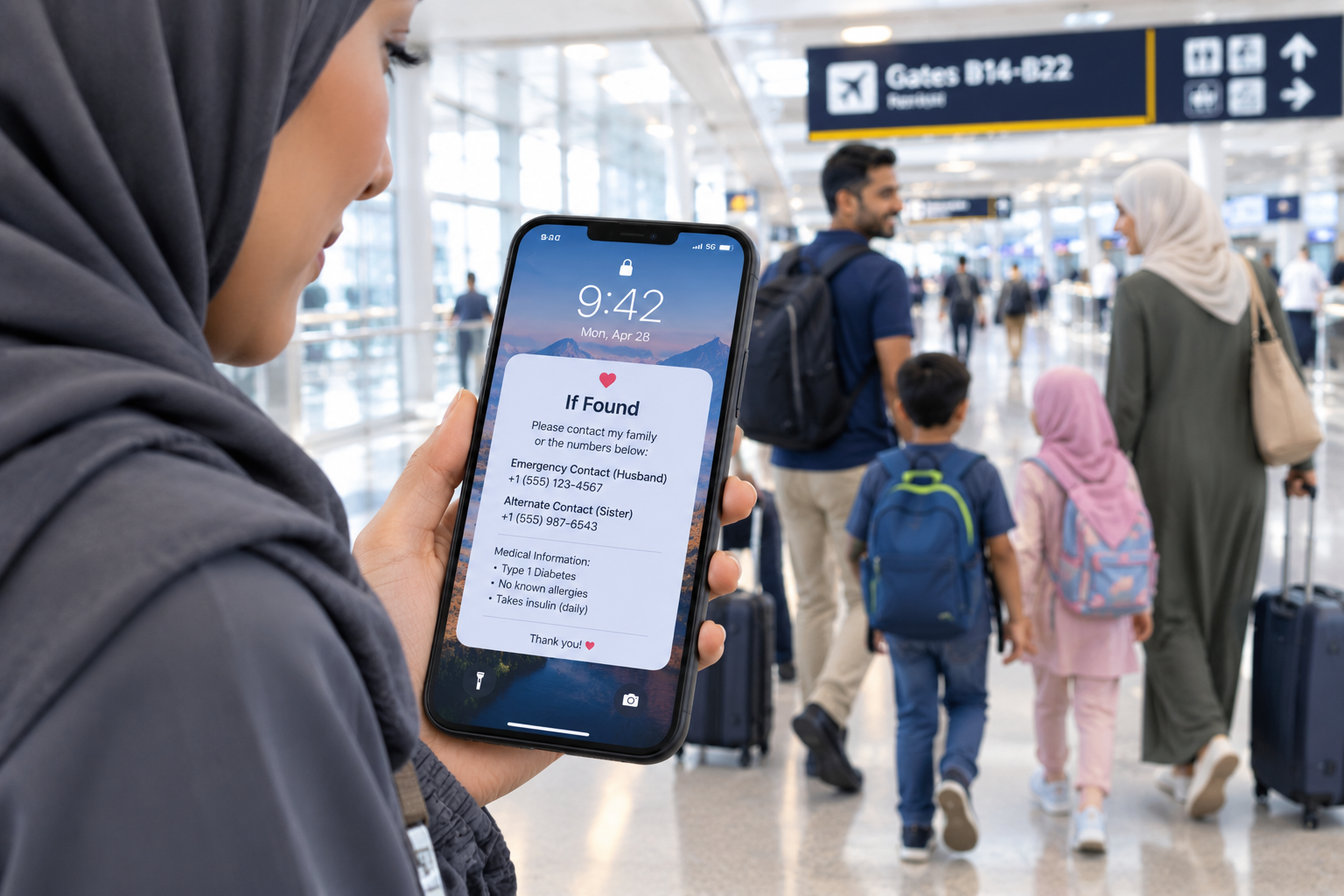
The “lock screen” trick is a great, simple safety hack. Before traveling, change your phone’s lock screen wallpaper to an image showing an “If Found” message with an emergency contact number and any serious medical info (like “Allergic to penicillin”). This shares important facts even if the phone is locked, adding value alongside choosing the best portable chargers for travel.
Essential Communication Devices
- Primary Phone: Fully charged and ready.
- Portable Charger (Power Bank): At least 10,000mAh capacity to refill batteries quickly.
- Local SIM Card/eSIM: For cheap, reliable international data.
- Satellite Messenger: To text via satellites when there is zero cell service.
- Universal Travel Adapter: To plug into wall outlets anywhere in the world.
Which emergency survival items provide crucial support during unexpected family situations?
Important survival tools include Mylar emergency blankets for warmth, a loud whistle for signaling, a reliable headlamp, water purification tablets, and a versatile multi-tool.
According to the Centers for Disease Control and Prevention (CDC), drowning is a major risk for young children, reinforcing the need for survival items like proper, U.S. Coast Guard-approved life vests when near water, rather than cheap inflatable toys.
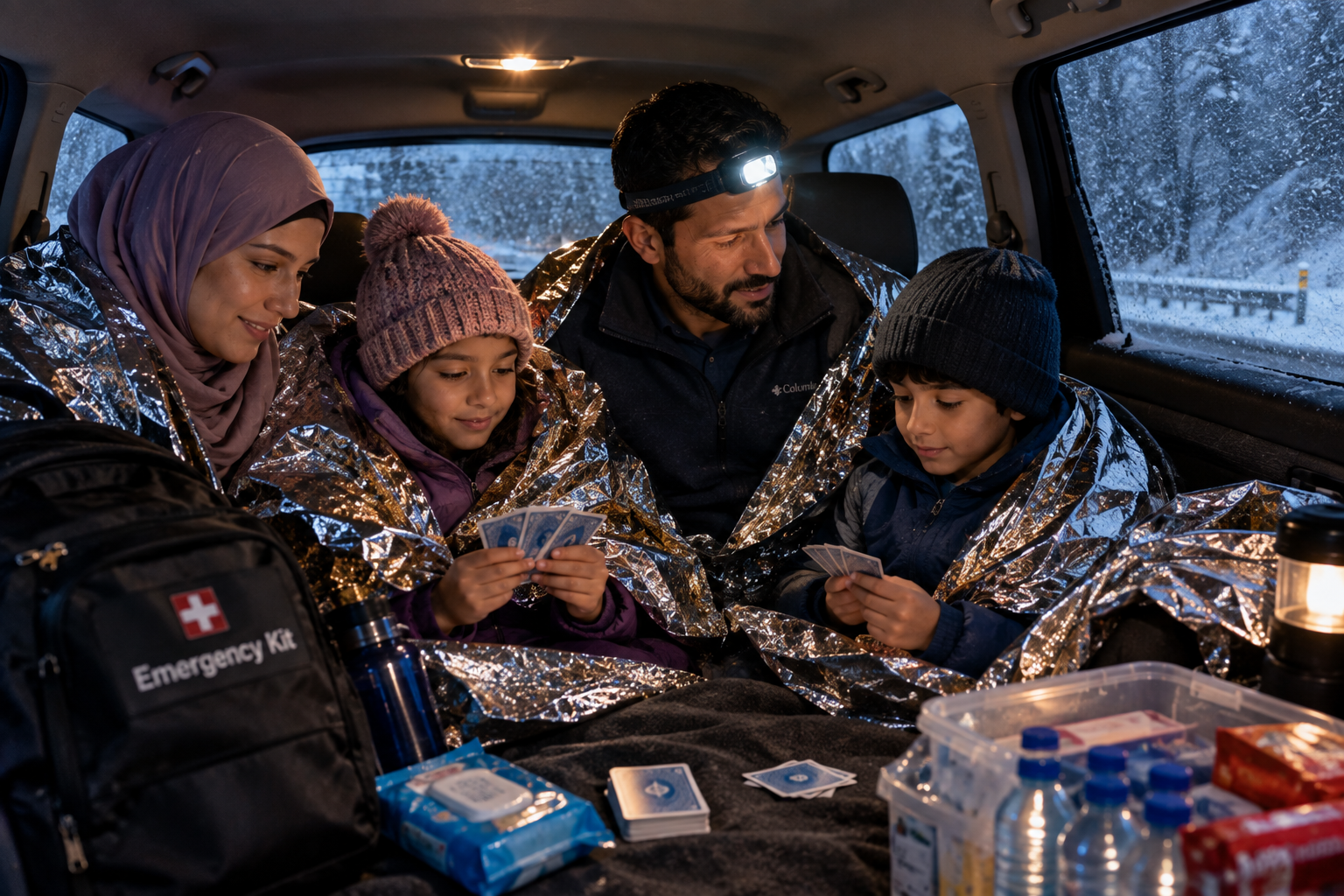
For families, a simple deck of waterproof playing cards should be seen as an emergency item. In a long, stressful wait (like being stuck in a car during a snowstorm), keeping kids busy and distracted is a very important part of staying calm, alongside following water safety tips for family vacations.
Key Emergency Survival Items
- Mylar Emergency Blankets: Thin, foil blankets that trap body heat.
- High-Decibel Whistle: To loudly call for help without losing your voice.
- Headlamp/Flashlight: A hands-free light source with extra batteries.
- Water Purification Tablets: To make dirty water safe to drink.
- Multi-tool: A folding tool with knives, pliers, and screwdrivers.
4. How can families effectively pack essential safety items for quick access?
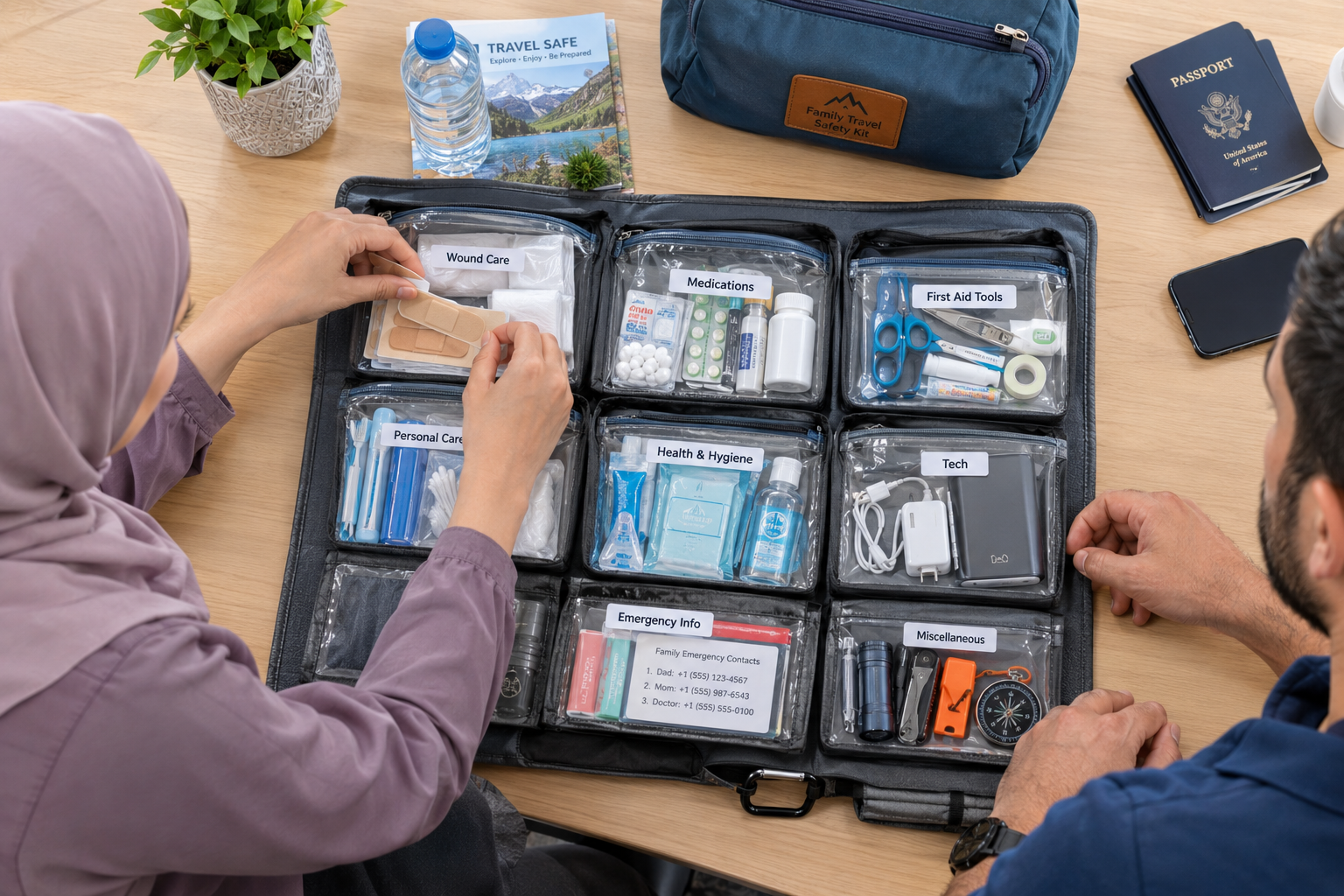
Families can pack safety items efficiently by putting them all in a single, clearly marked “safety bag” and sorting the contents by category into smaller, labeled plastic pouches.
The secret is a dedicated ‘Go-Bag’ that is always kept in your daypack or carry-on, never stored in the cargo hold. Use smaller, colorful pouches inside this bag for ‘First Aid,’ ‘Tech,’ and ‘Personal Items’ so you can grab what you need instantly.
What are the best methods for organizing your family’s safety kit?
Sort your gear into clear, labeled zip-top bags or packing cubes. Keep the items you will use the most in the outer pockets so you can grab them fast.
Having an organized, dedicated bag for each family member can save up to 30 minutes of searching and unpacking at every hotel stop.
Try the ‘surgical tray’ trick. Put your kit inside a foldable nylon mat or a large Ziploc bag. When you need a bandage, unfold the mat on the ground to give yourself a clean surface, stopping tiny tweezers or pills from falling in the dirt. This is a very helpful efficient packing strategy for family travel.
Organization Methods
- Use clear, zip-top pouches or small packing cubes.
- Label each pouch clearly by category (like “Wound Care” or “Medications”).
- Place most frequently accessed items in the easiest-to-reach pockets.
- In the dark, with a crying child, you need to be able to find the thermometer by feel, not by sight.
Where should you store emergency safety items within your family luggage?
Critical safety gear and medicines should always be stored in your carry-on luggage or a backpack that stays with you. Never put essential, life-saving items in a checked bag.
Airline reports show that thousands of bags are lost or delayed every year, proving that checked luggage is not a safe place for important medical items.
Use the “Rule of Two Locations.” For truly critical items, like an EpiPen or a passport copy, do not keep them all in one bag. Keep one in the daypack and the backup in the roller suitcase. If one bag gets stolen, you still have the backup, making what to do if your luggage is lost or delayed far less frightening.
For more tips on flying smoothly, read about what essential items belong in your family’s carry-on bags.
5. What pre-travel checks ensure your family’s safety items are ready for use?
Before you leave, you must check the expiration dates on all creams and pills, turn on every electronic device to make sure it works, and count your supplies to see if you are running low.
At least one week before you leave, do a full review of your safety kit. Replace expired bandages, charge the power banks, and make sure you have enough medicine.
How do you check expiration dates and functionality of family safety gear?
At least one week before your trip, physically look at the “EXP” dates on all medicines. Turn on every electronic device (like flashlights) to ensure the batteries work and that they hold a charge.
The CDC highlights the danger of broken travel gear, noting that testing life-saving equipment like portable alarms before a trip is a serious matter.
Write a simple “Kit List” on a piece of paper that includes the expiration dates of the items inside. Keep this paper inside the kit. Before your next trip, you can just read the paper instead of pulling every single bandage out to check dates, keeping your family safe from unseen dangers like carbon monoxide safety while traveling.
What steps should you take to educate your family on using packed safety items?
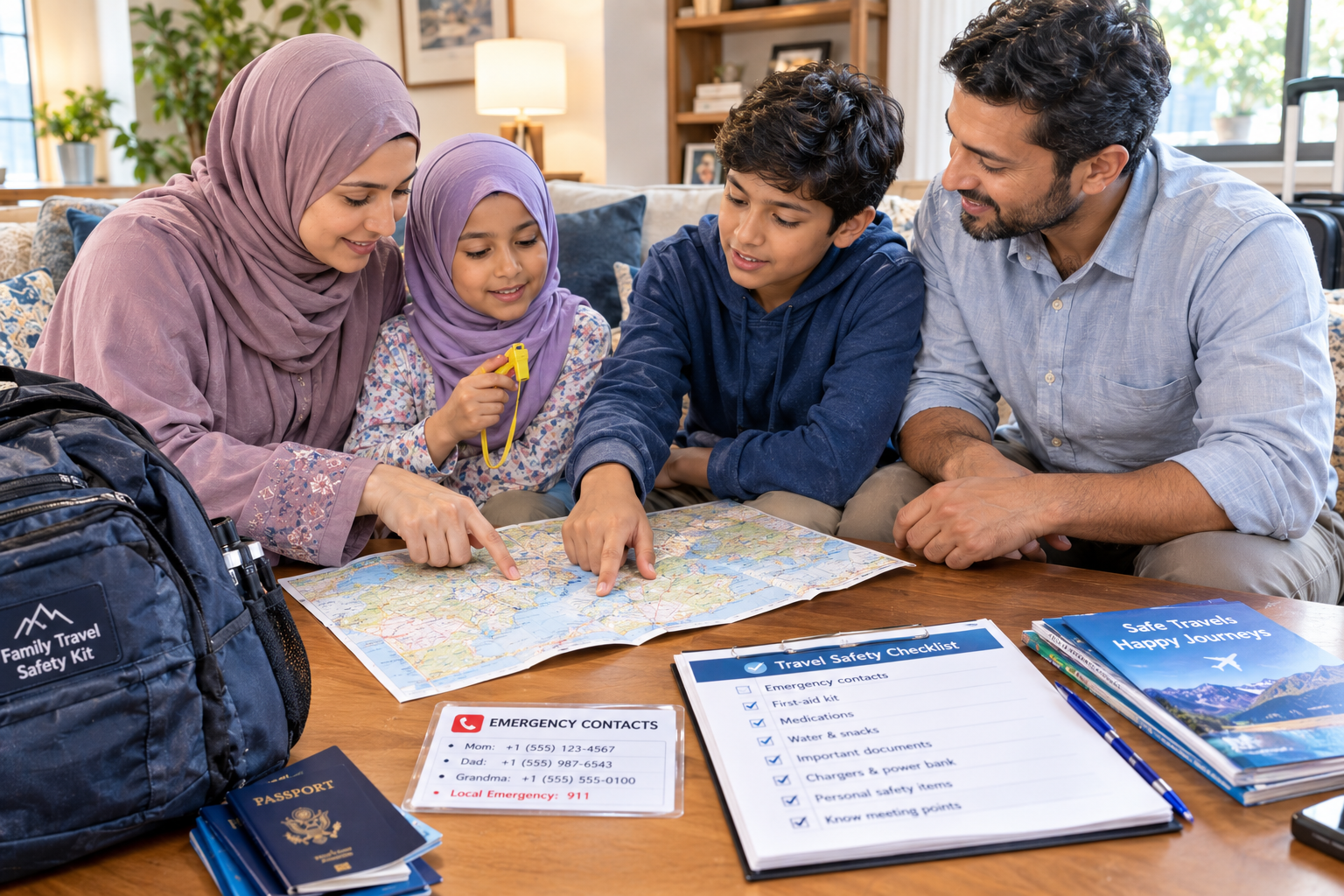
Have a brief safety meeting before you leave. Show everyone where the kit is kept. Teach teenagers where the hotel address card is, and show young children how to blow the emergency whistle loudly.
Safety data shows that children are safer when they know the rules before getting into a car or airplane, making pre-trip talks incredibly important.
Use simple “if-then” scenarios based on your kids’ ages. For a young child: “If you can’t find us, stay still and blow this whistle.” This gives them a clear action to take, aligning with child passenger safety guidelines for travel.
Don’t forget to review understanding the specific medical paperwork needed for a family vacation, which is essential for getting quick care abroad.
What are the pitfalls of overpacking or underpacking essential safety gear?
Overpacking makes your kit too heavy and hard to dig through when you are in a rush. Underpacking leaves you without the basic tools needed to fix common, easy-to-treat problems, causing unnecessary stress.
A 2023 survey showed that 65% of families admit to packing heavy “just in case” items that they never actually use.
Packing irrelevant items is a big trap. Packing a heavy snakebite kit for a trip to a modern city is a waste of space. Pack for the most likely risks of your specific trip, an idea central to minimalist packing for families.
How do families prevent forgetting critical safety items before departure?
Use a checklist weeks in advance and set up a physical “Staging Area” (like a cardboard box) in your home. When you buy a safety item, drop it in the box immediately so you don’t forget it later.
Research shows that roughly 20-25% of travelers have to turn their car around to go back home for a forgotten item.
Do not rely on your memory; rely on your system. A staging area stops the “I’ll pack that in a minute” excuse that leads to leaving important gear behind, a core element of creating the ultimate family travel checklist.
6. Logistics: Family Safety Packing Checklist
| Checklist Item / Tactic | Status |
|---|---|
| PRE-TRIP CHECK: Verify all medications and creams for expiration dates. | ⬜ |
| DEVICE TEST: Test all battery-powered devices (headlamps, power banks) for functionality. | ⬜ |
| REPLENISH SUPPLIES: Replenish any first aid or essential items used on previous trips. | ⬜ |
| PACK CARRY-ON: Ensure all critical medications, first-aid, and communication devices are in carry-on luggage. | ⬜ |
| FAMILY BRIEFING: Conduct a 5-minute safety meeting to review kit location and emergency procedures. | ⬜ |
Resolution
Packing essential safety items for a family vacation builds a confident, worry-free travel experience. By understanding *why* safety is crucial, choosing the right *what* for your destination, and mastering the *how* of packing, preparedness transforms from a chore into an integral, empowering part of creating cherished family memories. A well-organized safety kit is your family’s ticket to focusing on having fun, knowing you are ready for the unexpected. The ultimate goal of a safety kit is for it to never be needed, but its true value is delivered the moment it is packed: it buys you complete peace of mind for the entire duration of your trip.