Are family vacation resort kids’ clubs worth the cost?
Table of Contents
Family Vacation resort kids’ clubs are dedicated, supervised environments within a resort that offer a structured schedule of age-appropriate entertainment and activities for children.
These clubs function as on-site childcare and enrichment centers, providing services from arts and crafts to sports and cultural activities. They are designed to entertain children, allowing parents to have their own leisure time. The first step in any successful trip, especially when considering amenities like kids’ clubs, is to understand how to plan a family vacation step by step, ensuring every detail aligns with your family’s needs.
1. What Are Family Resort Kids’ Clubs and What Do They Offer?
Family vacation resort kids’ clubs are dedicated, supervised environments within a resort that offer a structured schedule of age-appropriate entertainment and activities for children.
What Age Groups Do Kids’ Clubs Typically Cater To?
Family resort kids’ clubs typically cater to children by segmenting them into distinct age groups to ensure activities and supervision are appropriate. Most clubs serve children from ages 3 or 4 up to 12. Separate programs for toddlers (under 3, often for a fee) and teens (13-17) are common at larger family-focused resorts.
At Martinhal Resorts in Portugal, childcare and kids’ clubs are offered for little ones aged 6 months and up to teens.
The most valuable kids’ clubs for families with multiple children offer distinct physical spaces and programming for different age brackets (e.g., a soft-play area for toddlers, a craft room for kids, and a “no adults allowed” lounge for teens), preventing older kids from feeling like they are in a “daycare.”

How Do Resort Kids’ Clubs Structure Their Daily Activities and Programs?
Resort kids’ clubs structure their daily activities and programs around a published schedule, often organized by hourly blocks with specific themed events. A typical day’s structure includes a mix of high-energy games (pool time, sports), creative pursuits (arts & crafts), and quiet time (movies, story time). Many high-end resort destinations also integrate unique local experiences, like nature walks or language lessons.
At Cheetah Plains in South Africa, kids’ club activities include scavenger hunts, tracking, crafts, and baking.
The structure is not just for fun; it’s a key safety and operational feature. A predictable schedule allows staff to manage transitions smoothly, account for all children, and ensure proper staff-to-child ratios for different activities (e.g., higher ratios for swimming).

2. Why Do Parents Consider Resort Kids’ Clubs for Family Vacations?
Parents consider resort kids’ clubs for family vacations primarily to gain windows of adult-only time for relaxation and reconnection, while ensuring their children are safely entertained and engaged.
How Do Kids’ Clubs Enhance Parental Relaxation and Downtime?
Kids’ clubs enhance parental relaxation and downtime by providing secure, reliable, and scheduled blocks of child-free time. This dedicated time allows parents to engage in activities they otherwise could not, such as romantic dinners, spa treatments, or physically demanding excursions. The peace of mind from knowing their children are supervised and happy is a crucial component of this relaxation.
Author’s Experience
“I once spent a week at a resort where the kids’ club was exceptional. Knowing my children were safe and happy allowed me to truly unwind by the pool with a book, a luxury I rarely experience at home. This invaluable downtime transformed a regular family trip into a genuine vacation for me, too.”
Vomo Island Resort in Fiji offers a personal “baby butler” for up to four hours a day, allowing parents to relax at the adults-only pool or take a hike.
The “scheduling” aspect is a key enhancer. Knowing the club is open from 9am-5pm allows parents to pre-book their own activities (like a spa appointment or a tee time) with confidence, maximizing the value of their free time rather than deciding what to do on the fly.
The value parents place on these blocks of free time also relates to understanding why is family vacation downtime important for children as well, ensuring a balanced experience for everyone.
What Are the Child-Centric Benefits of Attending a Resort Kids’ Club?
The child-centric benefits of attending a resort kids’ club center on social interaction, skill development, and exposure to new experiences in a novel environment. Kids’ clubs offer children a chance to make new friends, combat vacation boredom, and participate in activities that may not be available at home. This provides them with their own sense of adventure and independence.
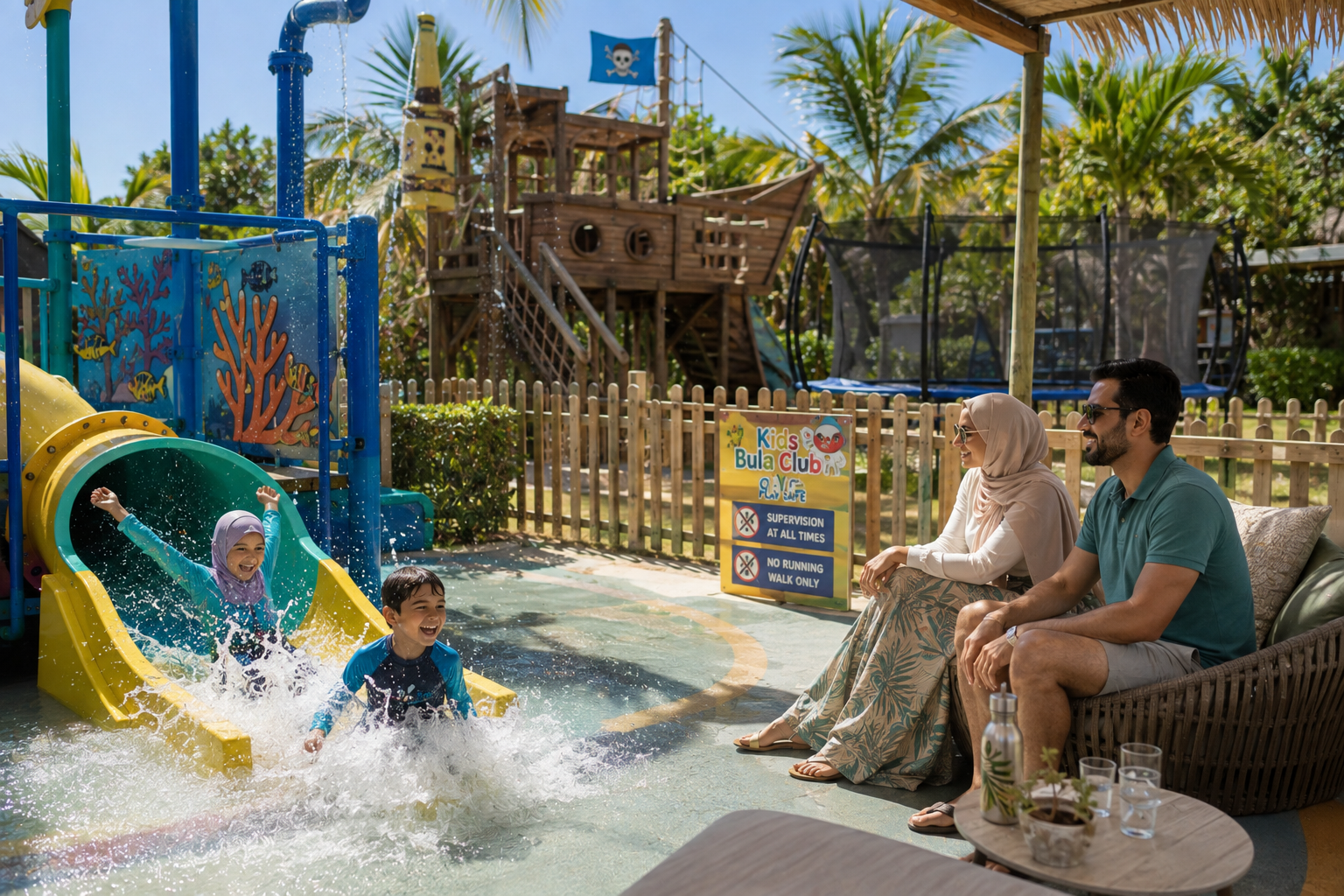
The Kids Bula Club at the Jean-Michel Cousteau Resort in Fiji features a pirate ship-themed treehouse, two pools, a waterslide, a splash area, and a playground with a zip line and trampoline.
A significant, often-overlooked benefit is cultural exposure. Many high-quality resort kids’ clubs (e.g., in Mexico or the Caribbean) incorporate local music, crafts, and food, giving children a fun and accessible introduction to the destination’s culture that they might resist in a more formal setting.
3. What Are the Common Costs Associated with Family Resort Kids’ Clubs?
The common costs associated with family resort kids’ clubs depend entirely on the resort’s pricing model, ranging from fully-inclusive to à la carte hourly or daily fees.
Are Kids’ Clubs Included in All-Inclusive Resort Packages, or Are There Extra Fees?
Whether kids’ clubs are included in all-inclusive resort packages varies by resort brand and the specific package purchased. While many family-focused all-inclusive resorts (like Beaches or Club Med) include daytime kids’ club access for ages 4-12, extra fees often apply for toddlers, evening hours, or special workshops. It is never safe to assume “all-inclusive” means the kids’ club is 100% free.
At Club Med resorts, the Mini Club Med™ for ages 4–10 years is included in the package, but the Baby Club Med™ (4–23 months) and Petit Club Med™ (2–3 years) are offered at an additional cost.
A key detail to verify is the definition of “program.” The basic supervised space and simple activities may be included, but high-value activities like horseback riding, scuba certification, or off-site excursions organized through the club will almost always be an ancillary charge.
What Hidden Fees or Additional Charges Should Families Anticipate for Resort Kids’ Clubs?
Families should anticipate hidden fees or additional charges for resort kids’ clubs related to meals, extended hours, and premium activities. The most common extra charges are for lunch service if the child stays through midday, evening “pajama party” sessions that extend past dinner time, and any off-site excursions. Materials for specialized crafts can also sometimes be an extra charge.
While many all-inclusive resorts do not provide care options for infants and toddlers, Club Med’s kids’ clubs are available to children as young as 4 months of age for an additional cost.
A truly “hidden” cost can be the resort’s “convenience” photography service. Photographers often visit the kids’ club to take pictures of the children playing, which are then offered for sale at a high price point later in the week, creating an emotionally-driven, unplanned expense for parents.
4. How Do Families Evaluate if Resort Kids’ Clubs Are Worth the Cost for Their Children?
Families evaluate if resort kids’ clubs are worth the cost by weighing the price against key factors like their child’s personality, the quality of the program, and their own need for adult downtime.
Which Kids’ Club Program Elements Signal High Value for the Investment?
Kids’ club program elements that signal high value for the investment include a low staff-to-child ratio, a diverse and structured schedule, and unique, destination-specific activities. Look for programs that offer more than just a TV and crayons. High-value signals are educational content (STEM/culture), certified staff, and excellent, clean facilities that show a real investment by the resort.
The Kids Bula Club at the Jean-Michel Cousteau Resort in Fiji signals high value by providing personal nannies for children under 5 and dedicated ‘Buddies’ for children aged 6 to 12.
A key high-value signal is flexibility. A top-tier club allows for drop-in/drop-out participation throughout the day (vs. requiring a full-day commitment), respecting the family’s desire to balance club time with family time. This flexibility demonstrates a focus on the guest experience, not just operational convenience.

Understanding the specific elements that signal high value can help parents decide which family-friendly hotel amenities matter most during planning vacation to enhance their overall experience.
How Do Child’s Age and Personality Influence the Perceived Value of a Kids’ Club?
A child’s age and personality dramatically influence the perceived value of a kids’ club, as a program’s success hinges on its ability to engage that specific child. An outgoing, independent 8-year-old will likely find immense value, making the cost worthwhile. A shy 4-year-old or a cynical 13-year-old who resists participation may render the club a wasted expense, regardless of its quality.
Club Med’s Teens Club Med for ages 11-13 encourages self-expression through creative workshops and dance performances, while the Chill Pass Club Med for ages 14-17 offers exclusive evenings like pool parties and laser games.
The “tween gap” (ages 9-12) is where value often drops off. This age group feels too old for “kid stuff” but is too young for teen lounges. A resort that specifically programs for this “tween” audience with activities like mocktail mixology, DJ lessons, or drone flying provides exceptionally high value for families with children in this bracket.

5. Which Factors Help Compare the Value and Cost of Different Resort Kids’ Clubs?
The factors that help compare the value and cost of different resort kids’ clubs are staff qualifications, safety protocols, operating hours, and the cost structure itself.
What Staff Qualifications and Safety Protocols Should Families Prioritize When Comparing Options?
Families prioritizing safety must compare kids’ clubs based on staff qualifications like first-aid/CPR certification and safety protocols like a secure check-in/check-out system. The highest priority should be on verifiable safety measures. This includes confirming staff have undergone background checks and that the facility has controlled access to prevent unauthorized entry or exit.
At Club Med, qualified childcare managers are all trained early childhood professionals who care for little ones with kindness, ensuring safety and compliance with staff-to-child ratio regulations.
Beyond basic check-in, a top-tier safety protocol includes a “password” or “photo-matching” system for pick-up. This ensures a child is only released to a verified guardian, a crucial security layer that parents should actively inquire about when comparing less-known resort brands against established leaders.
Families prioritizing safety must compare kids’ clubs based on staff qualifications like first-aid/CPR certification and safety protocols like a secure check-in/check-out system, which are crucial considerations for how to keep kids safe on a family vacation.
How Can Online Reviews and Resort Resources Inform the Value of a Kids’ Club?
Online reviews and resort resources inform the value of a kids’ club by providing unfiltered parental feedback and official program details. Use resort websites and brochures for official information like hours and age ranges. Then, validate this information with recent online reviews on sites like TripAdvisor, specifically searching for comments that mention the kids’ club experience.
According to one review of Beaches Turks and Caicos, the resort has a 45,000-square-foot water park, which includes a surf simulator, a 650-foot lazy river, and a kids-only swim-up bar.
The most valuable online reviews are those that mention specific staff members by name (“Maria at the kids’ club was amazing with our shy daughter”). This is a strong, authentic signal of a positive culture and high-quality staff that cannot be faked in marketing materials. Look for patterns of praise or complaint.
To effectively research and validate resort information, leveraging digital tools for family vacation planning can provide invaluable insights and save significant time.
6. How Can Families Maximize the Value of a Resort Kids’ Club Once Decided?
Families can maximize the value of a resort kids’ club by preparing their child beforehand, strategically planning their own free time, and maintaining open communication with both the child and club staff.
What Preparations Should Parents Make to Ensure a Smooth Kids’ Club Transition for Their Children?
To ensure a smooth kids’ club transition, parents should prepare their children by speaking positively about the club, showing them pictures or videos, and visiting the facility together on the first day. The key preparation is to frame the kids’ club as an exciting opportunity, not as a place where they are being “left.” A joint tour on the first day to meet a staff member can significantly reduce anxiety.
Before booking, it’s advised to research the resort and its kids club and look for detailed descriptions and photos of the activities to share with your child.
A powerful preparation technique is to “pre-pack” a dedicated “kids’ club bag” with your child. Including their favorite swimsuit, a special hat, and a small comfort item gives them a sense of ownership and control over the experience, making them more likely to participate willingly.
How Can Parents Best Utilize Their Free Time While Children Are Engaged in Resort Kids’ Clubs?
Parents can best utilize their free time while children are in resort kids’ clubs by pre-booking appointments and reservations for adult-only amenities. The best utilization comes from planning. Instead of wasting time deciding what to do, have spa appointments, dinner reservations, or tee times booked in advance to coincide with kids’ club hours.
At the Hotel Royal Evian, parents can enjoy dinner at the on-site Michelin 1-star restaurant while children are at the kids’ club, which offers drop-off service at 10 pm.
The ultimate power move is to use the time for an activity that is impossible with kids in tow. This isn’t just a quiet meal, but something like an off-site scuba dive, a challenging hike, or a long, uninterrupted visit to the resort’s art gallery. This maximizes the “uniqueness” of the free time.
7. What Common Misconceptions or Pitfalls Should Families Avoid Regarding Kids’ Club Value?
The most common misconception families must avoid is assuming all family resort kids’ clubs are of a uniform, high quality, which leads to a major pitfall of insufficient research.
When Might a Resort Kids’ Club Prove Not Worth the Cost for a Family?
A resort kids’ club proves not worth the cost when a child actively resists attending, or when the family’s vacation style prioritizes constant togetherness over individual activities. The cost is wasted if your child is miserable or refuses to go after the first day. It’s also not worth it for families who genuinely prefer to spend every moment of their vacation together, as the club’s primary benefit—separation—is of no value to them.
A family visiting a dude ranch like Colorado’s C Lazy U Ranch, where supervised activities for kids ages 3-17 are often separate, may find the club not worthwhile if their goal is to do all activities together.
The club is not worth the cost if your child has specific medical or behavioral needs that the club’s staff are not equipped or trained to handle. The potential safety risk and parental anxiety in this scenario create a massive “negative value,” making it a far worse option than hiring a specialized, private sitter.
How Can Families Handle Unexpected Issues or Dissatisfaction with a Kids’ Club Service?
Families can handle unexpected issues or dissatisfaction with a kids’ club service by communicating their specific concerns immediately and politely to the club’s manager or the resort’s front desk. Do not wait until checkout to complain. Address the issue—whether it’s a safety concern, a staff issue, or a billing discrepancy—in real-time to give the resort a chance to rectify the problem.
An important step before a trip is to not hesitate to ask the resort about their kids’ club, including the age range, activities, and supervision, so you have the correct information upfront.
The most effective way to handle an issue is to document it. Note the date, time, the specific issue, and the name of the staff member you spoke with. This factual record is far more powerful when escalating a complaint to a resort manager than a vague, emotional grievance.
Frequently Asked Questions (FAQs)
What are the common age groups served by resort kids’ clubs?
Most clubs serve children from ages 3 or 4 up to 12. Separate programs for toddlers (under 3, often for a fee) and teens (13-17) are common at larger family-focused resorts.
What kind of activities are included in a typical kids’ club daily schedule?
A typical day’s structure includes a mix of high-energy games (pool time, sports), creative pursuits (arts & crafts), and quiet time (movies, story time). Many high-end resort destinations also integrate unique local experiences, like nature walks or language lessons.
Are resort kids’ clubs always included in all-inclusive packages?
While many family-focused all-inclusive resorts (like Beaches or Club Med) include daytime kids’ club access for ages 4-12, extra fees often apply for toddlers, evening hours, or special workshops. It is never safe to assume “all-inclusive” means the kids’ club is 100% free.
How can I avoid unexpected charges at a resort kids’ club?
The most common extra charges are for lunch service if the child stays through midday, evening “pajama party” sessions that extend past dinner time, and any off-site excursions. Materials for specialized crafts can also sometimes be an extra charge.
What specific questions should I ask about kids’ club safety protocols?
The highest priority should be on verifiable safety measures. This includes confirming staff have undergone background checks and that the facility has controlled access to prevent unauthorized entry or exit.
Sources
- https://theeverymom.com/best-resorts-with-kids-clubs/
- https://www.forbes.com/sites/forbes-personal-shopper/article/best-all-inclusive-resort-for-families/
- https://www.clubmed.us/l/all-inclusive-resorts-for-families
- https://www.petitpasseport.com/insights/destination-worthy-hotel-kids-clubs-around-the-world
- https://thepointsguy.com/hotel/best-all-inclusive-resorts-for-families/
Resolution
In conclusion, whether family vacation resort kids’ clubs are worth the cost is a personalized calculation that balances the financial expense against the invaluable benefits of vacation harmony. The final determination of worth rests on a family’s diligent research into a specific club’s quality, a clear understanding of the true costs, and an honest assessment of their own child’s personality and their vacation goals. A well-chosen kids’ club is a powerful investment in the entire family’s enjoyment. The ultimate measure of worth is the post-vacation feeling. If the family returns home with both children and parents feeling rested, happy, and fulfilled, the kids’ club was unequivocally worth the cost, regardless of the price tag.