How to manage pre-existing conditions While on a family vacation?
Table of Contents
To manage pre-existing conditions on a family vacation, you must proactively secure specialized travel insurance, thoroughly research destination medical facilities, and strictly organize all necessary medications before leaving home.
When you prepare for health needs before you leave, you prevent small issues from turning into trip-ending disasters. This careful planning lets your family enjoy the trip without constant worry. This emphasis on health is an important part of the planning needed for any trip. To see how this fits into your whole trip, read How to Plan a Family Vacation Step by Step. This directly supports the goal of How Do You Plan for Family Vacation Health.
1. Why is managing pre-existing conditions crucial for a family vacation?
Managing these conditions is crucial because it stops minor health changes—caused by travel stress or new environments—from ruining your family’s trip. Proper planning for a pre-existing condition isn’t just about stopping a crisis; it’s about letting a family confidently pick more adventurous trips, knowing they have a strong safety net in place. For example, a well-managed asthma plan allows for a family hiking trip in a national park, not just a city-based vacation.
Exacerbation: a sudden worsening of a chronic or pre-existing condition, often caused by changes common during travel, such as different weather, new food, or more physical activity.
What health risks can pre-existing conditions pose while traveling with family?
The main health risks include sudden flare-ups triggered by new foods, changes in weather, or the stress of moving around. The biggest risks are acute flare-ups of chronic conditions like asthma or diabetes triggered by a new climate, problems from running out of essential medicine, and the danger of getting poor care in a place without good hospitals. These risks can quickly end the vacation for everyone.
According to MedicAlert, a globally recognized medical ID service, long trips by car or plane may increase your risk of blood clots, making it vital to stand and stretch when possible.
A critical risk often ignored is “decompensation,” where the stress and tiredness of travel itself, even without a specific trigger, can cause a stable condition to suddenly become unstable. This is very important for heart conditions and immune system disorders.

Decompensation: the worsening of an existing medical condition or the appearance of new symptoms because the body cannot stay stable under stress, such as the tiredness of travel.
How does proper planning protect your family’s vacation experience with pre-existing conditions?
Good planning protects your trip because you already have a set protocol if someone gets sick, preventing minor health issues from becoming major emergencies. By making a detailed medical plan, you make sure that any health flare-ups are managed quickly and effectively, stopping a small issue from becoming a trip-ending emergency. This readiness lets the family relax and focus on making memories.
As recommended by Squaremouth, a leading travel insurance comparison engine, look for policies that provide at least $50,000 in Emergency Medical coverage and $100,000 in Medical Evacuation coverage to properly safeguard your family.
The ultimate protection is empowerment. Proper planning empowers the family to not say “no” to travel, but to say “yes, and here’s how we will do it safely.” It changes the condition from a barrier into a manageable task.
2. How do you choose the right travel insurance for pre-existing medical conditions on a family trip?
Choosing the right travel insurance requires picking a policy with an explicit “pre-existing condition waiver” to ensure you are fully covered against exclusions. The right process involves declaring all conditions to the insurer and comparing specialized policies, not standard ones. Focus on high limits for emergency medical coverage and medical evacuation, and confirm in writing that your specific condition is covered for your destination.
Pre-existing Condition Exclusion Waiver (PCEW): a policy benefit that waives the standard rule against covering pre-existing conditions, adding coverage for them if the policy is bought within a specific timeframe (like 14-21 days) of the first trip deposit.
Many travelers think “trip cancellation” covers medical issues, but the most critical and expensive part for pre-existing conditions is Emergency Medical Evacuation. A standard policy might cover a $5,000 hospital bill, but a flight from a remote destination can exceed $100,000, which only specialized policies cover.
What types of medical travel insurance cover pre-existing conditions?
Standard travel insurance usually does not cover health issues you already have; you must buy a comprehensive plan that includes a specific “pre-existing condition waiver.” You must seek out either an annual or single-trip comprehensive plan and purchase it within the right timeframe, or apply for a specialized policy where you declare your condition and the insurer prices the policy based on your risk.
UnitedHealthcare, a major health insurance provider, explains that providers review your medical history during a ‘lookback period’, which is a window of time typically between 60-180 days before your policy purchase date.
A key difference is the “look-back period” – the timeframe (e.g., 60-180 days) an insurer reviews to see if a condition was treated or changed. A policy with a shorter look-back period is often better for people with well-managed but active conditions.
How to compare policies to find comprehensive coverage for your family’s specific needs?
To find the best insurance, you need to read the fine print to compare emergency medical flight limits and the definition of a “stable” condition. Create a spreadsheet comparing key features: the coverage amount for emergency medical and evacuation, the “look-back” period, the waiver purchase window, and the policy’s definition of “stable” for a condition. Call the provider to ask hypothetical questions related to your family’s specific needs.
American Visitor Insurance, a specialized broker, notes that the cost of trip cancellation insurance with a pre-existing condition exclusion waiver can start at $32 for a 15-day trip with a $1,000 trip cost.
The most critical comparison point is the “per-person” vs. “per-policy” coverage limit. For a family, a “per-person” limit is much better, as a single family member’s medical event will not use up the coverage for everyone else on the policy.
3. Which destinations and accommodations are safest for families with pre-existing health needs?
The safest destinations are major hubs with advanced, accredited healthcare, and the safest hotels offer specific support like refrigerators for medication or ground-floor access. Safe destinations are typically developed countries or major tourist hubs with JCI-accredited hospitals and reliable emergency services. Safe accommodations offer specific support, such as ground-floor rooms for mobility issues, refrigerators for medication, or kitchens for managing dietary restrictions.
JCI-Accredited Hospital: (Joint Commission International) a hospital outside the U.S. that has been certified to meet rigorous international standards of patient care and safety, acting as a reliable sign of quality for travelers.
The concept of a “medical-first” destination choice. Instead of choosing a destination and then checking for medical facilities, families with high-risk conditions should reverse the process: identify countries with top-tier, accessible healthcare and then choose a vacation within that country. This puts safety above all else.
How to assess medical facilities and accessibility at your chosen family vacation destination?
You can assess a location’s safety by verifying hospitals have international awards, like JCI accreditation, and by checking street access on map tools. Use tools like the IAMAT or the U.S. Embassy website to find lists of reputable, English-speaking doctors. Use Google Maps’ Street View to virtually “walk” the area around your hotel to check for hills, stairs, or other mobility challenges that could impact a family member.
Travel Guard, a prominent travel insurance provider, notes that the US embassy at your destination may also be able to refer you to a reliable pharmacy.
A pro-level tip is to contact your travel insurance’s 24/7 assistance line before your trip. Ask them which hospitals or clinics they have direct-billing agreements with at your destination. This pre-approved network is your best first stop in an emergency.
What accommodation features best support specific pre-existing conditions during a family vacation?
The best hotel features depend directly on your medical needs, such as a mini-fridge to cool insulin or a ground-floor room for easy wheelchair access. For diabetes, an in-room mini-fridge is a must for insulin storage. For mobility issues, request a ground-floor room or one near an elevator, and confirm the presence of a roll-in shower. For severe food allergies or Celiac disease, a vacation rental with a private kitchen provides the safest environment for food preparation.
For severe allergies, you should communicate your allergens to your transportation providers (airlines, cruise lines) and accommodation providers (hotel or personal hosts) well in advance.
The value of a “concierge” or “guest services” desk at a high-quality hotel is huge. Before booking, call and speak to them about your needs. A good concierge can pre-arrange things like distilled water for a CPAP machine, confirm local pharmacy locations, or even coordinate with the hotel restaurant about allergy protocols.
4. How to prepare medically for a family vacation with pre-existing conditions?
Preparing medically involves scheduling doctor visits early to secure written travel clearance, obtaining enough medication for the trip, and compiling a physical medical information folder. At least 6-8 weeks before your trip, visit your doctor to discuss your travel plans, get updated prescriptions, and request a formal doctor’s note. You must also gather all necessary medical records, confirm vaccinations, and create a folder with copies of everything to carry with you.
Reciprocal Healthcare Agreement (RHA): a formal agreement between two countries that allows visitors from one country to access the public healthcare system of the other for medically necessary treatment. Knowing if your destination has an RHA with your home country is a key planning step.
A crucial step is asking the doctor for prescriptions written with the medication’s generic name, not just the brand name. Brand names vary globally, but the generic (chemical) name is internationally recognized, making it much easier to replace a lost prescription in a foreign pharmacy.
What pre-trip doctor consultations and medical checks are necessary before a family vacation?
You must visit your doctor about six to eight weeks before your trip to review itinerary risks, get the right vaccines, and secure a formal letter explaining your health conditions. During your visit, you must review your specific destination, planned activities, and flight duration with your doctor to assess any unique risks. This is also when you obtain a doctor’s note detailing your condition and medications and confirm that all routine and travel-specific vaccinations are up to date.
When traveling with a chronic medical condition, schedule an appointment with your healthcare practitioner(s) for 4-6 weeks prior to your trip to allow time for vaccines to work.
Ask the doctor for an “emergency-only” prescription for an antibiotic or other medication relevant to a potential complication of your condition. Having this on hand can prevent a frantic search for a doctor for a predictable issue, especially in a remote location or during off-hours.

How to secure enough medication and medical supplies for the entire family trip?
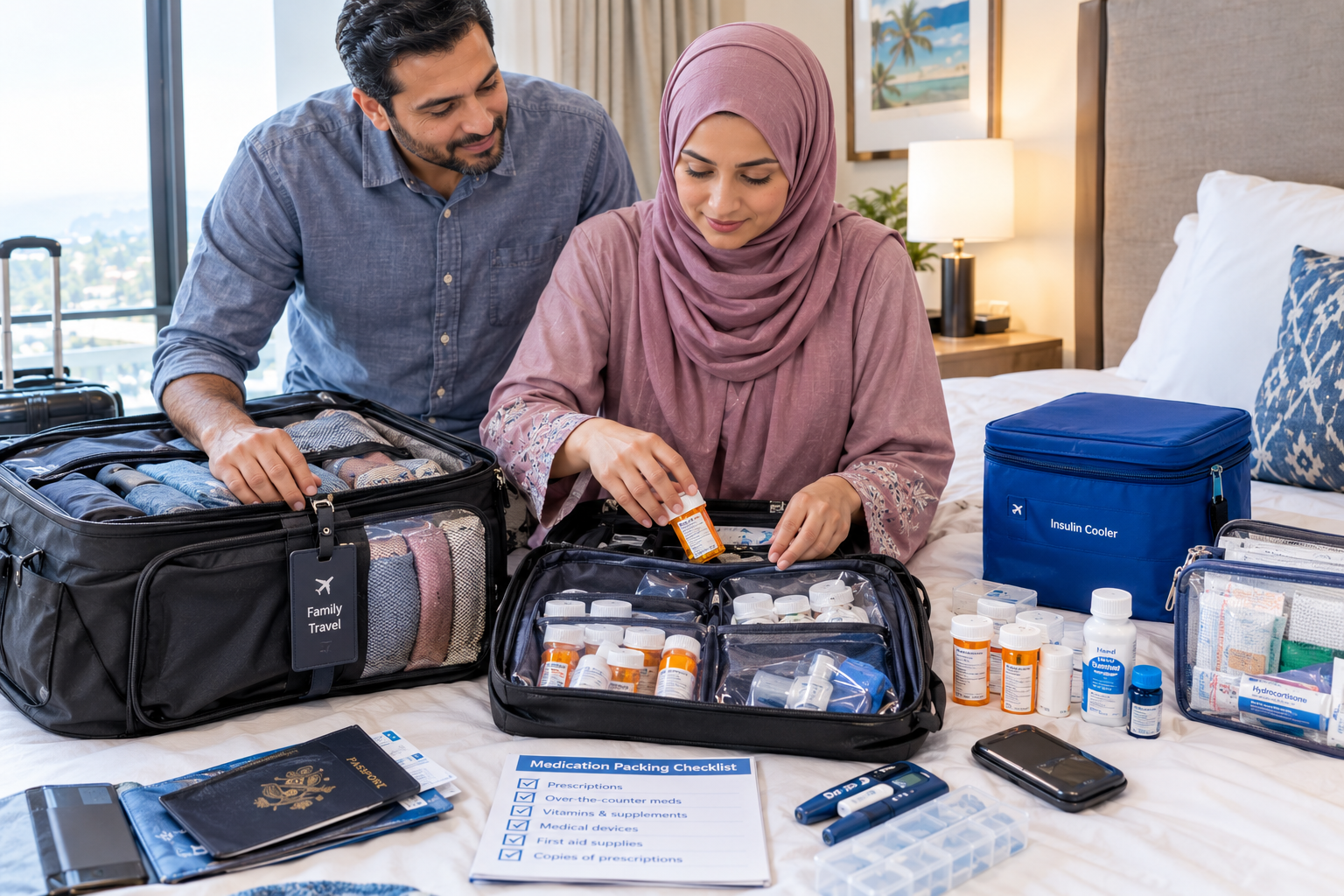
To secure enough medication, calculate your daily exact dosage needs, then pack your full trip supply plus a strict one-week emergency buffer just in case your flight home gets delayed. Obtain new prescriptions from your doctor and fill them well before your departure date, ensuring you have enough for the trip plus a buffer. Do not plan on being able to fill a prescription from your home country in a foreign destination, as this is often impossible.
Many countries allow you to bring a 30-day supply of certain medications; however, some common medications are illegal in other countries, so you must research rules ahead of time.
Split essential medications into two separate bags. Pack the majority in your carry-on luggage to prevent loss if checked bags are delayed, but place a smaller, 2-3 day emergency supply in a separate carry-on bag belonging to another family member. This creates a backup in case one carry-on is lost, stolen, or misplaced.
5. How do you manage medications and medical equipment while traveling with family?
You successfully manage medications and equipment by packing them strictly in your carry-on bag within their original bottles and being prepared to show them to airport security. Keep medicines in their original, pharmacy-labeled bottles to identify them for security and customs officials, and have your doctor’s letter easily reachable.
TSA Notification Card: a printable card from the Transportation Security Administration’s website that a traveler can secretly hand to an officer to tell them of a medical condition or medical device without needing to explain it aloud in a crowded security line.
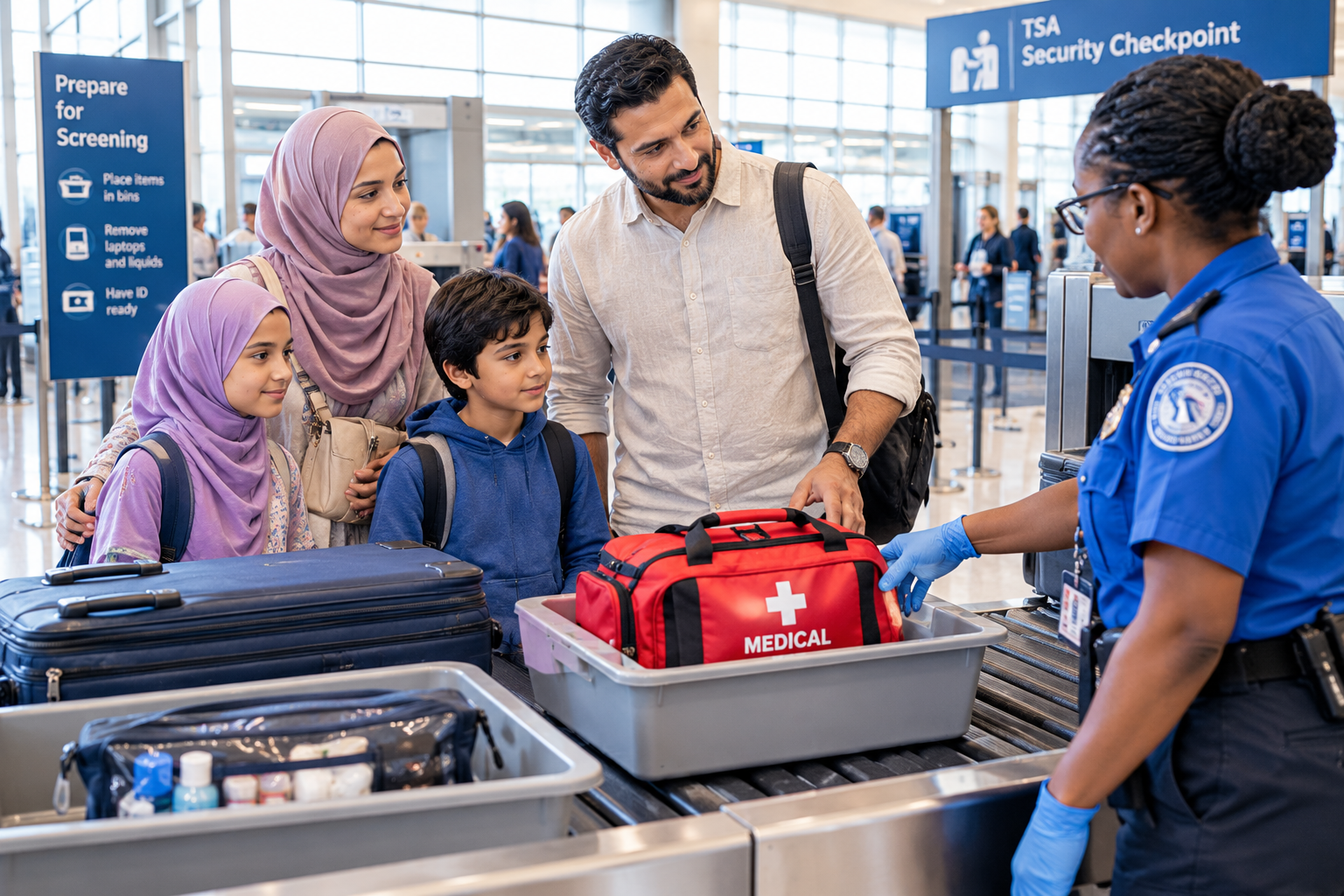
For families, a dedicated “medical bag” is much better than putting items among multiple personal bags. This single, brightly-colored bag contains all medications, the medical folder, and supplies. Every adult in the family knows what this bag is and that it’s the highest priority item to watch during travel.
What are the best practices for packing and carrying essential medicines for a family with pre-existing conditions?
The best practice is to always pack important medicine in your personal carry-on bag—never in checked luggage—while keeping them clearly marked in the original bottles from the pharmacy. For temperature-sensitive drugs like insulin, use a specialized travel cooler, and for liquids over the TSA limit, show them to the security officer as medically necessary.
Medically necessary liquids and creams that are more than 3.4 oz. should be removed from a carry-on bag to be screened separately by airport security.
Use a daily pill organizer for ease, but also bring the original bottles. If there is a customs check or a medical emergency, the officially labeled bottles are required proof of the prescription. The pill organizer is for daily use after you’ve arrived and cleared customs.
How to handle medical devices and special dietary requirements on the go during a family vacation?
You handle medical devices by calling the airline early to get security permission, and you manage dietary requirements by carrying detailed translation cards into local restaurants. For devices like a CPAP machine, contact the airline for their specific approval process. For food allergies, always carry multiple EpiPens and pack a day’s worth of non-perishable, safe snacks for each family member in case safe food cannot be found while out exploring.
For heart conditions, wear compression stockings on long trips to help with blood flow and stop fluid from building up in your legs.
Use “dietary translation cards.” These are small cards that explain a person’s specific food allergy or dietary need (e.g., “I have a severe allergy to peanuts. My food must not contain any peanuts or peanut oil.”) in the local language of your destination. This is much better than trying to explain it yourself.

6. How to establish clear emergency protocols for pre-existing conditions on a family trip?
Establishing clear emergency protocols means creating a written action plan that assigns roles and sharing that plan with all adult travelers before you leave. Your emergency plan must include knowing the location of the nearest pre-checked hospital, having local emergency numbers and your insurance hotline saved in all phones, and ensuring every adult knows their specific role if something goes wrong.
Medical Information Card: a wallet-sized card that summarizes a person’s critical health data: name, date of birth, pre-existing conditions, allergies, current medications, and emergency contacts. It provides essential facts to first responders when a person cannot speak.
The “role-playing” technique. For families with older children or multiple adults, physically walking through a scenario is highly effective. Ask “If [child’s name] has a severe allergic reaction at the beach, what is the first thing we do? Who calls the ambulance? Who gets the EpiPen?” This acting out of roles stops confusion in a high-stress moment.
What information should be readily accessible in case of a medical emergency during a family vacation?
You should carry a physical card in your wallet that clearly lists your family’s allergies, their exact medicine dosages, your insurance policy number, and an emergency phone number. This critical information should be compiled on a “Medical Information Card” or in a special section of a smartphone for each family member.
If you’re traveling outside the U.S. and have a medical emergency, you can place a collect call to the MedicAlert hotline at (209) 634–4917, where they can accept calls in any language and provide translation services.
Beyond a simple list of medications, include the dosages and administration times. This information is critical for a doctor in an emergency room to understand the patient’s normal treatment and avoid bad drug interactions.
How to communicate health needs effectively with family members and travel companions?
To ensure everyone is on the same page, hold a calm meeting before the trip to talk about health rules and tell everyone exactly what their job is if an emergency happens. Hold a pre-trip family meeting where you clearly state the “what-if” plan without causing alarm. For children, use simple words to explain why certain rules exist (e.g., “We have to stop for your brother to use his inhaler so his lungs stay strong for playing”).
Pre-existing condition waivers from a travel insurance policy typically apply to travel companions listed on your policy and, depending on the policy, may also include non-traveling family members.
The “empower the patient” strategy. If the person with the pre-existing condition is old enough (e.g., a teenager with diabetes), they should be the one to lead the talk. This builds their own sense of responsibility and makes sure they can speak for themselves.
7. How to troubleshoot common health challenges and unexpected issues with pre-existing conditions during a family vacation?
To troubleshoot common health challenges, you must quickly execute your pre-prepared emergency plan and contact your travel insurance assistance provider immediately for guidance. If you lose medication, first use your extra supply, then contact your doctor at home and your insurance provider’s hotline to help find a local pharmacy and doctor.
Case Manager: the person assigned by a travel insurance company during a big medical event to watch over and arrange all parts of a patient’s care, from hospital admission to payment.
Your travel insurance’s 24/7 assistance line is not just for billing; it’s a powerful tool for planning. They have medically trained staff who can provide interpreter services over the phone with local doctors, help find new prescriptions, and set up medical care. They should be your first call in any serious situation.
What steps to take if you run out of medication or lose medical supplies abroad on a family vacation?
If you lose your medicine, do not panic; call your travel insurance hotline right away so they can use their network to find a local doctor who will write you a new prescription. Your insurance provider can help find a local doctor who can write a new, local prescription, often helped by a copy of your original prescription and a call with your home doctor. Use your pre-packed doctor’s note and the generic name of the medication to help this process.
The right travel insurance coverage can help if you lose prescription medications and offers access to 24/7 emergency assistance services, including language translation.
The role of the local U.S. Embassy or Consulate. While they cannot provide medical care, their website lists checked local doctors, and in a true emergency, the embassy staff can help contact family back home and guide you through the local healthcare system.
How to handle sudden flare-ups or unexpected health complications away from home with pre-existing conditions?
If a sudden health problem starts, administer your child’s emergency rescue medicine right away, and have one adult call for help while the other parent focuses on care. First, give any immediate-response medications like an EpiPen or rescue inhaler. Next, have one adult call local emergency services while another calls the travel insurance hotline. Grab your medical information folder and go to the nearest hospital you researched before the trip.
Some premium travel insurance plans have a pre-existing condition lookback period of only 90 days, compared to 180 days on other plans.
The importance of “Time to Treatment.” During a flare-up (e.g., a severe asthma attack or allergic reaction), the most critical factor is shortening the time between the start of symptoms and getting real medical care. All planning is designed to shorten this window. Hesitation is the enemy.
8. Logistics: Medical Planning Execution Checklist
| Checklist Item / Tactic | Status |
|---|---|
| Step 1: Secure specialized travel insurance with PCEW. | ⬜ |
| Step 2: Consult doctors and gather all necessary medications. | ⬜ |
| Step 3: Prepare a comprehensive emergency action plan. | ⬜ |
Resolution
Ultimately, managing pre-existing conditions on a family vacation is not about limitation but about empowerment through meticulous preparation. By systematically choosing the right insurance, destination, and accommodations, and by creating robust medical and emergency plans, you transform potential risks into manageable logistics. This proactive approach is the key to unlocking safe, memorable, and stress-free travel experiences for the entire family.