Sick on a Family Vacation? How to Find Doctors, Hospitals, and Pharmacies Fast.
Table of Contents
The fastest method is to call the 24/7 assistance number on your travel insurance policy, as they have vetted, in-network provider lists and can often arrange appointments.
Preparing for medical issues abroad prevents a health scare from becoming a financial and logistical catastrophe. This involves organizing documents, securing insurance, and understanding local risks before departure. This detailed guide on finding medical care is an essential part of your comprehensive health planning for your family vacation, ensuring peace of mind throughout your journey.
1. Why Should Families Prepare for Sickness Before a Vacation Abroad?
Families must prepare for potential sickness before a vacation abroad to mitigate high financial risks, reduce stress during an emergency, and guarantee timely access to appropriate medical care in an unfamiliar system. Preparing for medical issues abroad prevents a health scare from becoming a financial and logistical catastrophe by organizing documents, securing insurance, and understanding local risks before departure. Many popular family destinations operate on a “pay-first, claim-later” healthcare model for tourists, meaning even insured families can face immediate, significant out-of-pocket expenses for hospital care without pre-planning and confirmation of direct billing.
Reciprocal Healthcare Agreement: An agreement between countries allowing visitors to receive public healthcare services for free or at a reduced cost. Families should verify if their destination has such an agreement with their home country, but never rely on it as a substitute for travel insurance. Prioritize comprehensive pre-trip medical planning if traveling with young children or family members with pre-existing conditions, as their risks are significantly higher.
Understanding specific health needs is key, especially learning how to manage pre-existing conditions while on a family vacation. Understanding the necessity of preparation logically leads to identifying the specific health risks your family might face at your chosen destination.
What Are the Common Health Risks Families Face on International Trips?
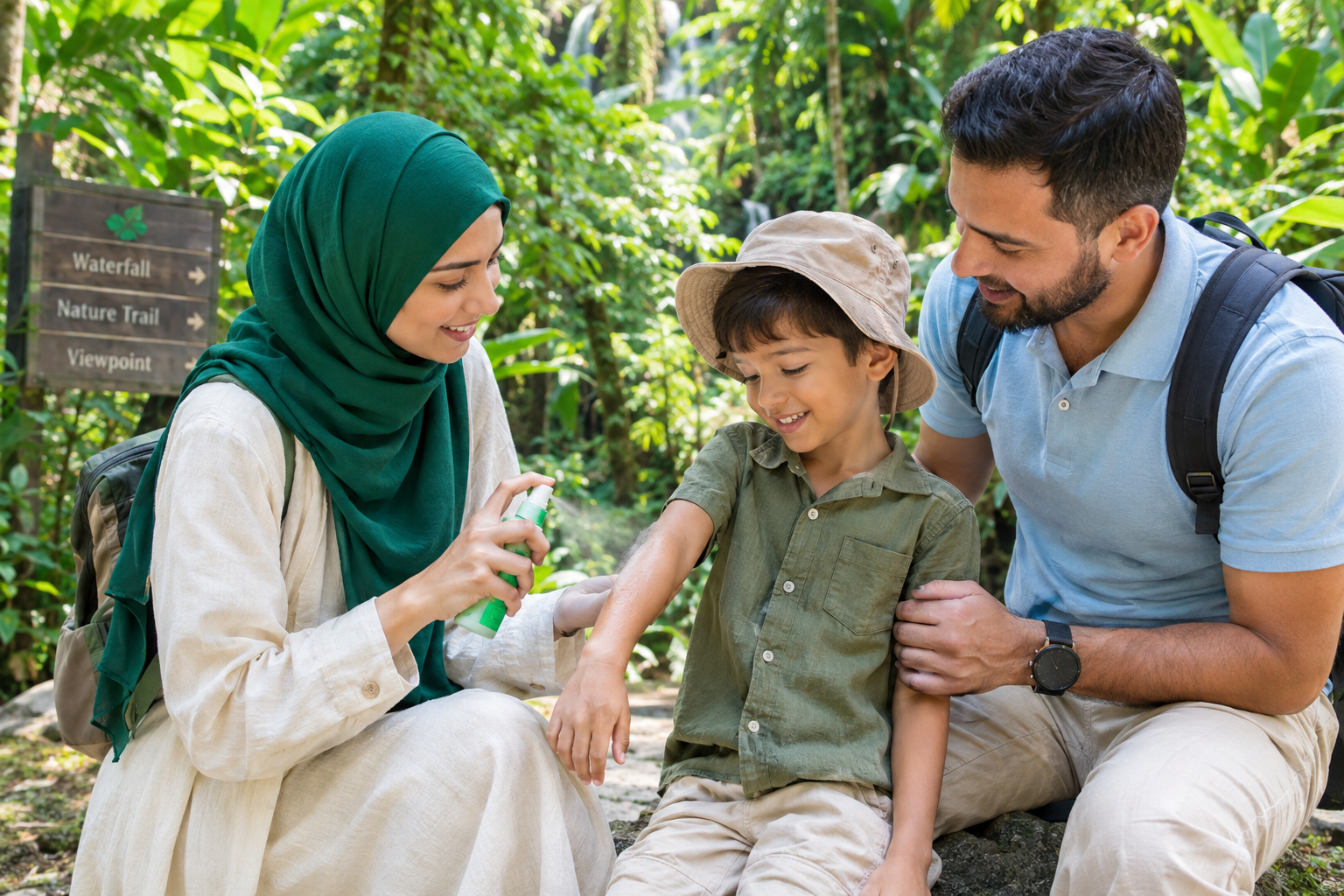
Families abroad commonly encounter health risks ranging from food and water-borne illnesses to region-specific diseases. Young children are particularly susceptible to changes in environment and diet.
Traveler’s diarrhea is the most common illness affecting international travelers, and an antibiotic should be reserved for when a fever or bloody stool is present, or symptoms do not improve after 24 hours. According to clinics, Traveler’s diarrhea is the most common illness affecting international travelers.
Go beyond “travelers’ diarrhea” and explain that for children, the primary danger is not the illness itself but rapid dehydration, making access to pediatric electrolyte solutions a critical pre-trip consideration for destinations in Southeast Asia or Latin America.
Author’s Experience
“Navigating my child’s sudden fever in Rome taught me the real value of pre-packed electrolyte salts and a translated phrasebook. It wasn’t the ideal vacation highlight, but having a plan made all the difference in quickly getting the help we needed, transforming a scary moment into a manageable one.”
2. What Essential Medical Information Should Families Organize Before Traveling?
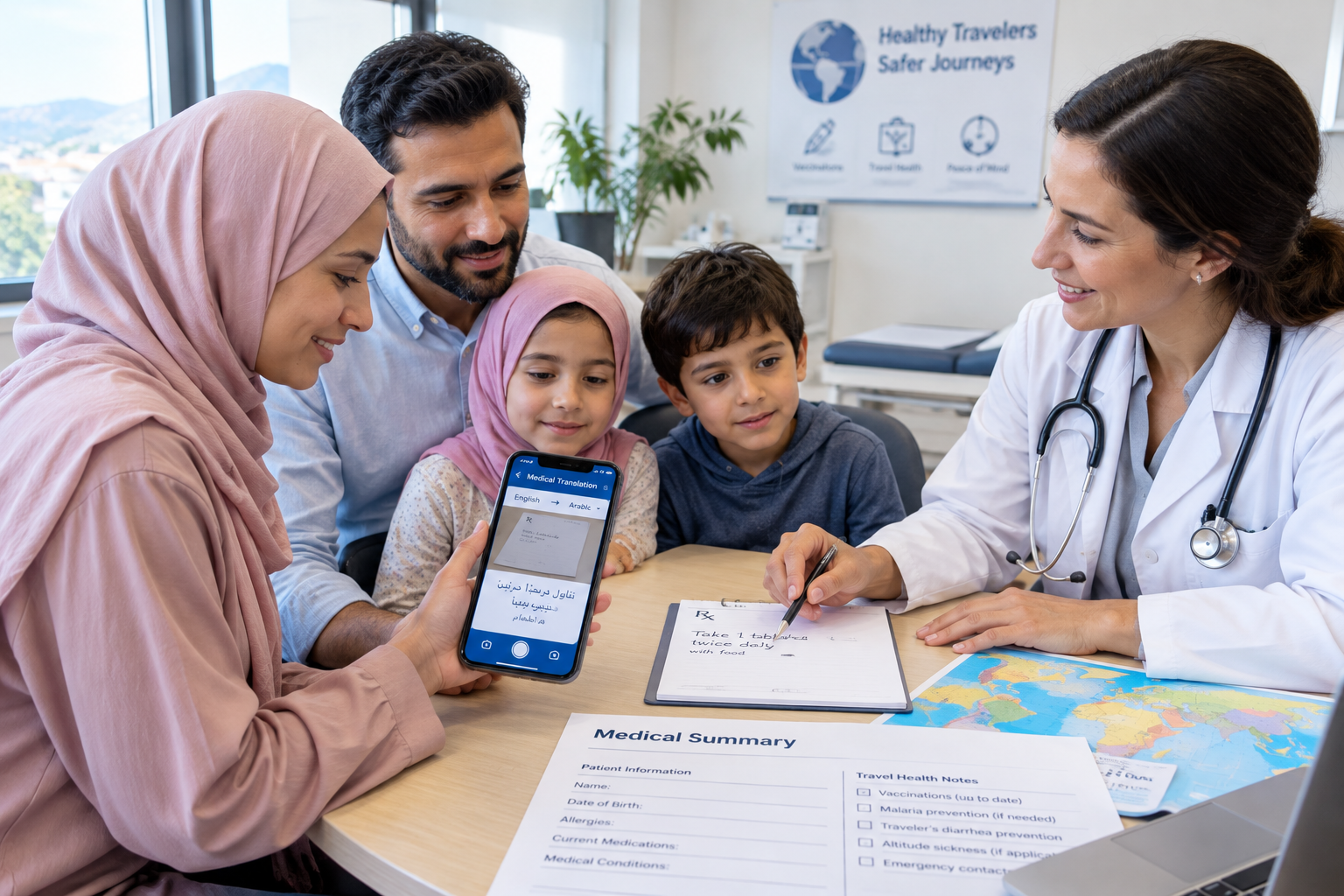
Families must organize essential medical information before traveling, including digital and physical copies of passports, travel insurance details, individual medical histories, vaccination records, and a list of all current medications. Before any international trip, a family should create a centralized dossier of medical information including insurance policy numbers, emergency contacts, a summary of conditions, and notes from their home doctors. Explain the importance of creating a single, password-protected digital document (e.g., a PDF stored on a cloud service and a phone) that contains photos of all documents. This provides a crucial, accessible backup if physical copies are lost or stolen.
Medical History Summary: A concise, one-page document for each family member listing their name, date of birth, blood type, known allergies, chronic conditions, current medications (with dosages), and their primary care physician’s contact information. Use a secure cloud storage service trusted for data privacy to store your digital medical dossier, ensuring accessibility from any device worldwide.
Once your family’s core medical data is organized, the next step is to assemble a physical first-aid kit with the essential medications you’ll need on hand. For practical preparation, consider reviewing what to include in a family vacation first-aid kit to address minor issues on the go.
Which Medications Should Families Pack in a Travel First-Aid Kit?
A family travel first-aid kit must include child-appropriate dosages of key medications, personal prescription drugs, and items specific to destination risks, for managing minor issues and providing initial care.
Oral Rehydration Salts (ORS) are a critical component of a travel medical kit because they contain the precise sodium and glucose ratio needed for effective rehydration during bouts of diarrhea or heat exhaustion. According to Chasing Hippoz, Oral Rehydration Salts are a critical component.
Differentiate a “standard” kit from an “expert” one by advising parents to include a digital thermometer, pediatric electrolyte sachets, and a small tube of hydrocortisone cream, as these three items address the most common and stressful child-related travel ailments (fever, dehydration, skin reactions).
Verify that all prescription and even some OTC medications are legal to carry into your destination country.
3. How to Choose the Best Travel Health Insurance for Your Family Vacation?
The best way to choose travel health insurance for your family vacation is to compare policies based on four critical factors: the medical expense limit, coverage for medical evacuation, inclusion of pre-existing conditions, and family-specific benefits like “named-child” coverage. Choosing the right travel insurance requires scrutinizing policy wording for high coverage limits, medical emergencies, and crucially, including medical evacuation and repatriation, especially for families. The most overlooked but critical feature for families is “medical evacuation” vs. “medical repatriation.” Evacuation gets you to the nearest adequate facility, which might still be foreign. Repatriation gets you home, a vital distinction when a child is hospitalized for an extended period.
Medical Evacuation: Transportation to the nearest medical facility that can provide the required level of care. This is a standard and essential feature. Medical Repatriation: Transportation back to your home country to receive medical care, which is often a more expensive and separate policy benefit. Choose a policy with a minimum of $1,000,000 in medical coverage and $500,000 in medical evacuation/repatriation coverage for international family travel, especially to remote or medically underdeveloped destinations.
To ensure adequate protection, a critical early step is determining how to choose travel insurance for a family vacation that meets your specific needs. To simplify this decision, use the following table to compare key features across different types of travel insurance policies. After selecting insurance, you must understand which type of facility to use for different levels of sickness.
What Questions Should Families Ask When Evaluating Travel Insurance Policies?
To properly evaluate an insurance policy, ask targeted questions before you buy. Focus on pre-existing conditions and the exact procedure for getting emergency medical care approved and paid for abroad.
Some travel insurance policies may not cover risky activities such as scuba diving, hiking, or kayaking, which could lead to significant out-of-pocket medical bills. According to UnitedHealthcare, these activities may not be covered.
The single most important question is: “What is your definition of a ‘stable’ pre-existing condition?” Policies often have a ‘look-back’ period (e.g., 90-180 days) where any change in medication or treatment for a condition can make it ‘unstable’ and therefore ineligible for coverage.
Key Questions
- Does the policy cover a parent staying with a hospitalized child and flying a relative out for support?
- What is your definition of a ‘stable’ pre-existing condition?
- What is the process for direct payment to hospitals?
- What is the 24/7 assistance contact procedure? (Save this number in multiple places!)
- Are there exclusions for specific activities?
4. Which Types of Medical Facilities Are Best for Different Illnesses on a Family Vacation?
The best type of medical facility for an illness on a family vacation is determined by the severity of the symptoms: pharmacies are for minor ailments, clinics or urgent care centers are for moderate, non-life-threatening issues, and hospital emergency rooms are for severe or life-threatening conditions. Knowing where to go for medical care abroad saves critical time. A local pharmacy handles minor ailments, a clinic is for non-urgent issues, and a hospital ER is for severe or life-threatening conditions. In many European and Latin American countries, the local pharmacist (farmacéutico/Apotheker) is a highly trained professional authorized to provide advice and dispense certain medications that would require a prescription in the US or UK, making them a valuable and underutilized first point of contact for families.
Urgent Care Clinic (Centro de urgencias/Notaufnahme): A walk-in facility that treats illnesses or injuries that are not life-threatening but require immediate attention outside of a hospital’s emergency room. They are often faster and cheaper than an ER for issues like minor fractures, fevers, or infections. Use a pharmacy first for advice on non-urgent, common illnesses to save time and money; proceed to a clinic or hospital if symptoms are severe or if the pharmacist recommends it. This decision matrix simplifies the choice. Understanding the difference between facility types is critical, but so is understanding the payment systems they operate under.
How Do Public vs. Private Healthcare Systems Differ for Travelers Abroad?
For travelers, public hospitals offer lower cost but often have long waits and language barriers. Private hospitals cater to tourists with faster service, but travel insurance must confirm coverage.
Treatment in an emergency department can cost up to three times more than the same care provided in a primary care provider’s office. Alliance Direct Benefits notes this cost difference.
The critical detail is that your travel insurance’s “assistance company” may have a direct billing agreement with a specific private hospital but not the public one just down the street. Always call the insurance assistance line *before* going to a facility (in a non-critical emergency) to confirm which one is in their network to avoid paying entirely out-of-pocket.
Public vs. Private Healthcare Systems Comparison
While public hospitals offer lower cost but often have long waits and language barriers, private hospitals provide faster service, familiar amenities, and English-speaking staff. Emphasize the action of calling the insurance provider as the single most important step in this decision.
5. How Can Families Quickly Find a Doctor or Hospital While Traveling?
Families can quickly find a doctor or hospital while traveling by using a prioritized sequence of actions: first, contact your travel insurance’s 24/7 assistance line; second, ask your hotel concierge or host; third, contact your country’s local embassy or consulate. The fastest way to find a reputable doctor abroad is to call your travel insurance’s emergency assistance number for vetted, English-speaking providers. Your hotel’s front desk is the next best local resource. While Google Maps is useful, it doesn’t vet for quality or international accreditation. A superior digital tool is the International Association for Medical Assistance to Travellers (IAMAT), which maintains a global network of vetted, English-speaking doctors who have agreed to a fixed-fee schedule for members.
Consular Services: Services provided by a country’s embassy or consulate in a foreign nation. For medical emergencies, they can provide lists of local doctors and hospitals, help notify family back home, and assist in a crisis, but they will not pay for medical bills. In a medical emergency, always start with the resource that has a financial and legal obligation to help you: your travel insurance provider. All other methods are secondary. To ensure you don’t miss a step in a panic, follow this checklist. Once you’ve located a provider, your next challenge might be finding one who speaks your language.

Where Can Families Find English-Speaking Doctors or Pediatricians Abroad?
Your travel insurance’s 24/7 assistance service is the most reliable source for locating vetted, English-speaking pediatricians. Major private hospitals in tourist hubs also commonly have English-speaking staff.
U.S. embassies and consulates can provide lists of local physicians and hospitals to assist American travelers in finding medical care abroad. Baylor Scott & White Health confirms this service.
A powerful “hack” is to search for international schools in the area (e.g., “American School of [City]”). These schools require a large body of expat teachers and families, and the school administration or parent networks are often the best-kept secret for finding trusted local English-speaking pediatricians.
6. How Do Families Access Pharmacies and Medications When Sick on Vacation?
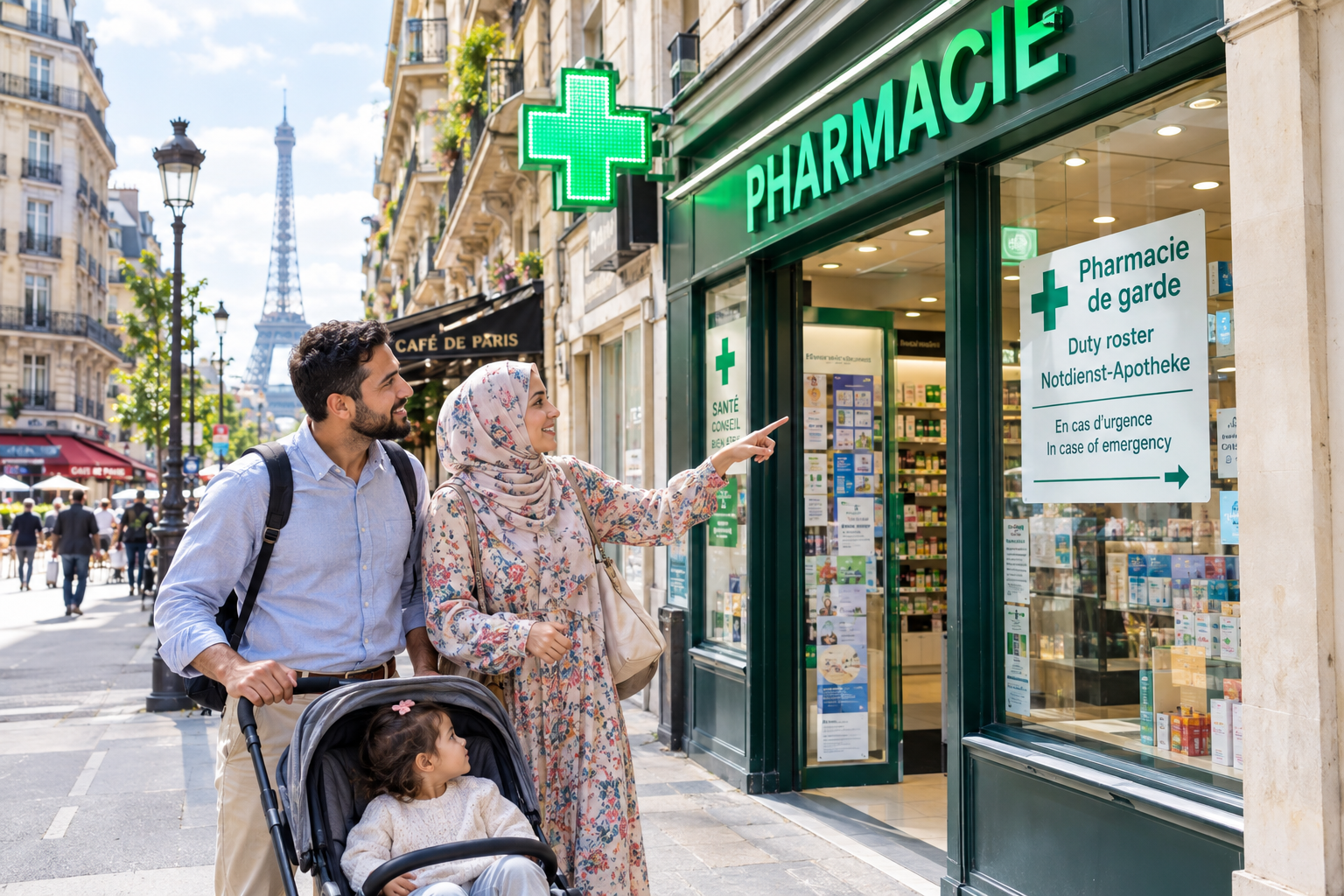
Families access pharmacies and medications on vacation by locating a local pharmacy (farmacia, apotheke), presenting a doctor’s prescription if needed, and using the medication’s generic name to find a local equivalent. To get medication abroad, first find a pharmacy. For prescriptions, you need a local doctor’s note; for OTC drugs, knowing the generic name is crucial as brand names vary. Many countries use a green cross symbol to identify pharmacies. When a pharmacy is closed, they are often required by law to post a sign (a “duty roster”) in the window indicating the name and address of the nearest 24-hour or on-duty pharmacy (Notdienst-Apotheke in Germany, pharmacie de garde in France).
Generic Name: The chemical name of a drug’s active ingredient (e.g., ibuprofen), which is universal, as opposed to the Brand Name (e.g., Advil, Motrin), which changes from country to country. Always travel with the generic names of your family’s essential medications written down. Before your trip, create a note on your phone listing all essential medications by their generic name to show directly to a foreign pharmacist. Follow this checklist to ensure a smooth pharmacy visit. A key part of this process involves understanding the rules for the prescriptions you brought from home.
What Are the Rules for Traveling with Prescription Medications Internationally?
To travel with prescriptions, carry them in original, labeled containers with a doctor’s note. For controlled substances, check your destination country’s laws with its embassy, as common medications can be illegal.
If carrying controlled substances or injectable medication, you should carry a note on letterhead from the prescribing physician and check with the foreign embassy to ensure the medications are allowed in that country.
The “90-day supply” rule is a common guideline, but it is not universal. Some countries, like the UAE, have extremely strict laws and may classify common medications (like those containing codeine) as illegal narcotics. The only authoritative source is the destination country’s embassy or consulate.
Mandatory Guidelines
- You MUST keep medication in original, labeled containers.
- Carry a copy of the prescription or a doctor’s note.
- Only bring a quantity sufficient for the duration of your trip.
- For controlled substances (e.g., ADHD medication, strong painkillers), check specific laws with the destination country’s embassy or consulate.
7. How Should Families Communicate Medical Needs and Histories Effectively Abroad?
Families should communicate medical needs and histories effectively abroad by using translation apps, carrying a pre-written medical history summary in English, and learning a few key medical phrases in the local language. To communicate effectively with a foreign doctor, use a reliable translation app for real-time conversation and show them your pre-prepared medical summary document, combining digital tools with prepared information. Instead of just using a translation app for voice, use its camera function. Point your phone’s camera at a medication box, a doctor’s written instructions, or a hospital form, and the app will often provide an instant on-screen translation, which is invaluable for understanding dosage and instructions.
Medical Phrasebook: A specialized guide containing specific questions and vocabulary for medical situations, often organized by symptom or body part. It is a reliable, no-battery-required backup to a translation app. Prepare a simple, pre-written note in the local language that says: “My child is sick. We speak English. Can you please help us find an English-speaking doctor or use a translation app?” This can be a lifesaver in a moment of panic. This checklist outlines a multi-layered communication strategy. For the most critical situations, knowing a few key phrases by heart is essential.
Which Phrases Are Essential for a Medical Emergency in a Foreign Language?
In a medical emergency abroad, know “Help!”, “Hospital,” and have your child’s specific severe allergy written down. Learning “Where is the nearest…?” can also be life-saving.
Language barriers can complicate medical communication; it is recommended to download translation apps that include medical terminology before traveling.
Beyond single words, the most powerful phrase is “Where is the nearest…?” (e.g., “¿Dónde está el… más cercano?”) combined with “hospital” or “pharmacy.” This single grammatical structure is a key that unlocks directions to any needed facility.
Essential Emergency Phrases
| English Phrase | Example Local Language Phrase (e.g., Spanish/French) |
|---|---|
| Help! | ¡Ayuda! (Spanish) / Au secours! (French) |
| Doctor | Médico (Spanish) / Médecin (French) |
| Hospital | Hospital (Spanish) / Hôpital (French) |
| Emergency | Emergencia (Spanish) / Urgence (French) |
| Allergy to [e.g., peanuts] | Alergia a los cacahuetes (Spanish) / Allergie aux arachides (French) |
| Where is the nearest…? | ¿Dónde está el… más cercano? (Spanish) / Où est le… le plus proche? (French) |
| Fever | Fiebre (Spanish) / Fièvre (French) |
| Pain | Dolor (Spanish) / Douleur (French) |
| Difficulty breathing | Dificultad para respirar (Spanish) / Difficulté à respirer (French) |
Write these phrases on a card and keep it in your wallet, and also save them as a screenshot on your phone’s lock screen during your trip.
8. How to Effectively Handle Unexpected Medical Bills After a Family Vacation Sickness?
The most effective way to handle unexpected medical bills after a family vacation sickness is to immediately notify your insurance provider, keep meticulous records of all payments and medical documents, and submit a complete claim form as soon as possible. To handle post-vacation medical bills, be organized and proactive. Contact your insurer to open a claim, gather all itemized receipts and doctors’ reports, and submit before the policy’s deadline. Do not accept a simple credit card slip as a valid receipt. You must request an *itemized bill* (factura detallada/detaillierte Rechnung) from the hospital or clinic that lists every service and medication provided. Without this, your insurance provider is likely to reject the claim.
Itemized Bill: A detailed invoice that breaks down all the costs associated with a medical treatment, including individual charges for consultations, procedures, supplies, and medications. This is a non-negotiable document for any insurance claim. Even if a bill seems small, start the claim process immediately. Consolidating all expenses into one claim at the end is more efficient and prevents you from missing deadlines. Properly handling the bills is the final step in the incident itself. The next section will focus on the crucial steps for filing the actual insurance claim.
What Steps Should Families Take to File a Travel Insurance Claim for Medical Expenses?
To file a successful claim, you need a claim number from your insurer, all original itemized receipts, the doctor’s report or diagnosis, and a perfectly completed claim form. Make digital copies of everything before mailing originals.
Once an accident occurs, you should file a claim with your insurance company as soon as possible and keep all paperwork and receipts from any medical visits.
When filling out the claim form, be precise and use the exact terminology from the doctor’s report. Do not editorialize or add emotional language. The claim is processed by an adjuster looking to match services rendered to policy coverage, not by a sympathetic reader.
Travel Insurance Claim Submission Checklist
- Contact the insurer to get a claim number.
- Gather all required documents including itemized bills and medical reports.
- Complete the claim form accurately and submit the entire package before the deadline.
- Make copies of everything before sending.
- Follow up with the claims department in writing if you have not heard back within the timeframe they provided.
9. How Can Families Prevent Sickness While Enjoying Their Vacation?
Families can prevent sickness while enjoying their vacation by practicing rigorous hand hygiene, being cautious with food and water sources, protecting against sun and insects, and allowing for adequate rest to avoid fatigue. The best way to prevent vacation sickness is to focus on fundamentals: wash hands frequently, drink only bottled water, eat well-cooked food, use insect repellent and sunscreen, and don’t overschedule your family. The “don’t overschedule” advice is more than just about mood; it’s a medical imperative. Jet lag, time changes, and constant activity suppress the immune systems of both children and adults, making them significantly more susceptible to viruses they would normally fight off.
Food and Water Precautions: A set of travel health guidelines that include avoiding tap water (even for brushing teeth), ice cubes, unpeeled fruits, and food from street vendors with questionable hygiene. The common mantra is “Boil it, cook it, peel it, or forget it.” Adopt the “one major activity per day” rule for the first 48-72 hours in a new time zone to allow your family’s bodies and immune systems to acclimate. These initial tips are part of broader preventive health strategies for family travel that can significantly reduce health risks. These general prevention strategies are your first line of defense. For families with young children, a few extra hygiene and safety tips are essential.
What Are Key Hygiene and Safety Tips for Families Traveling with Young Children?
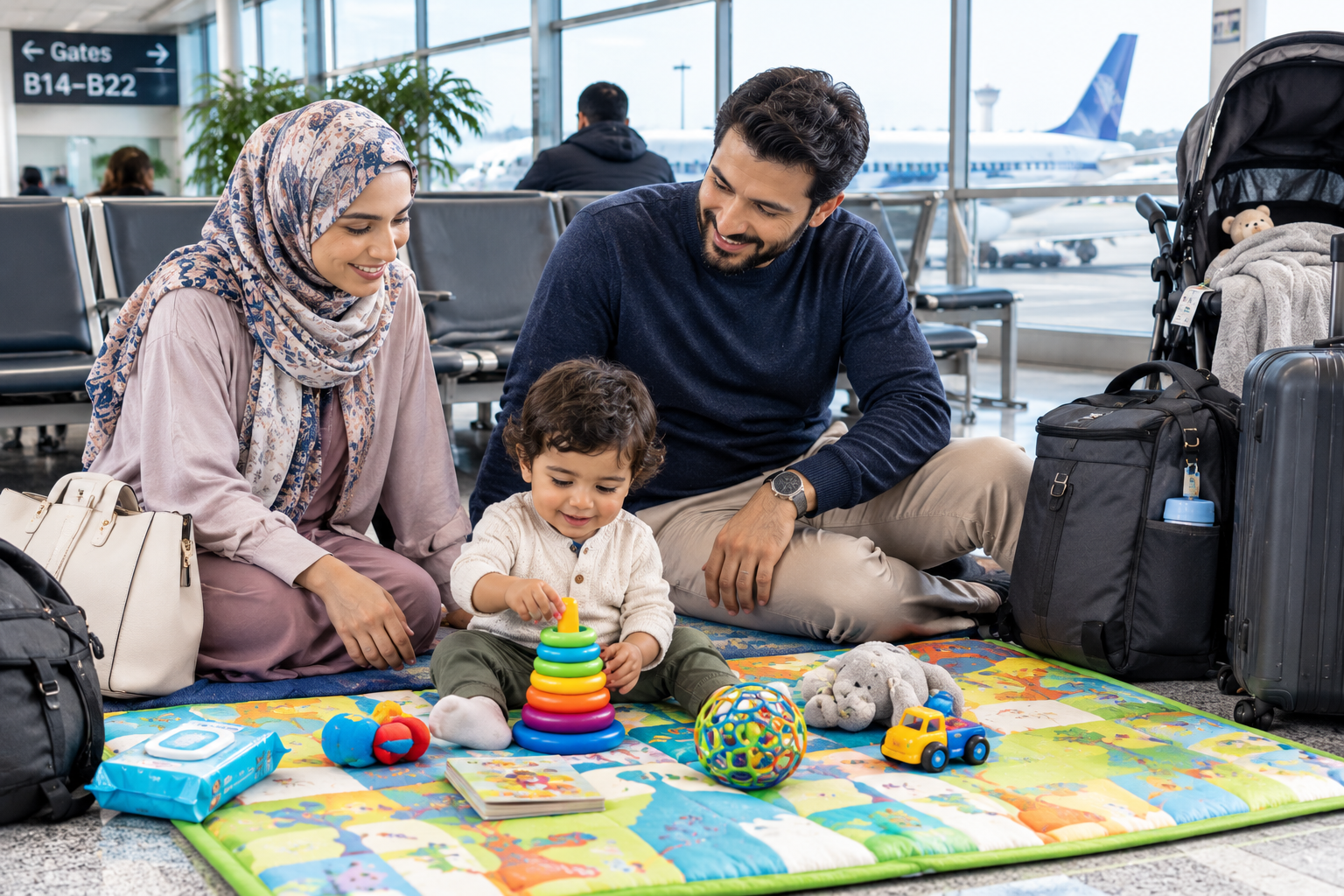
When traveling with young kids, elevate hygiene. Carry hand sanitizer, be vigilant about what they touch and eat, and protect them from sun and bug bites. A portable play mat provides a clean zone.
Hand washing is an effective way to remove germs and prevent the spread of infection; it is especially important to wash hands before and after handling, preparing, or administering any medicine.
For toddlers, the biggest risk is often the floor. Carry a large, packable “play mat” or even a clean hotel sheet to create a safe, clean zone for your child to play on in an airport lounge, a hotel room, or even a park, preventing contact with contaminated surfaces.
Toddler-Specific Travel Tips
- Enforce constant hand washing or sanitizing.
- Ensure they only drink bottled water.
- Closely supervise them to prevent them from putting objects in their mouths.
- Maintain their nap schedule.
- Wipe down high-touch surfaces like airplane tray tables and hotel remote controls with antiseptic wipes.
10. Logistics: Travel Insurance Claim Filing Checklist
| Checklist Item / Tactic | Status |
|---|---|
| STEP 1: Contact the insurer to get a claim number. | ⬜ |
| STEP 2: Gather all required documents including itemized bills and medical reports. | ⬜ |
| STEP 3: Complete the claim form accurately and submit the entire package before the deadline. | ⬜ |
Resolution
Ultimately, ensuring your family’s health abroad isn’t about preventing every possible illness, but about having a robust plan in place. By organizing documents, securing proper insurance, and knowing how to access help, you turn fear into preparedness. The mindset shift is from “What if we get sick?” to “When we face a health issue, here is exactly what we will do.” This guide provides the blueprint for that confidence. Make the creation of a “Family Medical Travel Plan” a permanent part of your vacation planning checklist, just like booking flights and hotels.