What to Do on a Hot Day During a Family Vacation?
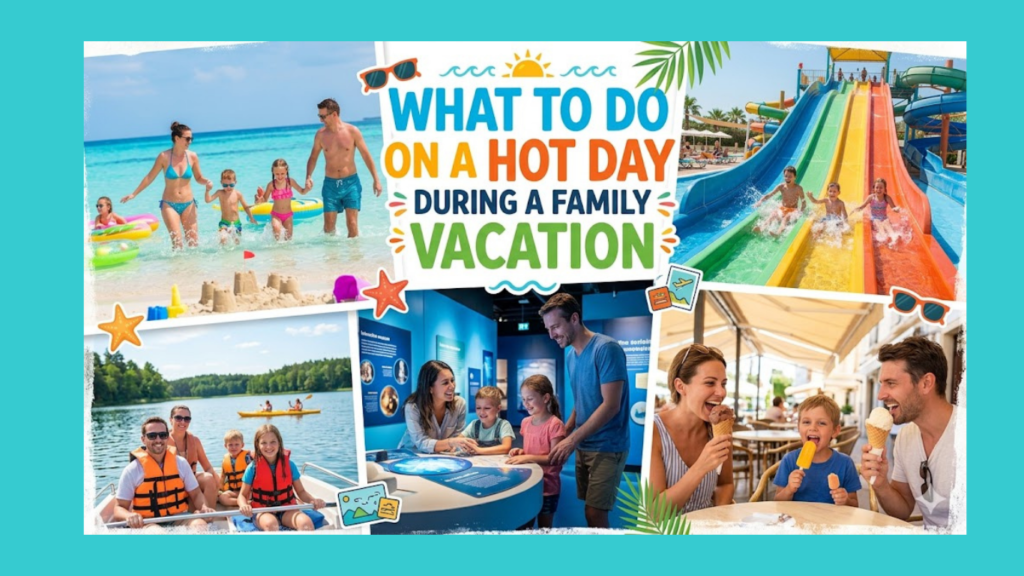
What to Do on a Hot Day During a Family Vacation

What to Do on a Hot Day During a Family Vacation | WovenVoyages What to Do on a Hot Day During a Family Vacation Table of Contents Authored by Abdullahi Azaam Adan 1. The Ultimate Extreme-Heat Strategy 2. Why is Safety Critical? 3. Heat & Meltdowns 4. Venues that Maximize Fun 5. Tactical Cooling Gear 6. Scheduling the Day 7. Shade Logistics 8. Salvaging Exhaustion 9. Handling Resistance 10. Packing Checklist Resolution Table of Contents 1. The Ultimate Extreme-Heat Strategy 2. Why is Safety Critical? 3. Heat & Meltdowns 4. Venues that Maximize Fun 5. Tactical Cooling Gear 6. Scheduling the Day 7. Shade Logistics 8. Salvaging Exhaustion 9. Handling Resistance 10. Packing Checklist Resolution Deciding what to do on a hot day during a family vacation requires parents to aggressively rotate environments and execute pre-planned cooling strategies to prevent dangerous heat exhaustion while maximizing the trip’s fun. Trying to power through extreme heat like an adult will guarantee a disastrous outcome for children. The Ultimate Extreme-Heat Strategy: Water-Based Immersion (Active Cooling): Visit local water parks, hotel splash pads, or shaded natural swimming holes to actively lower core body temperatures. “Deep Cooling” Attractions (Zero Sun Exposure): Pivot to extreme-indoor venues like indoor ice skating rinks, massive air-conditioned science museums, or local dine-in movie theaters. The “Split-Shift” Itinerary (Chronological Bypassing): Hit outdoor attractions aggressively at 8:00 AM, retreat to the hotel for a mandatory 1:00 PM – 4:00 PM “siesta,” and resume activities after dusk. Tactical Shade & Hydration: If you must be outside, pre-book a covered cabana and mandate 15-minute breaks with electrolyte-enhanced water for every 45 minutes of play. This guide equips parents with a physiological and logistical framework to deploy pre-vetted cooling strategies, select climate-controlled venues, and execute “split-shift” itineraries that defeat the heat while mastering environmental risk management. Pediatric Thermal Fatigue identifies the rapid, dangerous depletion of a child’s physical and cognitive energy caused by their body’s inability to efficiently regulate extreme external heat. Contemporary Pediatrics data states that a child’s body temperature rises three to five times faster than an adult’s, driving a 170% skyrocketing increase in pediatric emergency department visits for heat-related illnesses over the past decade, with the risk of life-threatening thermal events being over three times higher during July and August. 2. Why is planning a hot family vacation day critical for safety? Planning a hot family vacation day is critical for safety because proactive thermal management actively prevents catastrophic pediatric heatstroke and severe dehydration. Hot weather requires adjusting daily plans to protect energy levels and avoid heat-related stress. The Reality Layer Watching a child turn bright red, stop sweating, and become dizzy in the middle of a theme park is a terrifying experience for any parent. Heat doesn’t just make kids cranky; it acts as a rapid, silent medical threat if you aren’t prepared. Proactive Safety → Mitigates → Sunstroke Risks. Recognize the rapid onset of pediatric thermal fatigue Recognizing the rapid onset of pediatric thermal fatigue forces parents to intervene long before a child verbally complains of physical heat distress. Thermoregulatory Immaturity defines the biological inability of a child’s developing central nervous system to efficiently coordinate sweat production and skin blood flow during extreme heat exposure. Children possess a significantly higher body surface area-to-mass ratio than fully mature adults, causing their skin to act as a massive thermal receptor that absorbs radiant heat at an exponentially accelerated pace, compounded by a delayed and less productive sweating response. Rule: Assume children will succumb to heat exhaustion twice as fast as adults. Reason: Because their cardiovascular system must work significantly harder to pump blood to the skin’s surface for cooling, children experience rapid cardiac strain and systemic energy depletion long before adults register uncomfortable warmth. Example: A 6-year-old suddenly complaining of a stomach ache or dizziness after just 45 minutes in a sun-baked theme park plaza is a clinical symptom of blood being aggressively shunted away from the gastrointestinal tract to facilitate emergency thermoregulation. Figure 1: Pediatric Core Temperature Escalation Core Temp Time in Direct Sun 98.6°F Baseline Adult Temp Rise Child Temp Rise (3-5x Faster) Heat Exhaustion Zone (>100.4°F) Line graph showing how a child’s body temperature rises 3-5 times faster than an adult’s when exposed to extreme radiant heat. © WovenVoyages Map peak UV index windows to prevent severe sunburns Mapping peak UV index windows accurately dictates your schedule, ensuring you eliminate direct exposure during the most biologically damaging hours of the afternoon. The Melanoma Research Foundation states that an alarming 69% of children report experiencing summer sunburns, and sustaining just one blistering sunburn during childhood or adolescence more than doubles an individual’s lifetime risk of developing melanoma skin cancer. If: Your weather app shows the local UV Index hitting a 9 or higher. Do: Hard-stop all direct outdoor exposure between the hours of 11:00 AM and 3:00 PM. Result: You completely eliminate the risk of second-degree sunburns that would physically ruin the rest of the trip, preventing the systemic inflammation and heightened baseline body temperatures that invariably follow a severe dermal burn. 3. How does a hot family vacation day trigger behavioral meltdowns? A hot family vacation day triggers behavioral meltdowns by pushing a child’s core temperature into a physiological survival state that completely bypasses logical reasoning. Extreme Heat Exposure → Exacerbates → Behavioral Meltdowns. Acknowledge the link between core temperature and emotional regulation Acknowledging the direct link between core temperature and emotional regulation helps parents realize that heat-induced tantrums are biological reactions, not disciplinary issues. To combat behavioral meltdowns, parents must prioritize cooling over lecturing. Heat can quickly increase fatigue, especially for younger children and older adults. The Alzheimer’s Drug Discovery Foundation states that significant impairments to attention, motor function, and emotional control become rapidly apparent when internal body temperatures reach 101.3°F (38.5°C). Furthermore, NYU research reveals that prolonged exposure to temperatures exceeding 86°F (30°C) directly impairs a child’s developing neurological capacity to self-regulate. Rule: Never attempt to discipline or negotiate with a child who is actively overheating.