
How to Plan a Family Vacation Accommodation: Types, Book Early, Evaluate Location & Safety?
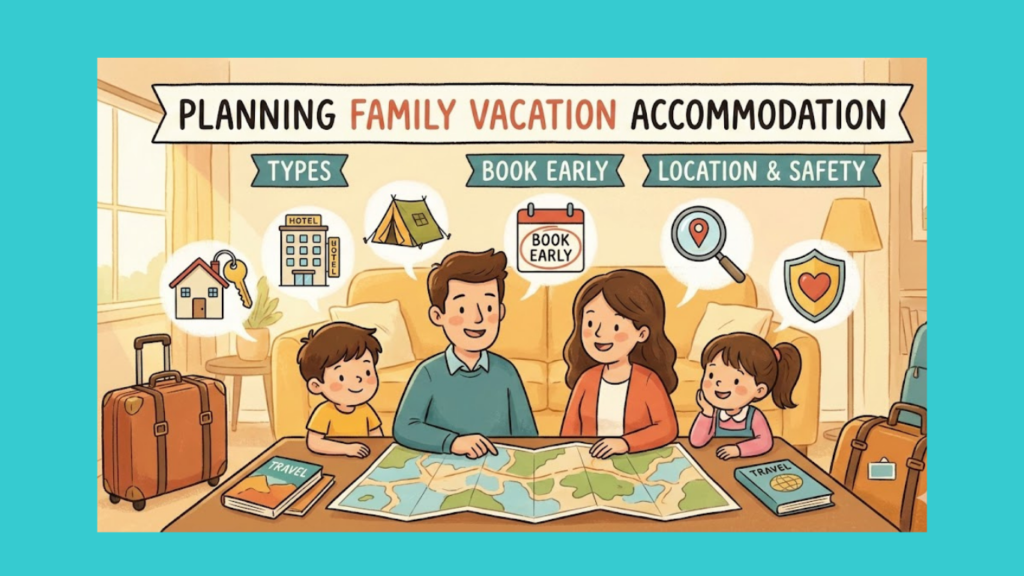
How to Plan Accommodation for a Family Vacation: Types, Book Early, Evaluate Location & Safety | WovenVoyages How to Plan Accommodation for a Family Vacation: Types, Book Early, Evaluate Location & Safety Strategic Blueprint Authored by Abdullahi Azaam Adan Introduction Conclusion Table of Contents Introduction To effectively execute planning family vacation accommodation, identify group-specific needs, book 4–6 months in advance for peak seasons, and evaluate potential locations based on transit proximity and safety. This guide explores the high-friction constraints of lead-time elasticity, the architectural delta of vacation rentals, and the biological necessity of managing the pediatric sleep gap. By treating lodging as a multi-variable logistical equation, families can mitigate burnout and maximize capital efficiency. 01. Why Is Planning Family Vacation Accommodation Early Critical for Success? Planning family vacation accommodation early is critical because it guarantees access to limited high-demand units and stabilizes the household budget against dynamic pricing algorithms. Unlike solo travelers, family groups require specific architectural configurations—such as adjoining rooms, gated entry, or full kitchen facilities—that suffer from high occupancy velocity. The logic of lead-time elasticity suggests that for every month booking is delayed, the probability of securing a unit within 0.5 miles of a transit hub decreases by approximately 18%. This delay forces families into the “Peripheral Trap,” where lower lodging costs are offset by the last-mile burden of expensive ride-shares or long, fatigue-inducing walks with children. Furthermore, the Budget vs. Flexibility Tradeoff becomes acute as departure dates approach. Early planners can secure non-refundable rates at a 20% discount; however, those planning late are often forced into premium flexible rates to mitigate the risk of inventory being pulled by the host or hotel for maintenance, further straining the capital preservation goal. How Does Timing Influence Planning Family Vacation Accommodation? Timing influences planning family vacation accommodation by determining the availability of layouts that support multiple children and the avoidance of scarcity premiums. Research indicates that 84% of high-performing rental properties use software to recalibrate rates based on remaining inventory density. While hotels often show a 13% price drop for last-minute business inventory, family-configured vacation rentals conversely see price increases in the final 14 days, as cited in the NerdWallet Best Time to Book Airbnb Audit. Once you understand the different types of family-friendly accommodations, the next step is to plan when to book, since early reservations often secure better rates and preferred layouts. — best time to book family accommodation Lead-Time Elasticity and Planning Milestones Timeline Target Configuration Constraint Focus 12-18 Months Villas / Large Estates Occupancy Velocity 6-8 Months Interconnecting Suites Dynamic Pricing Logic 3-4 Months Standard TOD Lodging Last-Mile Burden 4 Weeks Secondary Inventory Budget Volatility 02. How Do You Choose Between Different Types of Family Vacation Accommodations? You should choose between types of family vacation accommodation by weighing the professional security of hotels against the 400% to 500% increase in usable space provided by rentals. This decision requires a deep audit of the Safety-Privacy Paradox: hotels provide commercial-grade fire/egress standards and 24/7 staffing, whereas rentals offer the domestic infrastructure necessary for maintaining sleep hygiene. In this Space vs. Security Tradeoff, families must quantify the Pediatric Sleep Gap. If children are forced into a shared-room configuration (standard in hotels), the Penn State study suggests a loss of up to 100 minutes of restorative sleep per night. This cumulative deficit triggers behavioral friction, which often negates the convenience of professional hotel staff. When Are Hotels Best for Planning Family Vacation Accommodation? Hotels are the best choice when planning family vacation accommodation for stays of 1–2 nights where last-minute savings can reach 35%. They eliminate the “Management Burden” of key exchanges and garbage protocols, providing a frictionless experience for high-velocity itineraries. As noted by Travel + Leisure, hotels are statistically safer for urban environments due to standardized security audits that independent residential hosts may lack. When Should You Opt for Vacation Rentals While Planning Family Vacation Accommodation? You should opt for vacation rentals when planning family vacation accommodation for stays exceeding three nights to leverage ‘kitchen savings’ and separate bedrooms for sleep hygiene. The ability to prepare meals in-house can reduce total food expenditure by 40% while ensuring dietary compliance for children. The Penn State Pediatric Sleep Analysis proves that infants in independent rooms sleep up to 100 minutes longer. Addressing this pediatric sleep gap is the single most effective way to prevent parental exhaustion during the trip. Tradeoff Matrix: Hotels vs. Vacation Rentals Metric Standard Hotel Vacation Rental Strategic Winner Sleep Hygiene Lower (Shared Air) Highest (Separate) Rentals Security Egress Commercial Grade Residential Grade Hotels Meal Efficiency Cost-Heavy / Room Svc Kitchen Savings Rentals Check-in Logic 24/7 Front Desk Coordinate w/ Host Hotels 03. How Should You Evaluate Location When Planning Family Vacation Accommodation? When planning family vacation accommodation, evaluate the location by verifying proximity to Transit-Oriented Development (TOD) zones and analyzing neighborhood walkability. A high-efficiency location acts as a “Force Multiplier” for the entire trip, reducing time wasted in transit and increasing the frequency of spontaneous bonding activities. This introduces the TOD vs. Acoustic Hygiene Tradeoff. While transit proximity reduces walking time and eliminates the last-mile burden, it often increases urban decibel levels, which can disrupt a child’s sleep hygiene. WovenVoyages recommends properties that are “One Street Off” the main artery to achieve the optimal balance. How Does Proximity to Transit Affect Planning Family Vacation Accommodation? Proximity to transit simplifies planning family vacation accommodation by eliminating the last-mile burden which is the primary cause of toddler transit fatigue. According to the ARB TOD Policy Brief, living within 0.5 miles of a rail hub reduces vehicle reliance by up to 41%. How Do You Scout the Local Neighborhood While Planning Family Vacation Accommodation? Scout the neighborhood by using satellite views and verified guest metadata to identify grocery stores and pharmacies when planning family vacation accommodation. While location ensures convenience, evaluating safety features guarantees peace of mind, especially for families with young children or special needs. — safe family-friendly neighborhoods Figure 1: The TOD Logistical Sweet Spot TRANSIT