
On a family vacation, how much supervision do kids need?
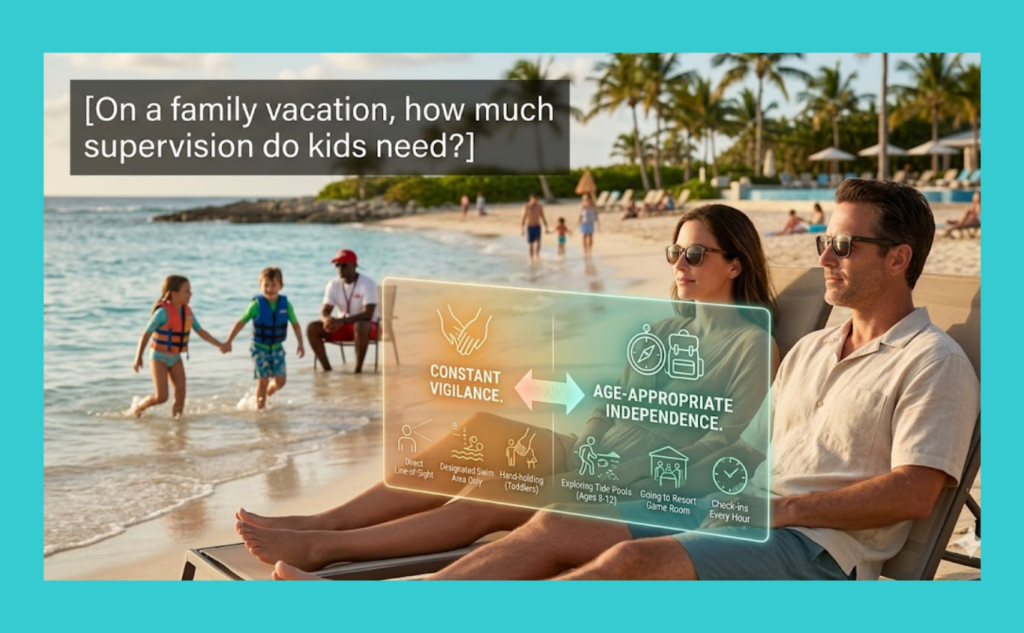
On a family vacation, how much supervision do kids need? | WovenVoyages On a family vacation, how much supervision do kids need? Table of Contents Authored by Abdullahi Azaam Adan 1. Age-Based Guidelines Resolution Table of Contents 1. Age-Based Guidelines The exact amount of supervision kids need on a family vacation scales strictly with their developmental age and hazard awareness, ranging from constant line-of-sight monitoring for toddlers to scheduled boundary check-ins for teenagers. Age-Based Vacation Supervision Guidelines: Infants & Toddlers (Ages 0-4): Constant Line-of-Sight Supervision. Require physical “arm’s reach” proximity near water, crowds, or transit hubs. Zero independent roaming allowed. Early Elementary (Ages 5-8): Zonal Supervision. Kids can play independently within a strictly defined physical zone (e.g., a fenced playground) while parents maintain continuous visual contact. Tweens (Ages 9-12): Check-In Supervision. Can navigate safe, enclosed areas with a buddy, requiring mandatory physical or digital check-ins every 1 to 2 hours. Teens (Ages 13-17): Boundary Supervision. Can explore wider areas independently, provided they have a fully charged phone, active passive location tracking, and a strict curfew. This guide equips parents with a scalable framework to evaluate monitoring tools, seamlessly execute caregiver handoffs, and confidently grant safe independence to traveling children. Immature neurological pathways fundamentally limit how youthful explorers perceive, analyze, and actively react to sudden environmental threats, forcing overwhelmed working memory to completely filter out lethal hazards. 2. Why is scaling vacation child supervision critical for safety? Scaling vacation child supervision remains critical for safety because a child’s cognitive development dictates their absolute ability to process unfamiliar travel environments. Dynamic Risk Assessments → Prevent → Situational Awareness Failures. Adolescents between twelve and fourteen years old represent nearly twelve percent of pedestrian fatalities due to sensation-seeking behaviors that actively suppress hazard recognition. Establish an age-appropriate baseline for parental monitoring Establishing an age-appropriate baseline for parental monitoring demands that caregivers scale their physical presence based on the child’s hazard recognition rather than chronological age. Supervision levels on a family vacation should change depending on a child’s age, maturity, and environment. Physical Proximity → Reduces → Injury Risk. The clinical reality shows that children positioned beyond the physical reach of their caregiver face the highest odds of severe injury, proving that proximity functions as the most critical dimension for reducing trauma among young children, as detailed by the Child Encyclopedia. Rule: Scale your physical presence based on the child’s hazard awareness, not just their age. Reason: A mature 8-year-old handles a resort arcade safely, while an impulsive 10-year-old requires stricter boundaries. Example: Allowing a tween to walk to the resort snack bar alone, but escorting them to the ocean. Recognize environmental factors that alter necessary monitoring levels Recognizing environmental factors that alter necessary monitoring levels forces parents to immediately revoke conditional autonomy privileges when moving into chaotic transit hubs. Parents should adjust supervision levels when travel fatigue reduces children’s attention and awareness. Environmental Familiarity → Dictates → Supervision Intensity. Pedestrian accidents, poor road conditions, and severe security threats dominate crowded international transit areas, manufacturing stampedes and criminal activity that create extremely hazardous environments for unsupervised children, according to State Department guidelines. Rule: Increase supervision intensity when environmental familiarity drops. Reason: A child who navigates their home neighborhood safely cannot predict foreign traffic patterns. Example: Reverting a teen to “Check-In Supervision” when visiting a highly congested international train station. 3. How does resort layout impact your vacation child supervision? Resort layout drastically impacts vacation child supervision by introducing hidden visual obstructions and unpredictable pedestrian traffic zones into the family’s immediate perimeter. Accommodation environments also influence how closely children must be supervised. Visual Obstructions → Compromise → Uninterrupted Line of Sight. Drowning remains the leading cause of unintentional injury death among children aged one to four, with 380 fatal child drownings occurring in a single year (a 12% increase), documented directly by the CPSC. Map physical sightlines across hotel and pool zones Mapping physical sightlines across hotel and pool zones allows parents to establish objective physical landmarks before permitting independent play. Strategic Spatial Awareness → Mitigates → Environmental Hazards. Seventy-five percent of fatal pool or spa-related drownings involve children under five years of age, and analysis of children drowning abroad reveals seventy-one percent of fatalities occur precisely in swimming pools. Step 1: Walk the perimeter of the pool or resort hub immediately upon arrival. Step 2: Identify obstructed views, such as large rock formations or winding lazy rivers. Step 3: Position your lounge chairs at the specific angle offering maximum uninterrupted visibility. Figure 1: Sightline Mapping Protocol Resort Pool Parent Blind Spot Visualizing how strategically positioned seating physically neutralizes blind spots in crowded hotel pool areas. © WovenVoyages Identify blind spots in high-traffic tourist areas Identifying blind spots in high-traffic tourist areas actively neutralizes the separation risks associated with massive crowds and multiple exit points. Busy tourist areas require closer supervision because children can easily become separated in crowded spaces. Strategic Positioning → Eliminates → Blind-Spots. Drowning occurs silently in under thirty seconds, entirely devoid of cinematic splashing, guaranteeing that momentary visual obstructions and structural blind spots result in fatal outcomes rapidly. If: You are dining at a crowded outdoor plaza featuring multiple pedestrian exits. Do: Seat the most impulsive child on the inside of the booth, physically blocking their exit trajectory. Result: You eliminate the risk of them slipping into a blind spot while you read the menu. 4. Which tech tools enhance remote vacation child supervision? Selecting the correct geolocation technology exponentially enhances remote vacation child supervision by maintaining a persistent digital tether to exploring teenagers. Geolocation Technology → Enhances → Parental Monitoring. Compare smartwatches against basic GPS tracking tags Comparing cellular smartwatches against basic GPS tracking tags reveals massive discrepancies in two-way communication hardware and passive location tracking reliability. Hardware Trackers → Bypass → Compliance Requirements. Bluetooth tracking collapses instantly in unpopulated areas lacking smart devices, whereas cellular devices drain batteries rapidly when actively searching for signals, instantly transitioning an uncharged device from monitored to lost, documented by Track Your Truck. The