
What are good indoor activities for a rainy family vacation day?
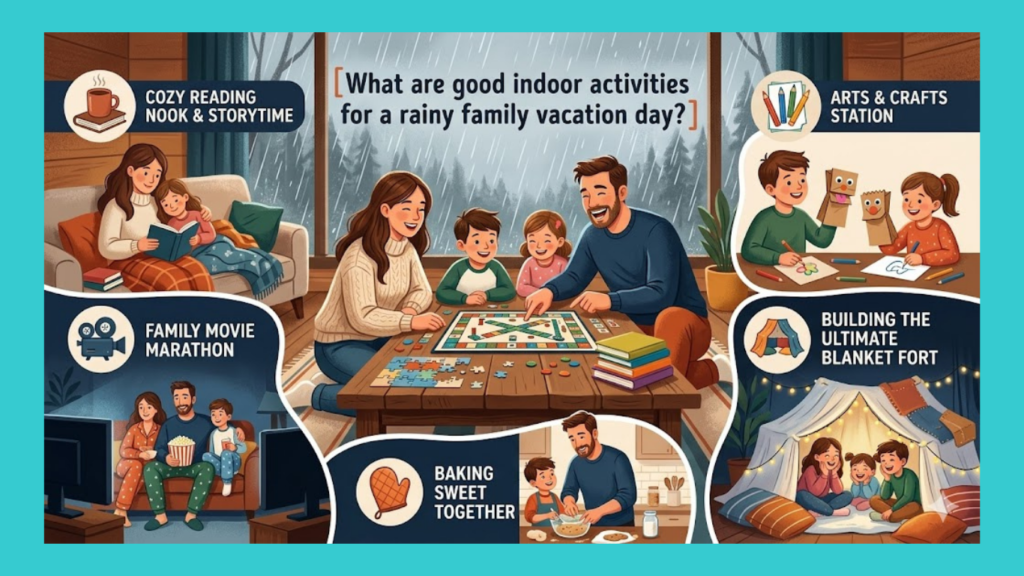
What are good indoor activities for a rainy family vacation day? | WovenVoyages What are good indoor activities for a rainy family vacation day? Table of Contents Authored by Abdullahi Azaam Adan 1. The Ultimate Strategy 2. Why Plan in Advance? 3. Eliminating Boredom 4. Best Local Venues 5. Optimal Travel Games 6. Scheduling the Day 7. Dry Transit Logistics 8. Fixing Overstimulation 9. Handling Resistance 10. Packing Checklist Resolution Table of Contents 1. The Ultimate Strategy 2. Why Plan in Advance? 3. Eliminating Boredom 4. Best Local Venues 5. Optimal Travel Games 6. Scheduling the Day 7. Dry Transit Logistics 8. Fixing Overstimulation 9. Handling Resistance 10. Packing Checklist Resolution Good indoor activities for a rainy family vacation day include high-energy trampoline parks, interactive science museums, and cooperative hotel games that perfectly balance physical exertion with focused cognitive engagement. Preventing cabin fever during a washout requires parents to quickly mitigate spatial confinement friction by deploying these pre-vetted options rather than relying on spontaneous plans. The Ultimate Rainy Day Strategy: High-Energy Indoor Venues (Burn physical energy): Local trampoline parks, indoor climbing gyms, large-scale children’s museums, or hotel indoor pool complexes. Immersive Educational Spaces (Burn cognitive energy): Interactive science centers, massive local aquariums, or hands-on cultural cooking classes. Low-Friction Hotel Activities (Zero transit required): Hotel-wide scavenger hunts, indoor blanket fort building, cooperative travel board games, or a supervised “spa day” in the room. Strategic Passive Entertainment (Rest and reset): A local dine-in movie theater or a designated 90-minute “screen time and room service” hotel picnic. This guide equips parents with a psychological and logistical framework to execute a structured “rainy day” itinerary, seamlessly pivoting from ruined outdoor plans to unforgettable indoor adventures. Spatial Confinement Friction identifies the rapid escalation in pediatric irritability and sibling conflict caused by being trapped in the small, restricted footprint of a standard hotel room. The 2025 U.S. Family Travel Survey conducted by the Family Travel Association (FTA) and the NYU School of Professional Studies states that 92% of parents plan to travel with their children, spending an average of $8,052 per domestic trip. Protecting this substantial financial and emotional investment from unpredictable weather requires a rigorously structured contingency plan. 2. Why must you plan indoor family vacation activities in advance? Proactively mapping indoor family vacation activities is essential because relying entirely on spontaneous, ad-hoc planning during a sudden downpour virtually guarantees extreme spatial confinement friction. The Reality Layer When you wake up to relentless rain on what was supposed to be a beach day, the disappointment is heavy. If you don’t instantly project confidence and unveil an exciting backup plan, the kids will spiral into a miserable, uncooperative mood. Proactive Planning → Mitigates → Spatial Confinement Friction. Why does spatial confinement trigger behavioral breakdowns? Acknowledging the profound psychological impact of spatial confinement proves that staying trapped in a standard hotel room without a structured activity will cause behavioral breakdowns within three hours. Weather changes can quickly cancel outdoor plans, making alternatives essential. Clinical assessments of pediatric stress responses demonstrate that when children are subjected to confinement without adequate physical outlets, the hypothalamic-pituitary-adrenal (HPA) axis activates, leading to a significant and measurable increase in circulating cortisol concentrations that directly predicts dysregulated behavior. Rule: Assume that staying trapped in a standard hotel room will cause behavioral breakdowns within 3 hours. Reason: Children require physical spatial transitions to regulate their nervous systems; removing those transitions spikes cortisol and irritability. Example: Siblings fighting over a television remote because they have no physical outlet for their pent-up travel energy. Figure 1: Spatial Confinement & Cortisol Escalation Cortisol Level Hours Confined in Room 1 Hr 2 Hrs 3 Hrs Baseline Behavioral Breakdown Animated graph visualizing how being trapped in a standard hotel room rapidly spikes pediatric cortisol levels. © WovenVoyages How does active engagement differ from passive screen time? Differentiating between active indoor engagement and passive screen time forces parents to treat electronic devices as a strategic fallback rather than an immediate crutch. Dopamine Deficit defines the lethargic, highly irritable state a child enters immediately after terminating prolonged, passive screen time. Rule: Never use screen time as the first response to a rainy vacation day. Reason: Extended passive screen time creates a dopamine deficit, leaving kids more lethargic and irritable when the screens are finally turned off. Example: Deploying a physical, cooperative card game at 9:00 AM and saving the iPad movie strictly for the 2:00 PM afternoon slump. 3. How do indoor activities eliminate trip-ruining boredom? Strategically deploying indoor family vacation activities eliminates trip-ruining boredom by overriding travel monotony with highly novel, heavily structured sensory stimulation. High-Energy Venues → Override → Boredom Monotony. How to transform the hotel room into an exclusive play zone Recognizing the power of novel, out-of-routine hotel experiences allows parents to transform mundane hospitality environments into exclusive, highly desirable play zones. Scientific research into associative learning and neuroplasticity demonstrates that novel experiences trigger a substantial release of dopamine in the prefrontal cortex and hippocampus, which directly facilitates memory persistence and enhances cognitive flexibility during travel disappointments. Rule: Transform mundane hotel environments into exclusive play zones. Reason: Novelty instantly overrides disappointment. Doing something “forbidden” at home feels like a massive adventure on vacation. Example: Allowing the kids to eat a room-service pizza while sitting inside an elaborate blanket fort built over the hotel beds. Why are culinary activities effective for burning cognitive energy? Mapping the correlation between prolonged culinary activities and time-burning reveals that structured food preparation serves as a masterclass in burning immense cognitive focus. Participating in a structured cooking environment forces children to follow sequential logic and engage multiple senses simultaneously, safely exhausting their cognitive energy reserves. If: You have a massive 4-hour block of heavy rain to kill before dinner. Do: Book a hands-on, local cooking class (like pizza or pasta making) rather than just sitting passively at a restaurant. Result: You successfully burn 3 hours of highly engaging, structured time that organically ends with a fully fed family. 4. Which local venues offer