
How Do Neighborhood Safety and Noise Levels Affect Family Accommodation Decisions?
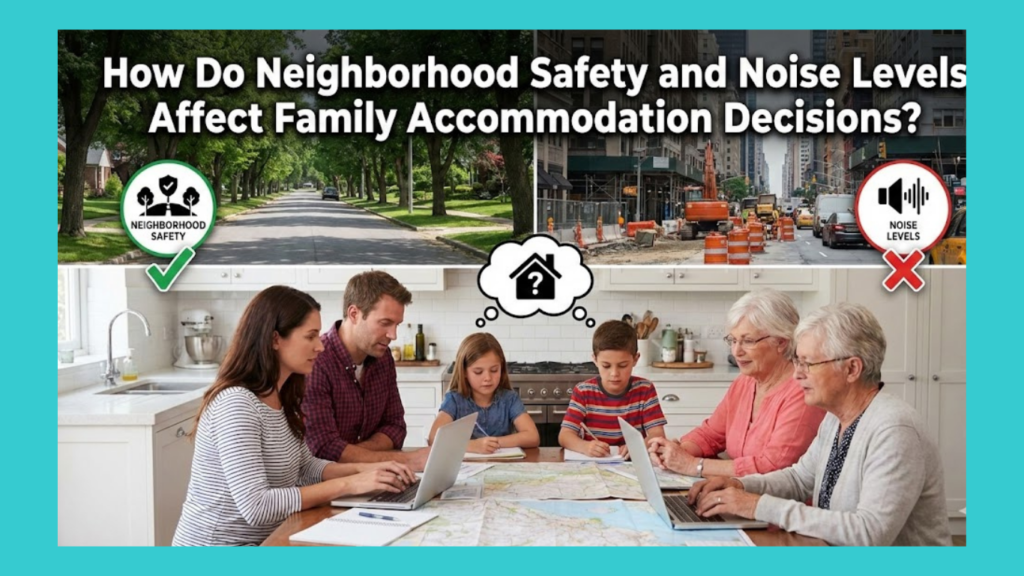
How Neighborhood Safety and Noise Affect Family Accommodation | WovenVoyages How Do Neighborhood Safety and Noise Levels Affect Family Accommodation Decisions? Table of Contents Authored by Abdullahi Azaam Adan 1. Introduction Resolution Table of Contents 1. Introduction Neighborhood safety and noise levels affect family accommodation decisions by acting as the primary predictors of long-term domestic stability; securing a quiet, secure environment prevents chronic infant sleep disruption, eliminates parental hyper-vigilance, and avoids the severe financial penalty of prematurely breaking a lease or selling a home. Evaluating locations purely through the lens of aesthetic gentrification or property values completely ignores the biological toll a high-friction environment exerts on a household. Planners must assess the specific acoustic and physical metrics of a street to protect the physiological baseline of the family. Neighborhood safety directly impacts family stress levels and daily mobility. 2. Why Do Neighborhood Safety and Noise Levels During Family Accommodation Decisions Dictate Domestic Stability? Neighborhood safety and noise levels during family accommodation decisions dictate domestic stability because chronic exposure to sirens, high-speed traffic, and perceived localized crime elevates household cortisol levels and systematically degrades the family’s baseline mental health. High-Security / Low-Noise Zones: Serve as restorative environments that systematically lower heart rates, protect Circadian rhythms, and encourage unstructured outdoor pediatric play in defensible spaces. Low-Security / High-Noise Zones: Operate as chronic stress environments that force the nervous system into a state of permanent defense, accelerating parental burnout and driving high rates of residential mobility. How Do Neighborhood Safety and Noise Levels During Family Accommodation Decisions Impact Pediatric Sleep? Neighborhood safety and noise levels during family accommodation decisions impact pediatric sleep by determining the frequency of nocturnal awakenings; continuous environmental noise above 45 decibels prevents infants and toddlers from reaching restorative deep sleep phases. Continuous road traffic noise above 45 dB induces severe sleep fragmentation; meta-analyses published via the NCBI / NIH demonstrate that noise exposure impairs cognitive performance in children with a standardized mean difference (SMD) of -0.544. Sudden acoustic peaks cause immediate Cortical arousals, forcefully pulling children out of restorative slow-wave sleep and destabilizing critical Circadian rhythms and growth hormone release. Noise levels determine sleep quality, which directly shapes children’s mood and daily energy. High Ambient Noise → Disrupts REM Sleep Cycles → Triggers Pediatric Exhaustion. Figure 1: The Cortisol Stress Cascade Cortisol Level Nighttime Hours Acoustic Spike (>45dB) Visualizing how continuous environmental noise physically fragments sleep architecture and forces artificial cortisol spikes. © WovenVoyages Why Do Neighborhood Safety and Noise Levels During Family Accommodation Decisions Influence Parental Stress? Neighborhood safety and noise levels during family accommodation decisions influence parental stress by either eliminating or amplifying hyper-vigilance; an objectively safe, quiet neighborhood allows parents to relax their guard during outdoor play, whereas high-traffic or high-crime zones require constant, exhausting threat assessment. Continuous hyper-vigilance regarding property crime or violent crime chronically spikes parental cortisol levels and significantly shortens telomere length, a primary biological marker for accelerated aging and cardiovascular disease. Forcing the amygdala into perpetual overdrive drastically reduces overall household Livability, preventing families from utilizing outdoor defensible space and frequently accelerating forced residential mobility. 3. How Do You Evaluate Neighborhood Safety and Noise Levels During Family Accommodation Decisions? You evaluate neighborhood safety and noise levels during family accommodation decisions by ignoring stylized real estate photos and actively auditing local municipal crime heatmaps, pedestrian infrastructure, and the presence of traffic calming measures. The “Real Estate vs. Reality” Audit Matrix The Real Estate Claim The Forensic Translation The Family Impact “Up-and-coming vibrant street” High late-night foot traffic and noise pollution Frequent 2:00 AM awakenings and sleep fragmentation “Convenient highway access” Direct exposure to arterial road exhaust and noise Elevated baseline stress and unsafe pedestrian boundaries “Bustling commercial zone” Early morning delivery trucks and waste removal Disrupted circadian rhythms for infants and toddlers Do Neighborhood Safety and Noise Levels During Family Accommodation Decisions Require Nighttime Audits? Yes, neighborhood safety and noise levels during family accommodation decisions require nighttime audits because properties that appear tranquil at 10:00 AM frequently transform into high-traffic, noisy thoroughfares or poorly lit, unsafe corridors by 9:00 PM. Improved street lighting directly reduces nighttime index crimes by a massive 21% to 36%, successfully deterring assaults and robberies. Without proper illumination, natural surveillance collapses entirely. A nighttime audit operates as a mandatory step to measure the true Lnight output of modified vehicle exhausts and pedestrian egress noise entirely invisible during midday. Figure 2: The Nighttime Illumination Shield Natural Surveillance Zone Index Crime Risk Mapping the direct correlation between street lighting and the collapse of localized property crime. © WovenVoyages How Do Neighborhood Safety and Noise Levels During Family Accommodation Decisions Relate to Sidewalk Infrastructure? Neighborhood safety and noise levels during family accommodation decisions relate to sidewalk infrastructure because the physical separation between fast-moving vehicles and walking toddlers is the most immediate daily safety variable families will physically encounter. Lowering average vehicle speeds by just 1% results in a 4% decrease in fatal crashes; data curated by Road Safety NGOs indicates installing speed humps reduces child pedestrian injury odds by 53% to 60%, and single-lane roundabouts reduce crashes by 70% to 80%. Traffic calming neighborhoods with robust sidewalk infrastructure physically neutralize the threats posed by an adjacent arterial road, establishing critical Walkability. Safer, quieter areas increase walkability and reduce nighttime transport risks significantly. 4. What Metrics Measure Neighborhood Safety and Noise Levels During Family Accommodation Decisions? The metrics that measure neighborhood safety and noise levels during family accommodation decisions include proximity to emergency flight paths, distance from active freight train lines, and the decibel rating of the street facing the home’s primary bedrooms. The Highway Radius How Do Neighborhood Safety and Noise Levels During Family Accommodation Decisions Account for Intermittent vs. Continuous Noise? Neighborhood safety and noise levels during family accommodation decisions account for intermittent versus continuous noise by recognizing that occasional daytime construction is a temporary annoyance, while the continuous drone of a multi-lane highway is a permanent biological stressor. The Lden metric explicitly calculates annoyance by applying a strict 5