When to plan quiet time during a family vacation?
When to plan quiet time during a family vacation?

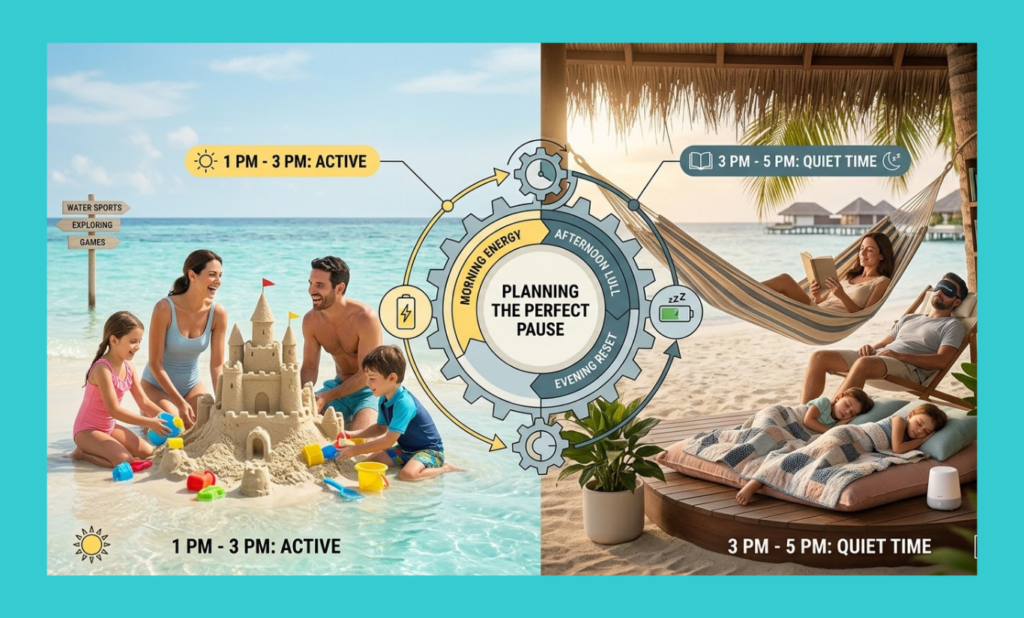
When to plan quiet time during a family vacation? | WovenVoyages When to plan quiet time during a family vacation? Table of Contents Authored by Abdullahi Azaam Adan 1. The Optimal Windows Resolution Table of Contents 1. The Optimal Windows Determining exactly when to plan quiet time during a family vacation requires parents to map mandatory decompression blocks directly onto a child’s natural physiological and cognitive dips. The Optimal Downtime Scheduling Windows: The Post-Lunch Thermal Crash (1:00 PM – 3:30 PM): The body’s natural circadian dip combines with digestion and peak afternoon heat. This is the ultimate, non-negotiable 90-minute window for a dark-room hotel break. The Pre-Dinner Transition (4:30 PM – 5:30 PM): A 45-minute “screen-only” or silent reading buffer before heading back out to crowded restaurants. It resets the nervous system after a loud afternoon. The Post-Transit Decompression (Immediate Arrival): Plan 60 minutes of zero-demand quiet time the moment you arrive at a new hotel before unpacking or exploring. The 1:1 Pacing Trigger: Regardless of the clock, enforce 30 minutes of quiet active-rest (e.g., sitting under a tree) immediately following any high-stimulation environment lasting longer than 3 hours. This guide equips parents with a chronological and psychological framework to schedule non-negotiable breaks, mitigate sensory overload, and prevent cumulative exhaustion during demanding travel itineraries. Cognitive Load defines the mental energy children expend processing unfamiliar travel environments, new languages, and crowded tourist hubs. Anthropological researchers at Northwestern University establish that a five-year-old child’s brain absorbs nearly 66 percent of the body’s resting metabolic expenditure to support neurogenesis, physically starving somatic systems of immediate fuel when exposed to the intense demands of navigating novel environments. 2. Why is family vacation quiet time critical for survival? Family vacation quiet time proves critical for survival because unrelenting environmental novelty rapidly exhausts a child’s mental bandwidth to process new travel experiences and regulate emotions. Environmental Novelty → Exhausts → Neurological Capacity. Prevent cumulative sensory overload in unfamiliar environments Preventing cumulative sensory overload in unfamiliar environments stops the rapid depletion of the prefrontal cortex and intercepts severe behavioral crashes before they manifest publicly. Children require predictable downtime to stay emotionally balanced during busy travel days. Sensory Overload Prevention → Intercepts → Behavioral Crashes. Data published by Autism.org establishes that roughly 5% to 12% of children exhibit diagnosed sensory processing challenges, while 93% to 96% of children with autism spectrum profiles experience profound sensory reactivity differences where outward-focused brain networks exhibit critically low activity under stress. Action: Treat mental overstimulation on trips as a physical energy drain. Mechanism: Severe behavioral crashes result directly from rapid mental fatigue when processing new languages, crowds, and constant noise. Outcome: Protecting a child’s travel stamina results directly from proactive sensory sheltering. Map restorative downtime to natural circadian dips Mapping restorative downtime to natural circadian dips synchronizes the travel itinerary with the undeniable biological reality of the pediatric nervous system. Midday breaks are often the most effective time for rest, especially in demanding travel environments. Restorative Downtime → Synchronizes With → Circadian Dips. Chronobiology researchers from the National Sleep Foundation state that a secondary physiological valley in the early afternoon manifests entirely independently of food consumption, driven strictly by the internal timing of the suprachiasmatic nucleus. Action: Align all scheduled travel breaks strictly with the biological post-lunch slump. Mechanism: Mid-day family meltdowns result from fighting natural energy cycles and pushing through the 2:00 PM physiological valley. Outcome: Sustained evening travel energy results from mandatory air-conditioned rest. Figure 1: The Circadian Dip & Thermal Crash Override Energy Level 8 AM 2 PM 8 PM Thermal Crash Zone Visualizing the intersection of post-lunch digestion and the natural circadian valley that necessitates mandatory hotel isolation. © WovenVoyages 3. Which locations maximize your family vacation quiet time? Selecting environments that naturally lower physiological arousal maximizes your family vacation quiet time and accelerates cognitive recovery. Low-Stimulation Environments → Accelerate → Cognitive Recovery. Compare in-room isolation against shaded nature retreats Comparing in-room isolation against shaded nature retreats reveals distinct advantages based on the severity of the child’s immediate sensory exhaustion. Isolation Environments → Dictate → Recovery Speed. Soft Fascination defines the effortless mental restoration that occurs when watching natural scenery, like ocean waves or rustling trees, lowering travel stress. TotalCommunication therapy data states that exposing a child to a natural outdoor environment for just 20 minutes lowers systemic stress hormones, including cortisol, by up to 21%. Downtime Environment Matrix Environment Type Sensory Mechanism Optimal Use Case Hotel Room Full Sensory Deprivation Post-Lunch Thermal Crash (Severe Exhaustion) Quiet Park Soft Fascination / Active Rest Morning Transition Buffers Empty Café Low-Demand Engagement Pre-Dinner Transition Buffers Evaluate low-stimulation activities for active rest periods Evaluating low-stimulation activities for active rest periods provides older children with necessary neurological breaks without forcing them into unwanted naps. Even teenagers benefit from unstructured downtime to recharge between activities. Active Rest Periods → Lower → Heart Rates. Transitioning from active sightseeing to active rest explicitly signals the cessation of environmental threat to the child’s nervous system, allowing profound cognitive load reduction while the child remains fully conscious. Action: Deploy “active rest” utilizing zero external demands. Mechanism: Lowered heart rates and travel recovery result from providing older children with noise-canceling headphones in low-demand environments rather than forcing sleep. Outcome: A calm, regulated child results from providing zero-demand engagement during breaks. 4. How do you schedule mandatory family vacation quiet time? Scheduling mandatory family vacation quiet time requires parents to physically block out time on the itinerary with the same rigidity as a prepaid flight. Rigid Time-Blocking → Secures → Rest Periods. Block rigid 90-minute decompression slots into daily itineraries Blocking rigid 90-minute decompression slots into daily itineraries guarantees the nervous system possesses adequate time to process and dump the morning’s accumulated cognitive load. Quiet time should be scheduled between high-energy activities to prevent fatigue buildup. Decompression Slots → Process → Cognitive Load. National Institutes of Health data indicates that 90% of children require a full 60-minute regulation phase to return cortisol levels to a pre-stress baseline after