
How Do Alternative family Accommodations Factor Into Family Planning Choices?
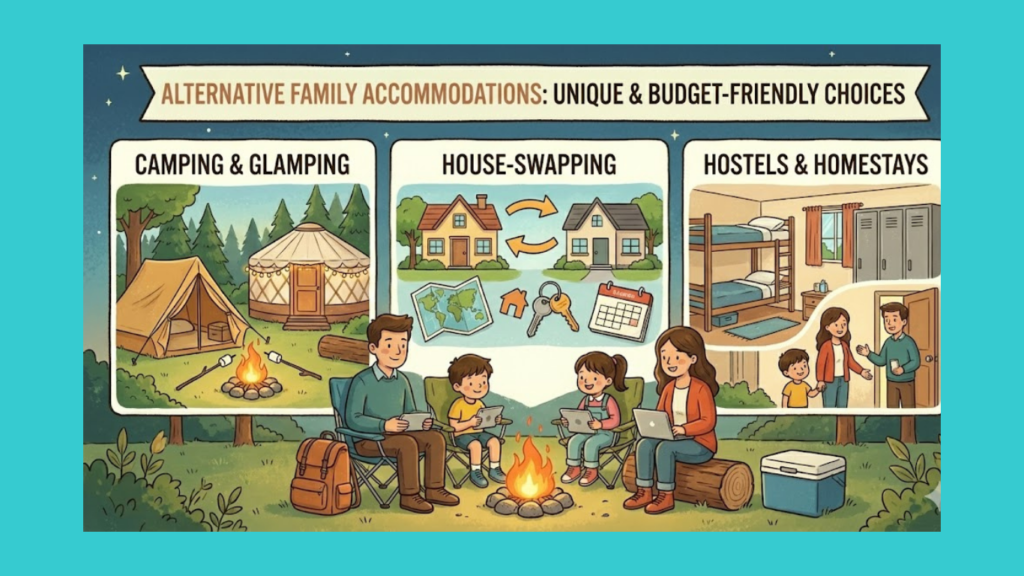
How Do Alternative family Accommodations Factor Into Family Planning Choices? | WovenVoyages How Do Alternative family Accommodations Factor Into Family Planning Choices? Strategic Blueprint Strategic analysis by Abdullahi Azaam Adan Strategic Context Executive Summary Strategic Navigation Introduction Alternative family accommodations factor into family planning choices by providing experiential, non-traditional lodging—such as glamping, farm stays, as well as house swaps—that prioritizes immersion over standard services. These choices influence the trip by offering unique educational opportunities, physical privacy, as well as potential cost savings. Data confirms the rise of Kidfluence, noting that 74 percent of children now play a decisive role in travel planning, often pushing for non-traditional environments that replicate adventure as well as provide Place-Based Learning. Figure 1: Experience Arbitrage Flow Commercial Lodging High Cost / Standard Service Alternative Stays Low Cost / High Immersion THE STRATEGIC SHIFT MEMORABILITY Strategic transition from service-heavy models to high-salience immersion outcomes. © WovenVoyages Successfully integrating alternative family accommodations into a trip requires a shift from service-based expectations to experience-based outcomes. This contrast with conventional hotel or resort structures establishes a core conflict between convenience as well as immersion. Selecting these models results in a high degree of Self-Sufficiency, dictating a need for robust pre-arrival logistics. Place alternative family accommodations within your overall family lodging plan to ensure every choice supports comfort, safety, as well as logistics across the entire duration of the journey. 01. Why Is Considering Alternative Family Accommodations a Strategic Move? Considering alternative family accommodations is a strategic move because it allows parents to customize their travel environment to match specific educational goals or sensory processing needs that standard commercial hotels frequently fail to address. This customization results in a reduction of traveling friction for neurodiverse family members who possess specific neurodiverse travel requirements. Financial efficiency dictates this choice via the Dining Arbitrage effect. Families save over $1,500 per week by substituting restaurant meals ($260–$360 per day) with grocery cooking ($40–$60 per day). This fiscal reclaim enables the extension of the trip duration or the funding of higher-tier activities. Residential kitchens in farm stays as well as glamping units facilitate this budgetary control. Figure 2: Weekly Dining Arbitrage Projection $2,520 (Est. Restaurant) $420 (Est. Grocery) TOTAL WEEKLY COST (FAMILY OF 4) Visualizing a 285% markup reduction for dining out versus residential meal preparation. © WovenVoyages Comparisons regarding the Total Cost of Ownership (TCO) reveal that a 3 to 5 bedroom rental ($200–$350 per night) offers a 30 to 60 percent base rate savings compared to booking 2 to 3 hotel rooms ($450–$750 per night). (Source: FunStayHomes 2025 Cost Analysis). Compare alternative stays with family hotels to determine which structure better supports your family’s daily rhythm. Utilizing non-traditional lodging benefits results in a higher level of autonomy. In Eco-lodges, families experience integrated systems for solar power as well as Potable Water, which results in a heightened awareness of resource consumption. This transition shifts the parental role from passive consumer to active operational manager of the family unit. Value Comparison: Standard Lodging vs. Alternative Family Accommodations Feature Hotel Standard Alternative Benefit Privacy Shared corridors Total spatial seclusion Noise Elevator/Street ambient Natural soundscapes Amenities Concierge/Pool Private yard/Local tools Learning Passive/Entertainment Active/Skill-based Cost Basis Per-room premiums Group volume arbitrage How Does Place-Based Learning Benefit From Alternative Family Accommodations? Place-Based Learning benefits from alternative family accommodations by immersing children in local ecosystems or agricultural cycles, turning a lodging choice into a passive educational experience. This learning methodology results in higher memory retention by anchoring information to sensory input. The presence of sustainable waste management systems in Eco-lodges ensures children understand the direct impact of their consumption. Micro-Glossary: Place-Based Learning – A methodology where students learn via direct immersion in the local environment, economy, as well as culture of a specific region. The Agritourism market is projected to reach $21.30 billion by 2033, driven by parents seeking “agricultural literacy” for their children. (Source: Straits Research). This shift indicates a prioritization of environmental literacy as a travel outcome. Educational travel for kids results in Resilience as well as Competence development when they interact with local food origins. Can Alternative Family Accommodations Support Specific Sensory Needs? Alternative family accommodations support sensory needs by offering secluded, low-noise environments that lack the overwhelming stimuli of crowded hotel lobbies or busy resort pools. Private homes allow parents to control lighting as well as noise, addressing the hospitality industry’s current “C-” grade for inclusivity regarding neurodiverse travel requirements. Precise terms like “sensory overload” dictate the strategic choice of lodging. Research confirms that 78 percent of families with autistic children limit or cancel vacations due to sensory fears, making sensory-friendly vacation rentals a medical necessity for regulation. (Source: Lodging Magazine Sensory Inclusion Data). The use of Yurts ensures an acoustic environment that results in higher sensory processing comfort. 02. What Types of Alternative Family Accommodations Offer the Most Utility? The alternative family accommodations that offer the most utility include glamping for nature access with comfort, farm stays for interactive education, as well as house swaps for authentic neighborhood living as well as reduced lodging costs. Each model results in a specific set of immersive family travel experiences that prioritize Self-Sufficiency. Multi-generational travel groups possess specific requirements for communal interaction without the friction of elevator logistics. Residential spaces in Eco-lodges ensure that grandparents as well as children occupy the same structural footprint, resulting in more natural bonding opportunities. 71 percent of grandparents recently participated in multi-gen travel, creating a need for “bundled” domestic amenities that hotels cannot provide. (Source: SYTA Family Travel Data). Alternative Types: Glamping vs. Farm Stays vs. House Swaps Model Cost Efficiency Planning Effort Kid-Appeal Score Glamping Moderate Low 9.5/10 Farm Stays High Moderate 9.0/10 House Swaps Extreme Very High 8.0/10 Eco-Lodges Moderate High 8.5/10 How Do Farm Stays Function as Alternative Family Accommodations? Farm stays function as alternative family accommodations by providing an interactive environment where children participate in daily agricultural tasks. This interactive model teaches responsibility as well as food origins in a vacation setting. Specific Agri-tourism activities like