
How Should Family Travel size and age range be considered before planning a family vacation?
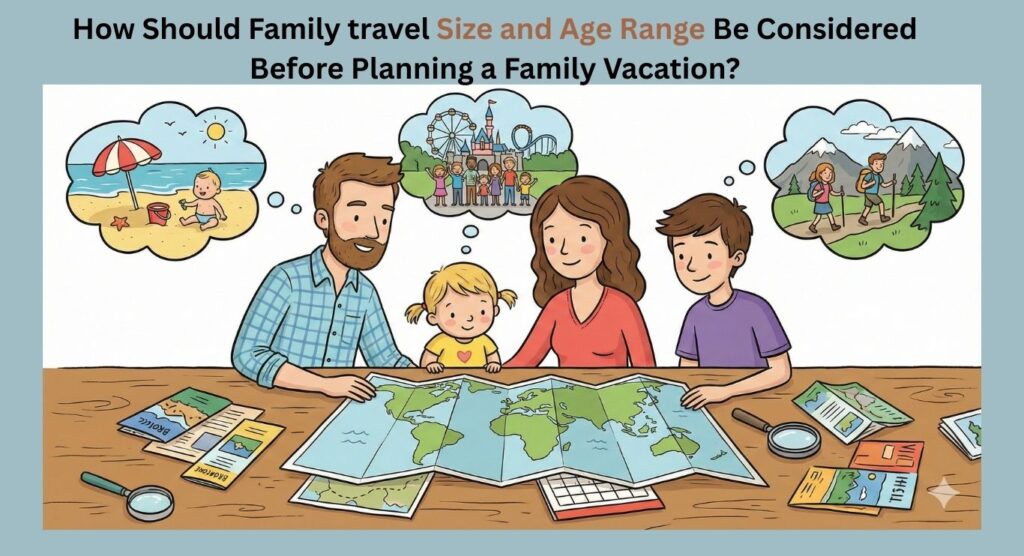
How Should Family Travel Size and Age Range Be Considered Before Planning a Family Vacation? | WovenVoyages How Should Family Travel Size and Age Range Be Considered Before Planning a Family Vacation? Pillar Overview Authored by Abdullahi Azaam Introduction FAQs Conclusion Table of Contents Introduction Consider **Family Travel Size and Age Range** by evaluating them as non-negotiable architectural constraints that directly determine the project’s overall feasibility, rather than as mere preferences. A thorough analysis of Family Size and Age Range (Entity) informs targeted decisions on lodging, transport, and pacing (Action). This systematic planning results in a cohesive itinerary that accommodates the physical and emotional needs of the entire group (Result). This guide mandates a shift from aspirational desires to factual, data-driven planning, prioritizing the mitigation of logistical friction. 1. Why Is Assessing Family Size and Age Range Critical? Assessing **Family Size and Age Range** is critical because these demographic variables function as the immutable boundaries that define the project’s logistical and financial scope. Failure to acknowledge these constraints dictates a high probability of “Budget Blowouts” and “Exclusionary Experiences,” eroding the entire travel experience. How Does the Family of Four Tipping Point Dictate Viability? The **Family of Four** tipping point dictates financial viability by marking the exact threshold where hotel economics collapse in favor of vacation rental strategies. A NerdWallet Analysis validates this financial pivot: for a family of 6, a vacation rental necessitates cost savings, proving 33% cheaper per head than 3 hotel rooms. Conversely, for a small nuclear family of 4, a hotel is often 29% cheaper. This analysis determines the most efficient deployment of capital. Figure 1: Cost-Per-Head Tipping Point (Hotel vs. Rental) Group Size Cost Per Head Group 4 Hotel (High) Rental (Low) Group 6 Hotel (Low) Rental (Optimal) TIPPING POINT: Group Size 4+ Larger groups unlock significant savings with rentals. © WovenVoyages Why Is the Affordability Paradox a Critical Constraint? The **Affordability Paradox** is a critical constraint because despite high travel intent (92%), affordability remains the top barrier (73%), mandating strict value engineering. This paradox validates the need for a systematic planning framework to mitigate high-friction points caused by cost overruns. Failure to assess this impact fractures the trip’s emotional return on investment (ROI), as confirmed by the Family Travel Association (FTA) data. 2. How Do You Evaluate the Impact of Family Travel Size and Age Range on Key Planning Verticals? Evaluate the impact of **Family Travel Size and Age Range** by analyzing specific ‘Planning Verticals’ to identify geometric and biological bottlenecks. This comprehensive process eliminates costly guesswork by quantifying the specific needs of the group before any money is invested. How Does Family Size Impact Accommodation Selection? **Family Size** impacts accommodation selection by dictating the ‘heads-in-beds’ logistic, which determines the cost-efficiency threshold between securing multiple hotel rooms and opting for dedicated vacation rentals. Furthermore, age range mandates safety features, such as baby-proofing for toddlers, and prioritizes privacy requirements, such as separate sleeping areas and washrooms for teenagers. This adherence eliminates logistical friction related to occupancy limits and comfort. How Do Size and Age Determine Transportation Logistics? **Size and Age** determine transportation logistics by establishing the geometric constraints of the group, specifically regarding vehicle capacity and car seat requirements. A family of 5+ exceeds standard sedan capacity, necessitating Minivan or Large SUV rentals. This capacity constraint determines ground travel feasibility. How Do You Assess Activity Pacing Based on Age Range? Assess activity pacing based on **Age Range** by calibrating the itinerary to the ‘lowest common denominator’ of physical stamina within the group to prevent burnout. This proactive measure mitigates the risk of investment waste. A mixed-age group mandates a flexible schedule that integrates periods of passive relaxation with high-energy activity. See our Activities Guide for more pacing strategies. How Does Kidfluence Impact Destination Selection? **Kidfluence** impacts destination selection by requiring the integration of preferences from children aged 7-12, who actively co-pilot a significant portion of travel decisions. FTA data validates this: 61% of parents involve children in trip planning, and 15% of children explicitly choose the location. Kidfluence prioritizes activities that create lasting memories, such as visits to theme parks or national parks. How Do You Assess the Privacy Paradox for Families with Teenagers? Assess the **Privacy Paradox** by recognizing that privacy and connectivity are non-negotiable requirements for families with teenagers, as Vrbo/Expedia data confirms 84% of travelers are driven by connectivity needs. Furthermore, 72% of parents report room size and privacy is a key feature, mandating accommodation choices that reconfigure sleeping dynamics. 3. What Are the Strategic Itinerary Responses to Family Size and Age Range Impacts? Strategic itinerary responses to **Family Size and Age Range** involve adopting specific operational models—such as ‘Hub and Spoke’ or ‘Convenience Premium’—tailored to the family’s composition. These models eliminate logistical friction by addressing constraints at the design level, ensuring a successful family trip. What Strategies Manage Large Families with Mixed Age Ranges? Manage large families with mixed age ranges by utilizing the ‘Hub and Spoke’ model, which mandates a central accommodation (the Hub) that serves as the base for concurrent, age-split activities (Spokes). The strategy details require that older children adventure (Spoke A) while younger children rest (Spoke B). This systematic separation eliminates “holding back” older kids or exhausting younger ones, which mitigates group fracture. What Strategies Manage Small Families with Young Children? Manage small families with young children by prioritizing the ‘Convenience Premium’ strategy, valuing proximity and ease over lowest cost to mitigate high caretaking demands. The American Academy of Pediatrics (AAP) “2-Hour Rule” is a medical imperative. It dictates that infants must not remain in car seats for over two hours to prevent oxygen desaturation. This medical constraint necessitates frequent stops or expensive direct flights. What Strategies Manage Families with Teenagers? Manage families with teenagers by implementing the ‘Autonomy Integration’ strategy, which structures the itinerary to integrate independent exploration and peer interaction. This approach recognizes that forcing constant “togetherness” creates friction, thereby necessitating periods of separate activity. Teens require less physical supervision but higher engagement levels. How