
How Do Resorts Compare as a Planning Option for Family Vacations?
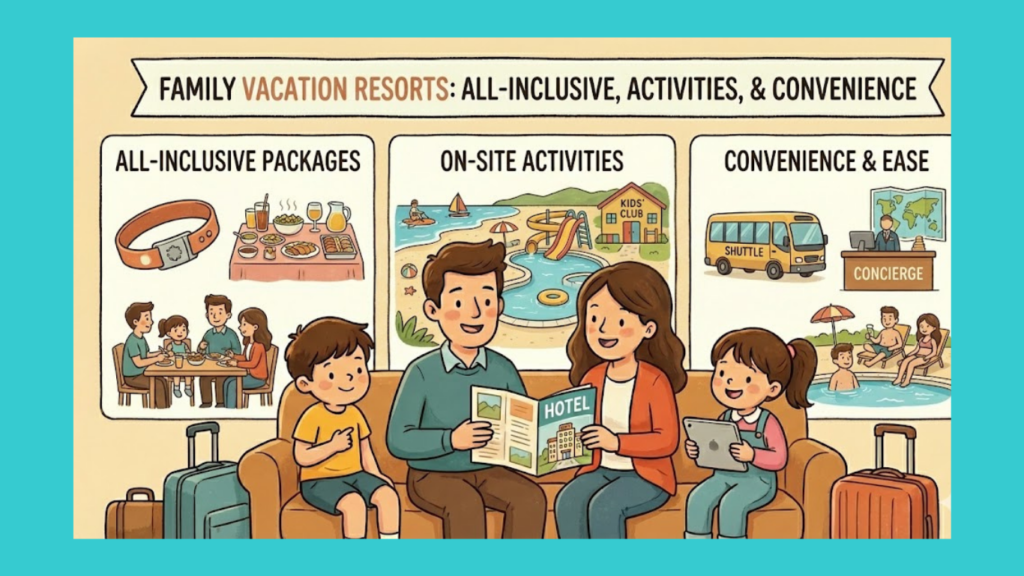
How Do Resorts Compare as a Planning Option for Family Vacations? | WovenVoyages How Do Resorts Compare as a Planning Option for Family Vacations? Pillar Overview Strategic analysis by Abdullahi Azaam Adan Strategic Framework Executive Summary Table of Contents Strategic Framework Resorts in family vacation planning function as a comprehensive, all-in-one option that prioritizes on-site amenities, supervised entertainment, as well as budget predictability over the urban flexibility of hotels or the private space of vacation rentals. This guide utilizes a “Strategic Blueprint” framing to evaluate lodging through hospitality logistics as well as the pediatric sleep gap. Data indicates that intent for family travel has reached its highest post-pandemic level, with 92 percent of parents indicating they are likely to travel with their children in the coming year. (Citation: NYU SPS 2025 Family Travel Survey). Resort availability as well as style often depend on the chosen family vacation destination, requiring a deep audit of how “All-inclusive hospitality” integrates into the broader itinerary to mitigate parental decision fatigue. 01. Why Is Choosing Resorts in Family Vacation Planning a Strategic Advantage for Parents? Choosing resorts in family vacation planning is a strategic advantage because it centralizes daily logistics, providing parents with a ‘one-stop’ environment that eliminates the stress of finding restaurants, booking activities, as well as arranging safe childcare in unfamiliar locations. To understand the depth of this advantage, one must consider the cognitive load placed on modern parents. Research states that the average American adult makes 35,000 decisions per day. In a travel context, “Decision fatigue” becomes a significant barrier to actual recovery. When a family stays in a traditional urban hotel, the parents remain the primary project managers of the vacation, continuously processing data points regarding meal timing, transport routes, as well as safety protocols. Resorts facilitate a “Decision Detox” by outsourcing these to child-centric infrastructure. [Consolidated amenities] → [Eliminate] → [Daily planning chores] Furthermore, the average parent spends 3 hours as well as 23 minutes daily on child-related logistics. The resort model specifically reclaims this time for leisure. By operating within gated environments, these properties allow for a level of autonomy for older children that would be impossible in an urban hotel setting. This creates a “Leisure-heavy itinerary” where the primary focus remains on connection rather than coordination. The infrastructure is designed to absorb the friction of childhood needs, from high-chair availability to spill-proof surfaces, ensuring that the parent is not in a state of constant hyper-vigilance. This structural relief allows for a physiological shift in the parent, moving from a “work” mindset to a “recovery” mindset. In urban environments, the transit between attractions often introduces high levels of cortisol due to navigation as well as safety concerns. Within a resort, the proximity of the pool, the dining hall, as well as the kids’ club means that the “cost of transition” is near zero. The “Professional childcare” found in these high-end environments is vetted as well as certified, providing a security layer that private rentals simply cannot match. For multi-generational cohorts, this centralized model serves as a neutral ground where different age groups can pursue on-site recreation at different cadences while remaining physically close. The logistical advantage is found in the removal of the “commute” from the vacation experience. Daily Logistics Comparison: Resorts versus Traditional Hotels versus Vacation Rentals Categories Resorts Traditional Hotels Vacation Rentals Meal Coordination All-Inclusive Curation External Restaurant Search Grocery Preparation Activity Planning On-Site Recreation Transit to Off-Site Events Independent Logistics Child Supervision Professional Childcare Limited Third-Party Sitters No Integrated Support Daily Transport Minimal (Walkable Campus) High (Uber / Public Transit) Mandatory Car Rental Budget Control Total Predictability Incidental Costs Apply Variable Cleaning Fees 02. How Do You Compare Resorts in Family Vacation Planning Against Traditional Hotels? You compare resorts in family vacation planning against traditional hotels by evaluating the depth of on-site amenities: while hotels provide a base for exploring a city, resorts are designed to be the destination itself, offering expansive grounds, multiple pools, as well as scheduled programming. A primary friction point in urban travel is the scarcity of family-friendly suites in business districts. Most traditional hotels are engineered for single or double occupancy by corporate travelers, often leading to families being split across non-connecting rooms or forced into cramped standard units. In contrast, resorts utilize multi-generational travel architecture. This means providing dedicated living areas as well as physical distance between “noisy zones” as well as “rest zones.” The psychological impact of “destination-based lodging” cannot be overstated. When the property is the destination, the family eliminates the “FOMO” (Fear Of Missing Out) associated with city travel. In a city, there is a pressure to see every museum as well as monument. In a resort, the pressure is replaced by a schedule of on-site recreation that is entirely optional but highly accessible. Comparing resorts with family-friendly hotels helps families balance convenience, flexibility, as well as cost to ensure that the accommodation aligns with the pediatric sleep requirements of the specific age group. Furthermore, the All-inclusive hospitality model common in resorts eliminates the constant transactionality of city travel. In a traditional hotel setting, every bottle of water, every snack, as well as every pool towel represents an additional cost as well as a decision point. Resorts remove these micro-decisions, allowing for a seamless flow of activities throughout the day. How Do All-Inclusive Amenities Impact Resorts? The impact of these amenities is measured through total price transparency. This allows families to manage their travel budget effectively without worrying about the fluctuating costs of meals as well as on-site activities. For large families, the cumulative cost of three meals plus snacks as well as drinks in an urban setting can easily add 200 to 400 dollars per day. 77 percent of travel advisors report clients choose all-inclusive options to manage costs. (Citation: Travel Weekly Thought Leadership). Detail that a typical 6-night stay costs 7,000 to 11,000 dollars. In domestic trips, separate food as well as transport costs often exceed resort bundles when activities like snorkeling (40 to