Family Beach Vacations: What Activities Are Best for Kids?
Table of Contents
The best beach activities for kids are those strategically chosen to match their specific developmental stamina, balancing unstructured sensory play with heavily supervised water exposure to prevent exhaustion and overstimulation.
Family beach vacations offer unparalleled opportunities for bonding and adventure, differing significantly from other trip types. Aligning these activities with children’s developmental stages ensures a memorable trip for everyone, and understanding how to choose the right beach can significantly enhance this process.
1. Why are specific beach activities essential for kids on family beach vacations?
Specific beach activities are essential for kids because they transform a vast, unstructured environment into a series of manageable, engaging challenges that prevent boredom and mitigate the risk of parental burnout.
How do planned activities enhance family beach experiences?
Planned activities like a group sandcastle build or a scavenger hunt foster teamwork and active bonding, minimizing aimless wandering and ensuring the vacation feels purposeful and engaging for everyone involved.
Destinations like Ocean City, Maryland, attract eight million visitors annually, drawn to its 10-mile coast and structured activities like the classic boardwalk.
The “anticipation effect” is a key psychological benefit; planning and discussing activities *before* the trip builds excitement and gives children a sense of ownership over the vacation itinerary.
Author’s Experience
“My most cherished family beach memory isn’t of a perfectly planned excursion, but of my youngest discovering a hermit crab during a quiet tide pool session. The sheer joy on his face solidified my belief that sometimes, the simplest, most spontaneous beach moments are the most profound.”
Micro-Glossary: Sensory Play
Sensory Play: Any activity that stimulates a young child’s senses: touch, smell, taste, movement, balance, sight, and hearing. Beach environments are rich sensory playgrounds, offering varied textures (sand, water, shells) and sounds.
What are the developmental benefits of engaging beach play for children?
Engaging beach play improves gross motor skills through digging and running, enhances sensory processing via varied textures and temperatures, and fosters scientific curiosity by discovering shells and marine life in a natural setting.
The entire island of La Palma in the Canary Islands is recognized as a UNESCO Biosphere Reserve, underscoring the connection between natural environments and family enrichment.
Unstructured play in a natural setting like a beach is scientifically shown to improve problem-solving skills and creativity more than structured, indoor activities. The unpredictable nature of waves and wind requires children to constantly adapt their play.
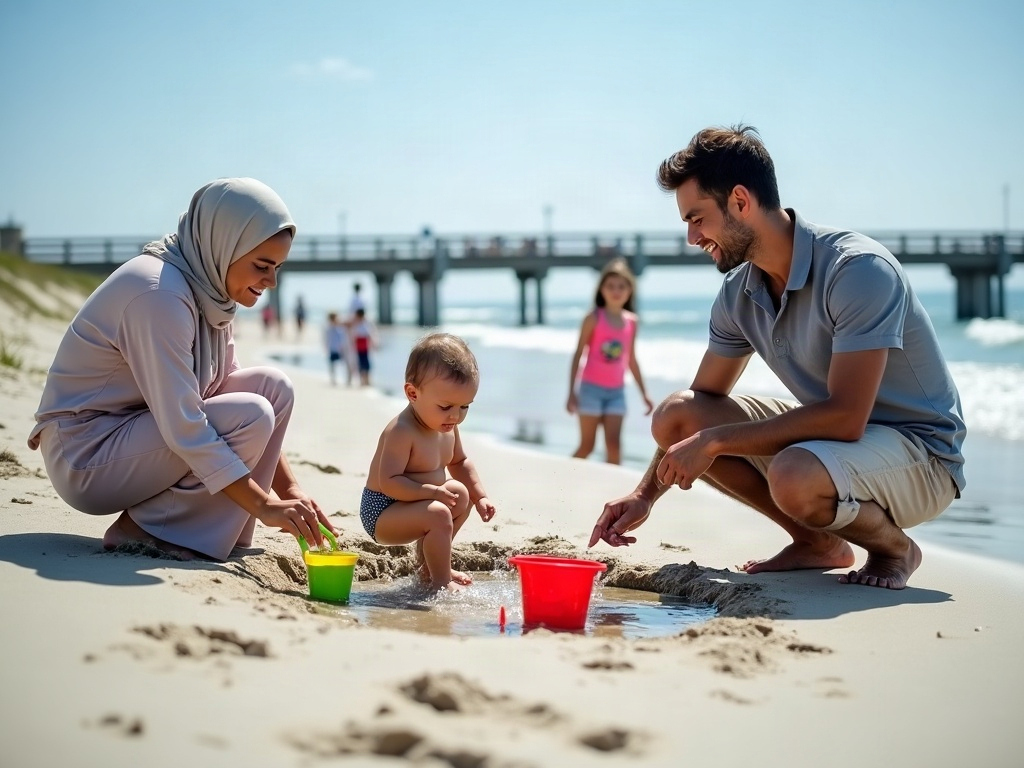
Demonstrating how different developmental stages dictate the optimal level of interaction with the coastal environment, from contained sensory play to active surf engagement.
© WovenVoyages.com
2. Which beach activities are perfect for different age groups of kids?
The perfect beach activities for different age groups are determined by matching their gross motor capabilities and risk awareness to the specific challenges of the coastal environment.
What activities engage toddlers and preschoolers at the beach?
Toddlers and preschoolers are best engaged with simple, repetitive sensory play in shallow water and the swash zone, including digging, filling buckets, and making tracks with toy trucks.
Hilton Head Island’s Coligny Beach, known for its splash pad and easy-access boardwalk, is a destination that caters to toddlers with purpose-built amenities.
The most successful toddler activity is creating a “contained play zone.” Dig a large, shallow hole a safe distance from the surf and fill it with a few inches of water to create a personal, warmer splash pool that keeps them contained and entertained.
Micro-Glossary: Shore Break
Shore Break: The area where waves break directly on the sand. It can be powerful and is a key safety factor to consider for young children’s water play.
How can elementary-aged children thrive with beach exploration?
Elementary-aged children thrive with beginner-level physical challenges like boogie boarding or learning to fly a kite, and exploring natural curiosity through structured scavenger hunts for shells.
The Outer Banks in North Carolina offers a massive 100-mile stretch of coastline where kids can build sandcastles, take surf lessons, and visit the Wright Brothers National Memorial.
Introduce the concept of a “beach journal.” Provide the child with a waterproof notebook to draw the creatures they find in tide pools or press seaweed, turning the vacation into a hands-on science project during the hottest part of the day.
Which activities capture the interest of pre-teens and teenagers at the coast?
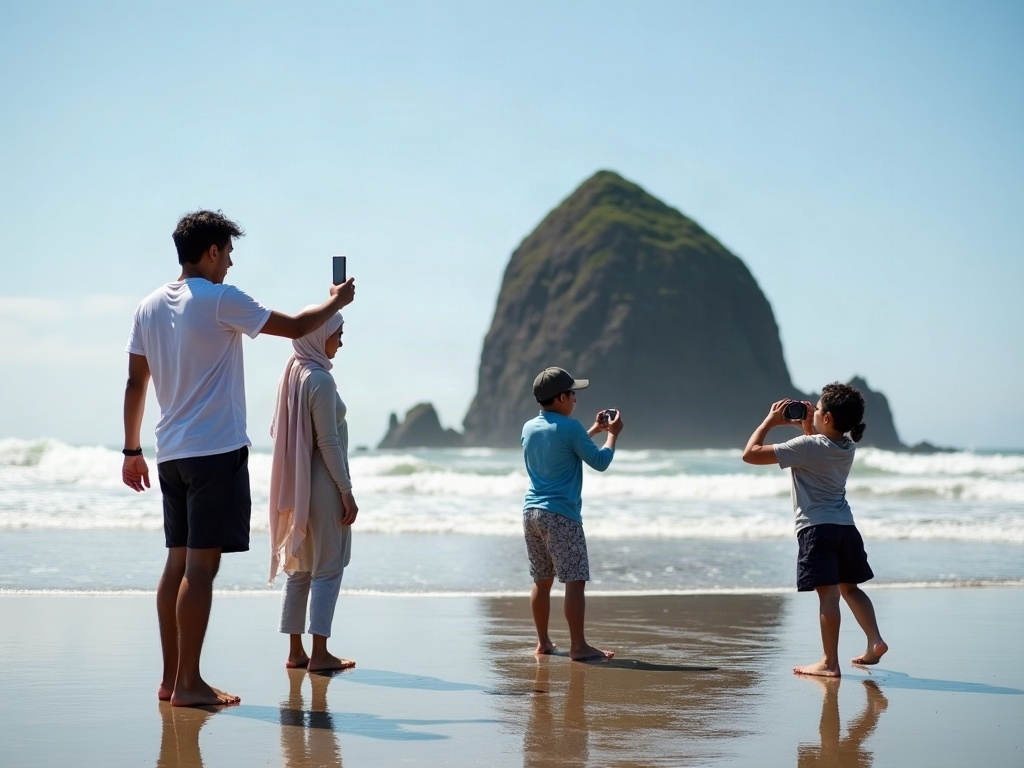
Pre-teens and teenagers are engaged by activities offering independence or peer interaction, such as renting kayaks, group surf lessons, or creative challenges like beach-themed social media content.
The 235-foot-tall Haystack Rock at Cannon Beach, Oregon, serves as a dramatic natural attraction for teens, offering adventurous tide pooling and photo opportunities.
The key is providing “structured freedom.” Grant them the autonomy to go to the surf shop or walk the boardwalk with a friend, but with clear boundaries, a set check-in time, and a designated meeting spot.
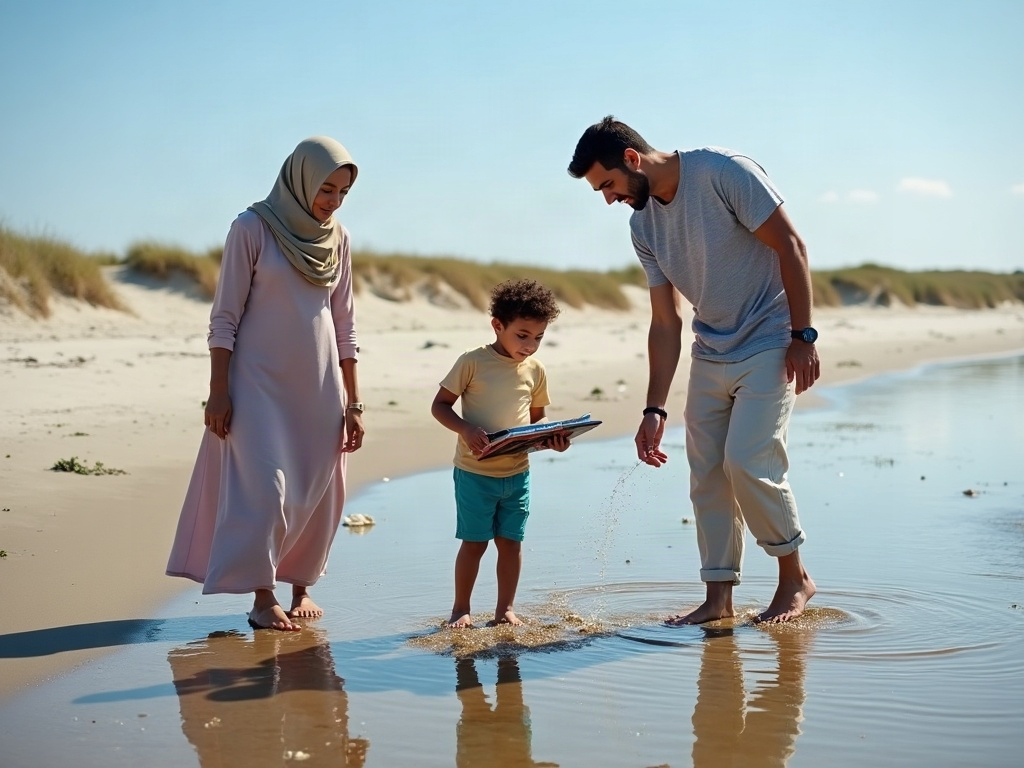
Showcasing how providing “structured freedom” through activities like guided surf lessons safely satisfies a teenager’s demand for autonomy.
© WovenVoyages.com
3. How can families ensure safe beach activities for children?
Families ensure safe beach activities by implementing a multi-layered strategy that includes active supervision (the “Water Watcher” system), understanding local water conditions, and diligent sun protection.
What are crucial water safety rules for kids at the beach?
Crucial water safety rules include enforcing a strict “never swim alone” policy, establishing clear depth boundaries, teaching children to face waves, and utilizing a designated adult “Water Watcher.”
The U.S. has approximately 95,000 miles of shoreline; the American Red Cross emphasizes the ‘buddy system’ and other universal water safety rules as a critical need for families.
Teach children the “shuffle your feet” rule when entering unclear water, especially in southern destinations like the Gulf Coast. Shuffling alerts stingrays and other bottom-dwellers to your presence, preventing painful stings.
Before finalizing your itinerary, it’s vital to review what conditions parents must check first for beach safety.
Micro-Glossary: Rip Current
Rip Current: A specific type of powerful, narrow water channel moving directly away from the shore. Explain the primary safety rule: do not fight the current; swim parallel to the shore until you are out of it.
How to protect children from sun exposure and heat during beach play?
Protect children from sun and heat by applying broad-spectrum SPF 30-50+ sunscreen every two hours, using UPF-rated clothing like rash guards, and ensuring mandatory shade breaks and consistent hydration.
The American Academy of Dermatology recommends avoiding peak sun hours between 10 a.m. and 4 p.m., when UV radiation is strongest, to minimize the risk of skin damage.
The “Shadow Rule” is a simple, effective guide: if your shadow is shorter than you are, the sun’s UV rays are at their strongest, and it is a critical time to seek shade.
Which non-water activities minimize risks for young children?
Non-water activities like building sandcastles, burying legs, playing with beach toys, or scavenger hunts on the upper beach minimize risks by keeping children engaged away from the unpredictable surf zone.
Jekyll Island, a 5,500-acre barrier island, offers unique sites like Driftwood Beach, providing a safe and engaging non-water alternative to swimming.
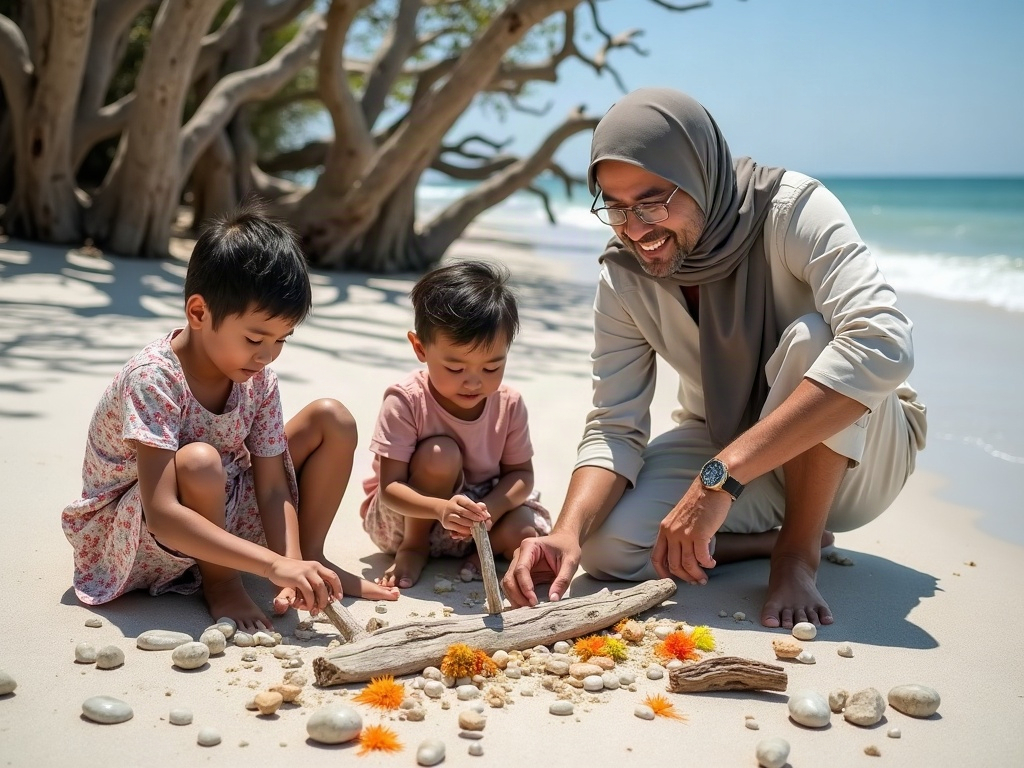
Create a “beach art” session. Have children collect interesting pieces of driftwood, seaweed, and pebbles, and arrange them into a mosaic on the dry sand. This is a calm, creative, and completely water-free activity.
Demonstrating how structured, non-water activities (like sandcastle engineering) safely engage young children away from the hazards of the surf zone.
© WovenVoyages.com
4. What types of engaging beach activities can families explore together?
The most engaging beach activities fall into three categories: collaborative sand-based creation, supervised water-based play, and educational nature-focused exploration.
How do sand-based games and crafts entertain kids at the beach?
Sand-based games like beach Pictionary, sand-darts, or building elaborate “sand cities” entertain kids by fostering creativity and teamwork, providing a safe alternative to continuous swimming.
According to the World Champion Sand Sculpting team ‘The Sand Lovers,’ allocating at least 30 minutes for children to develop sandcastle ideas fosters creativity and allows for complex designs.
Introduce the concept of “sand sculpture engineering.” Challenge older kids to build a sandcastle with advanced features like a moat that actually fills with the incoming tide, using architectural principles to prevent it from collapsing.
Micro-Glossary: Tidal Flats
Tidal Flats: Sandy or muddy areas of the coastline exposed during low tide and submerged at high tide. These are rich with marine life and perfect for exploration, especially at destinations like Cape Cod.
Which water sports and play options suit varying skill levels?
Options range from supervised shallow-water splashing for beginners, to intermediate options like boogie boarding, and advanced pursuits such as stand-up paddleboarding or surf lessons.
For families with mixed skill levels, La Jolla Shores in California is ideal, as its gentle surf is perfect for beginners, while advanced members can snorkel in nearby sea caves.
The choice of destination is paramount. Hawaii’s Poipu Beach offers a protected, shallow lagoon for beginners just feet away from a surf break for advanced riders, allowing a family to stay in one area.
What nature exploration activities foster learning at the beach?
Nature exploration activities include tide pooling during low tide to observe marine life, identifying different types of shells, and creating a log of shorebirds spotted, turning a beach day into an educational experience.
On Sanibel Island, Florida, a prime destination for nature-focused learning, the sea turtle nesting season runs from June through October, offering families a chance to witness hatchlings emerge.
Download a “species identification” app (like iNaturalist) before your trip. Challenge kids to be “citizen scientists” by photographing and identifying the plants and animals they find, gamifying the learning process.
Illustrating how equipping children with basic tools (like a net and a field guide) instantly transforms passive beach time into an active, educational biology lesson.
© WovenVoyages.com
5. How can parents plan and prepare for kids’ beach activities effectively?
Parents prepare effectively by treating the beach bag as a “mobile command center,” organizing it with specialized sub-kits (first aid, sun protection, entertainment) to handle any situation without returning to the hotel.
What essential gear should families pack for beach activities?
Essential gear includes multi-layered sun protection (UPF clothing, sunscreen, shade tent), a high-capacity cooler for hydration, and a curated selection of durable, open-ended toys.
The American Academy of Pediatrics recommends a full-spectrum UVA/UVB sunscreen with an SPF of 30 or higher for children, reapplied every two hours or after swimming. Review our guide on what must you pack for a family beach vacation to ensure you have the correct gear.
A lesser-known but critical piece of gear is a small bottle of baby powder. It works instantly to remove sticky, wet sand from skin before getting in the car or putting on clothes, preventing major discomfort and messes.
Micro-Glossary: Flexible Itinerary
Flexible Itinerary: A travel plan that outlines key goals but allows for spontaneous changes based on weather, energy levels, or unexpected opportunities, contrasting with a rigid schedule.
How to adapt activities for weather changes or unexpected conditions?
Adapt beach activities for weather changes by having pre-planned indoor backup options for rain, modifying on-beach activities for high winds (e.g., sand forts instead of kites), and dedicating “sand-only” days if the surf is too rough.
Families should be aware of seasonal weather patterns, such as the Caribbean hurricane season (June to November), and have non-beach alternatives ready for adverse conditions.
Always have a “Rainy Day Jar” with slips of paper listing pre-researched, local, indoor attractions (museums, movie theaters, bowling alleys). Letting a child pick the backup plan gives them a sense of control and turns a disappointment into a new adventure.
What strategies keep kids engaged throughout a beach day?
Keep kids engaged by rotating between high-energy water play and low-energy shade time, managing physical stamina with scheduled rest, and introducing a “surprise” toy or game when interest wanes.
Use the “pulse” method of engagement. Plan the day in 90-minute blocks: a 60-minute “on” period for an activity, followed by a 30-minute “off” period for rest, snacks, and rehydration in the shade. This rhythm mirrors natural attention spans and prevents meltdowns.
6. What common mistakes should families avoid during beach activities with kids?
The most common mistake is failing to respect the children’s biological limits—specifically ignoring the signs of heat exhaustion or overstimulation—and attempting to force a rigid itinerary in an environment that demands flexibility.
How to prevent overstimulation or boredom in children at the beach?
To prevent overstimulation, you must enforce mandatory “shade breaks” for quiet play, and execute a total “environmental reset” by leaving the beach entirely if a child exhibits signs of severe sensory overload.
Insights from family travel forums and psychological studies suggest that balancing activities with downtime, rather than over-packing an itinerary, is crucial to prevent child burnout and parental stress.
The “environmental reset” is a powerful technique. If a child is becoming overstimulated, physically remove them from the beach environment for 15-20 minutes. A short walk on the boardwalk or back to the hotel room can completely reset their sensory system.
Micro-Glossary: Overstimulation
Overstimulation: A state where a child is overwhelmed by sensory input (noise, sun, crowds, activity), often leading to irritability, crying, or meltdowns. It’s frequently mistaken for simple bad behavior.
What pitfalls to steer clear of regarding beach safety and supervision?
Critical safety pitfalls include passive “distracted” supervision (e.g., scrolling on a phone), failing to formally designate a “Water Watcher,” and the dangerous assumption that flotation devices replace active adult oversight.
The American Academy of Pediatrics and the U.S. Coast Guard emphasize that drowning signs are often silent and non-dramatic, a life-saving insight contradicting common media portrayals.
A deadly pitfall is the “drowning doesn’t look like drowning” misconception. Contrary to movie portrayals, a drowning person is often silent, upright in the water, and unable to call for help. Educating yourself on the true signs of drowning is non-negotiable.
How can parents manage expectations for a perfect beach day?
Parents manage expectations by embracing chaotic flexibility, defining success as safe moments of shared connection rather than flawless execution of an itinerary, and practicing the “one-thing” rule.
Practice the “one-thing” rule. Each morning, decide on the *one* most important thing you want to accomplish that day (e.g., “help Tim fly his kite”). As long as you achieve that one thing, the day is a success. This reframes the entire day around a single, achievable goal.
Before attempting more complex trips, ensure you understand the logistical baselines discussed in our guide on how to choose the perfect ship and itinerary for family cruise vacations.

Visualizing the reality of family travel: mitigating “overstimulation” and recognizing when to abandon an itinerary to enforce a mandatory sensory reset or nap.
© WovenVoyages.com
7. Logistics: Essential Beach Safety Checklist for Kids’ Activities
| Checklist Item / Tactic | Status |
|---|---|
| SUPERVISION: I have designated an adult ‘Water Watcher’ for a 15-minute shift. | ⬜ |
| SUN PROTECTION: Sunscreen (SPF 30-50+), hats, and rash guards are applied/worn. | ⬜ |
| WATER AWARENESS: I have checked local lifeguard flags and rip current warnings. | ⬜ |
| HYDRATION & SNACKS: Ample water and healthy snacks are packed and accessible. | ⬜ |
| HOME BASE: A visible “safety station” with shade and first-aid is established. | ⬜ |
8. Frequently Asked Questions (People Also Ask)
What are the best beach activities for toddlers?
How can families ensure water safety for kids at the beach?
How do you prevent children from getting bored at the beach?
Resolution
Making family beach vacations memorable for every child is achieved not by chasing perfection, but by combining thoughtful planning, diligent safety, and the flexibility to embrace simple moments of connection.
The most memorable moments are rarely the big, planned events but the small, unexpected ones—a shared laugh while digging a hole, the excitement of finding a unique shell, or quietly watching the sunset together. The goal of all the planning is simply to create the space for those moments to happen. This entire guide serves as a decision support framework for planning your next family beach vacation’s activity itinerary, ensuring you construct a trip defined by joy rather than logistical friction.
The WovenVoyages Standard
At WovenVoyages, we reject the premise that managing children at the beach must result in parental exhaustion. By deploying rigorous Decision Intelligence—from executing the “Pulse” method of engagement to enforcing strict “Water Watcher” protocols—we equip you to conquer the coastal environment. We ensure you select activities engineered specifically to absorb the stress of multi-generational dynamics, allowing you to actually experience the vacation you planned.